Where Americans Still Tip 20% (and Where They Don’t)
Key Takeaways:
- The average restaurant tip in America has fallen to 18.8%, suggesting that the long-standing 20% benchmark is no longer the norm.
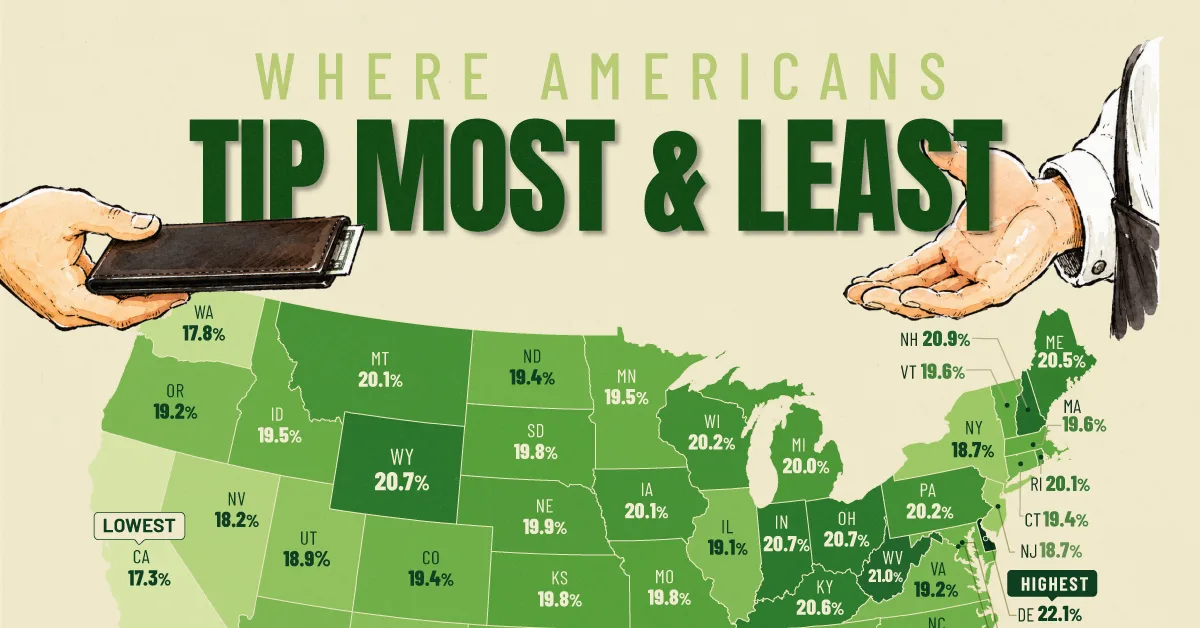
- Delaware leads the country with an average tip of 22.1%, while California ranks last at 17.3%.
- Full-service restaurants receive much larger gratuities than quick-service restaurants, averaging 19.3% versus 15.8%.
For decades, a 20% tip has been viewed as the standard for dining out in America. But according to new data from Toast, diners now leave an average gratuity of just 18.8%, suggesting that benchmark is becoming less common.
Based on millions of digital restaurant transactions across all 50 states and Washington, D.C., the data reveals where Americans tip the most, where they tip the least, and how gratuity habits differ between full-service and quick-service restaurants.
America’s Best (and Worst) Tippers
Below is the average restaurant tip by state, based on Toast’s transaction data.
| Rank | State or District | Overall | FSR | QSR |
|---|---|---|---|---|
| 1 | Delaware | 22.1% | 22.5% | 18.8% |
| 2 | West Virginia | 21.0% | 21.4% | 18.9% |
| 3 | New Hampshire | 20.9% | 21.7% | 15.5% |
| 4 | Wyoming | 20.7% | 20.9% | 19.0% |
| 5 | Ohio | 20.7% | 21.1% | 17.7% |
| 6 | Indiana | 20.7% | 21.1% | 17.0% |
| 7 | Kentucky | 20.6% | 20.9% | 18.0% |
| 8 | Maine | 20.5% | 21.3% | 15.9% |
| 9 | Wisconsin | 20.2% | 20.5% | 17.6% |
| 10 | South Carolina | 20.2% | 20.6% | 16.8% |
| 11 | Pennsylvania | 20.2% | 20.7% | 16.3% |
| 12 | Rhode Island | 20.1% | 21.1% | 14.6% |
| 13 | Montana | 20.1% | 20.7% | 17.3% |
| 14 | Iowa | 20.1% | 20.4% | 17.4% |
| 15 | Michigan | 20.0% | 20.6% | 15.9% |
| 16 | Nebraska | 19.9% | 20.3% | 16.7% |
| 17 | South Dakota | 19.8% | 20.1% | 17.1% |
| 18 | Missouri | 19.8% | 20.2% | 16.9% |
| 19 | Kansas | 19.8% | 20.4% | 15.5% |
| 20 | Vermont | 19.6% | 20.2% | 16.7% |
| 21 | Massachusetts | 19.6% | 20.3% | 15.0% |
| 22 | Minnesota | 19.5% | 20.0% | 16.0% |
| 23 | Idaho | 19.5% | 20.1% | 16.2% |
| 24 | Tennessee | 19.4% | 20.0% | 16.3% |
| 25 | Oklahoma | 19.4% | 19.8% | 16.6% |
| 26 | North Dakota | 19.4% | 19.8% | 17.0% |
| 27 | North Carolina | 19.4% | 19.8% | 16.9% |
| 28 | Maryland | 19.4% | 19.7% | 15.9% |
| 29 | Connecticut | 19.4% | 19.9% | 15.2% |
| 30 | Colorado | 19.4% | 19.9% | 16.8% |
| 31 | Alaska | 19.3% | 19.5% | 17.1% |
| 32 | Alabama | 19.3% | 19.9% | 16.3% |
| 33 | Virginia | 19.2% | 19.7% | 15.6% |
| 34 | Oregon | 19.2% | 19.7% | 17.4% |
| 35 | Arizona | 19.2% | 19.7% | 15.7% |
| 36 | Illinois | 19.1% | 19.5% | 15.8% |
| 37 | New Mexico | 19.0% | 19.4% | 17.1% |
| 38 | Utah | 18.9% | 19.6% | 15.2% |
| 39 | Arkansas | 18.9% | 19.3% | 15.8% |
| 40 | Georgia | 18.8% | 19.1% | 16.0% |
| 41 | New York | 18.7% | 19.1% | 15.3% |
| 42 | New Jersey | 18.7% | 19.2% | 13.4% |
| 43 | Mississippi | 18.7% | 19.0% | 16.4% |
| 44 | Texas | 18.6% | 19.1% | 16.0% |
| 45 | Hawaii | 18.6% | 19.0% | 15.7% |
| 46 | Louisiana | 18.5% | 19.0% | 15.7% |
| 47 | Florida | 18.3% | 18.6% | 15.4% |
| 48 | Nevada | 18.2% | 18.6% | 15.8% |
| 49 | Washington | 17.8% | 18.2% | 15.7% |
| 50 | District of Columbia | 17.5% | 17.8% | 14.6% |
| 51 | California | 17.3% | 17.7% | 14.8% |
Delaware tops the rankings with an average tip of 22.1%, followed by West Virginia (21.0%), New Hampshire (20.9%), and Indiana (20.7%). At the other end of the spectrum, California (17.3%), Washington, D.C. (17.5%), and Washington (17.8%), record the lowest average gratuities.
One notable pattern is that several of the country’s highest-tipping states are relatively small by population. Delaware, West Virginia, New Hampshire, and Indiana all average more than 20.5%, suggesting generous tipping habits aren’t necessarily concentrated in America’s largest dining markets.
Why Full-Service Restaurants Get Bigger Tips
Not every restaurant experience comes with the same expectations. Full-service restaurants (FSRs) offer table service, where servers take orders, bring food, and check in throughout the meal. Quick-service restaurants (QSRs), meanwhile, typically rely on counter ordering, kiosks, or drive-thrus with limited staff interaction.
The difference reflects how diners continue to distinguish between traditional table service and counter-service dining. While full-service restaurants receive an average tip of 19.3%, quick-service restaurants average just 15.8%, indicating that service level remains a major factor in how much customers choose to leave.
Tipping Fatigue Continues to Fuel Debate
The widening use of digital payment screens has expanded tipping requests well beyond traditional restaurants, prompting debate over when gratuities are appropriate. Many consumers say they’re experiencing “tip fatigue” as prompts appear at coffee shops, bakeries, self-checkout kiosks, and other businesses where tipping was once uncommon.
Critics argue the American system places too much responsibility on customers to supplement workers’ incomes, while supporters contend tips remain essential because many restaurant employees still rely on them for a significant share of their earnings. The debate has even become an issue for international visitors, with reports that some travelers planning trips for major events like the 2026 FIFA World Cup have expressed confusion over U.S. tipping expectations.
Meanwhile, labor costs continue to evolve across the industry, alongside broader discussions around fast food wages across the United States and how restaurants balance rising expenses with customer expectations.
Learn More on the Voronoi App 
Want to see how tipped workers are compensated across America Check out U.S. States with the Highest Minimum Wage for Tipped Employees on the Voronoi app, where you can explore more data-driven stories through interactive visualizations.