Where the World Is Burning in 2026
Key Takeaways
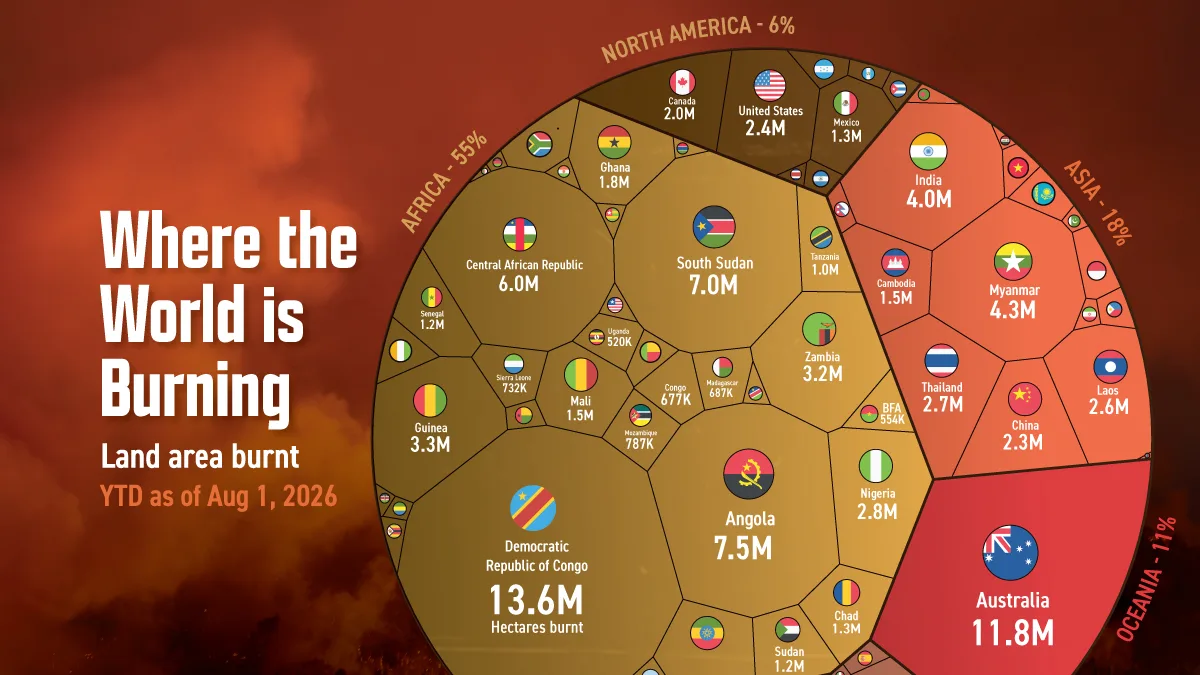
- Africa accounts for 55% of all land area burned globally in 2026 as of August 1st, more than all other regions combined.
- The Democratic Republic of Congo has recorded 13.6 million hectares burned, the most of any country in the world.
- The top three countries, DR Congo, Australia, and Angola, account for nearly 30% of all land burned worldwide.
As of August 1, 2026, wildfires and landscape fires have burned 112.3 million hectares of land across the globe, an area roughly the size of South Africa.
This visualization uses data from the Global Wildfire Information System (GWIS) via Our World in Data to show where that burning is concentrated in 2026 as of August 1. The data includes prescribed burns, agricultural burns, and uncontrolled wildfires.
Africa Is the Epicenter of Global Fire Activity
More than half of the world’s burned land so far in 2026 is in Africa.
The data table below shows the land area burned for every country as of August 1, 2026:
| Rank | Country or Territory | Area Burned in Hectares (YTD to Aug 1, 2026) |
Share | Region |
|---|---|---|---|---|
| 1 |  Democratic Republic of Congo Democratic Republic of Congo |
13,611,126 | 12.1% | Africa |
| 2 |  Australia Australia |
11,801,650 | 10.5% | Oceania |
| 3 |  Angola Angola |
7,473,034 | 6.7% | Africa |
| 4 |  South Sudan South Sudan |
6,955,022 | 6.2% | Africa |
| 5 |  Central African Republic Central African Republic |
6,017,881 | 5.4% | Africa |
| 6 |  Myanmar Myanmar |
4,325,702 | 3.9% | Asia |
| 7 |  India India |
4,029,704 | 3.6% | Asia |
| 8 |  Russia Russia |
3,335,029 | 3.0% | Europe |
| 9 |  Guinea Guinea |
3,250,992 | 2.9% | Africa |
| 10 |  Zambia Zambia |
3,213,687 | 2.9% | Africa |
| 11 |  Venezuela Venezuela |
2,977,466 | 2.7% | South America |
| 12 |  Nigeria Nigeria |
2,807,200 | 2.5% | Africa |
| 13 |  Thailand Thailand |
2,669,550 | 2.4% | Asia |
| 14 |  Laos Laos |
2,641,321 | 2.4% | Asia |
| 15 |  United States United States |
2,371,207 | 2.1% | North America |
| 16 |  China China |
2,265,057 | 2.0% | Asia |
| 17 |  Canada Canada |
2,031,754 | 1.8% | North America |
| 18 |  Brazil Brazil |
2,030,209 | 1.8% | South America |
| 19 |  Ethiopia Ethiopia |
1,851,131 | 1.6% | Africa |
| 20 |  Ghana Ghana |
1,763,395 | 1.6% | Africa |
| 21 |  Cambodia Cambodia |
1,525,312 | 1.4% | Asia |
| 22 |  Mali Mali |
1,490,698 | 1.3% | Africa |
| 23 |  Cameroon Cameroon |
1,435,373 | 1.3% | Africa |
| 24 |  Chad Chad |
1,309,155 | 1.2% | Africa |
| 25 |  Mexico Mexico |
1,264,823 | 1.1% | North America |
| 26 |  Sudan Sudan |
1,203,158 | 1.1% | Africa |
| 27 |  Senegal Senegal |
1,187,591 | 1.1% | Africa |
| 28 |  Tanzania Tanzania |
1,048,663 | 0.9% | Africa |
| 29 |  Colombia Colombia |
891,985 | 0.8% | South America |
| 30 |  Mozambique Mozambique |
787,066 | 0.7% | Africa |
| 31 |  South Africa South Africa |
784,647 | 0.7% | Africa |
| 32 |  Sierra Leone Sierra Leone |
731,535 | 0.7% | Africa |
| 33 |  Madagascar Madagascar |
687,086 | 0.6% | Africa |
| 34 |  Congo Congo |
677,354 | 0.6% | Africa |
| 35 |  Burkina Faso Burkina Faso |
553,719 | 0.5% | Africa |
| 36 |  Bolivia Bolivia |
546,490 | 0.5% | South America |
| 37 |  Argentina Argentina |
545,304 | 0.5% | South America |
| 38 |  Uganda Uganda |
519,601 | 0.5% | Africa |
| 39 |  Indonesia Indonesia |
488,365 | 0.4% | Asia |
| 40 |  Cote d’Ivoire Cote d’Ivoire |
451,527 | 0.4% | Africa |
| 41 |  Kazakhstan Kazakhstan |
429,520 | 0.4% | Asia |
| 42 |  Paraguay Paraguay |
405,669 | 0.4% | South America |
| 43 |  Benin Benin |
343,416 | 0.3% | Africa |
| 44 |  Honduras Honduras |
320,884 | 0.3% | North America |
| 45 |  Chile Chile |
304,983 | 0.3% | South America |
| 46 |  Vietnam Vietnam |
283,638 | 0.3% | Asia |
| 47 |  Philippines Philippines |
237,168 | 0.2% | Asia |
| 48 |  Papua New Guinea Papua New Guinea |
228,440 | 0.2% | Oceania |
| 49 |  Togo Togo |
208,905 | 0.2% | Africa |
| 50 |  Nicaragua Nicaragua |
205,306 | 0.2% | North America |
| 51 |  Guinea-Bissau Guinea-Bissau |
198,497 | 0.2% | Africa |
| 52 |  Zimbabwe Zimbabwe |
191,333 | 0.2% | Africa |
| 53 |  Cuba Cuba |
181,721 | 0.2% | North America |
| 54 |  Spain Spain |
179,677 | 0.2% | Europe |
| 55 |  Guatemala Guatemala |
171,398 | 0.2% | North America |
| 56 |  Botswana Botswana |
170,855 | 0.2% | Africa |
| 57 |  Liberia Liberia |
170,428 | 0.2% | Africa |
| 58 |  Nepal Nepal |
156,215 | 0.1% | Asia |
| 59 |  Ukraine Ukraine |
154,202 | 0.1% | Europe |
| 60 |  Namibia Namibia |
145,011 | 0.1% | Africa |
| 61 |  Bangladesh Bangladesh |
143,982 | 0.1% | Asia |
| 62 |  Iran Iran |
119,492 | 0.1% | Asia |
| 63 |  Gabon Gabon |
103,419 | 0.1% | Africa |
| 64 |  Costa Rica Costa Rica |
98,035 | 0.1% | North America |
| 65 |  Algeria Algeria |
97,985 | 0.1% | Africa |
| 66 |  Gambia Gambia |
97,664 | 0.1% | Africa |
| 67 |  France France |
96,050 | 0.1% | Europe |
| 68 |  Niger Niger |
87,000 | 0.1% | Africa |
| 69 |  Pakistan Pakistan |
80,485 | 0.1% | Asia |
| 70 |  Italy Italy |
69,050 | 0.1% | Europe |
| 71 |  Iraq Iraq |
65,826 | 0.1% | Asia |
| 72 |  Kenya Kenya |
62,459 | 0.1% | Africa |
| 73 |  Mongolia Mongolia |
60,447 | 0.1% | Asia |
| 74 |  Malawi Malawi |
57,640 | 0.1% | Africa |
Much of this reflects deliberate seasonal burning. Across sub-Saharan Africa, fire is a long-standing tool for clearing land, managing pasture, and preparing fields for planting. Even so, the scale is striking: Africa has recorded roughly 26 times as much burned area as the United States so far in 2026.
The Democratic Republic of Congo leads all countries with 13.6 million hectares burned, an area roughly the size of England. Angola follows at 7.5 million hectares, South Sudan at 7.0 million, and the Central African Republic at 6.0 million.
Major Fire Seasons Beyond the Global Leaders
Burned-area totals alone do not measure wildfire severity or risk, particularly because the GWIS dataset includes agricultural and prescribed burning. Still, several countries outside the global leaders have experienced significant uncontrolled wildfires in 2026.
Spain has experienced one of the year’s most severe fire seasons. Driven by extreme heat and drought, wildfires had scorched approximately 180,000 hectares as of August 1, an exceptionally high total for this point in the season. A massive fire in Ávila became the largest in Spanish history, and with simultaneous fires raging across France, combined evacuations across both countries surpassed 300,000.
Canada has recorded 2.0 million hectares burned as of August 1, with fires active across multiple provinces. The 2026 season follows the country’s record-breaking 2023 season, which burned approximately 15 million hectares according to Natural Resources Canada, seven times the historic national annual average.
The United States has recorded 2.4 million hectares burned, with Oregon and Washington experiencing some of the most severe ongoing fires. More than 100 large wildfires were actively burning as of early August, driven by drought conditions affecting more than a quarter of the country’s land area.
As four decades of U.S. wildfire data show, the number of fires has declined over time while the total land burned has increased, pointing to fires that are fewer but more intense.
Australia Stands Apart in the Southern Hemisphere
Outside Africa, Australia has recorded the largest burned area at 11.8 million hectares. That ranks second globally behind the Democratic Republic of Congo and accounts for nearly all of Oceania’s 11% share.
The data table below shows a regional breakdown of land area burned in 2026 so far:
| Region | Area Burned in Hectares (YTD to Aug 1, 2026) |
Share |
|---|---|---|
| Africa | 61,870,300 | 55.1% |
| Asia | 19,733,182 | 17.6% |
| Oceania | 12,061,714 | 10.7% |
| South America | 7,813,377 | 7.0% |
| North America | 6,804,905 | 6.1% |
| Europe | 3,992,404 | 3.6% |
| World | 112,275,880 | 100% |
Asia accounts for 18% of global burned land. Myanmar leads the region at 4.3 million hectares, followed by India at 4.0 million. Thailand, Laos, and China each add between 2.3 and 2.7 million hectares.
South America contributes 7% of global burned land, led by Venezuela at 3.0 million hectares and Brazil at 2.0 million. Europe accounts for just 3%, with Russia responsible for most of the region’s 3.3 million-hectare total.
Learn More on the Voronoi App
If you enjoyed this graphic, check out How Much CO2 do Wildfires Contribute Globally? on Voronoi.