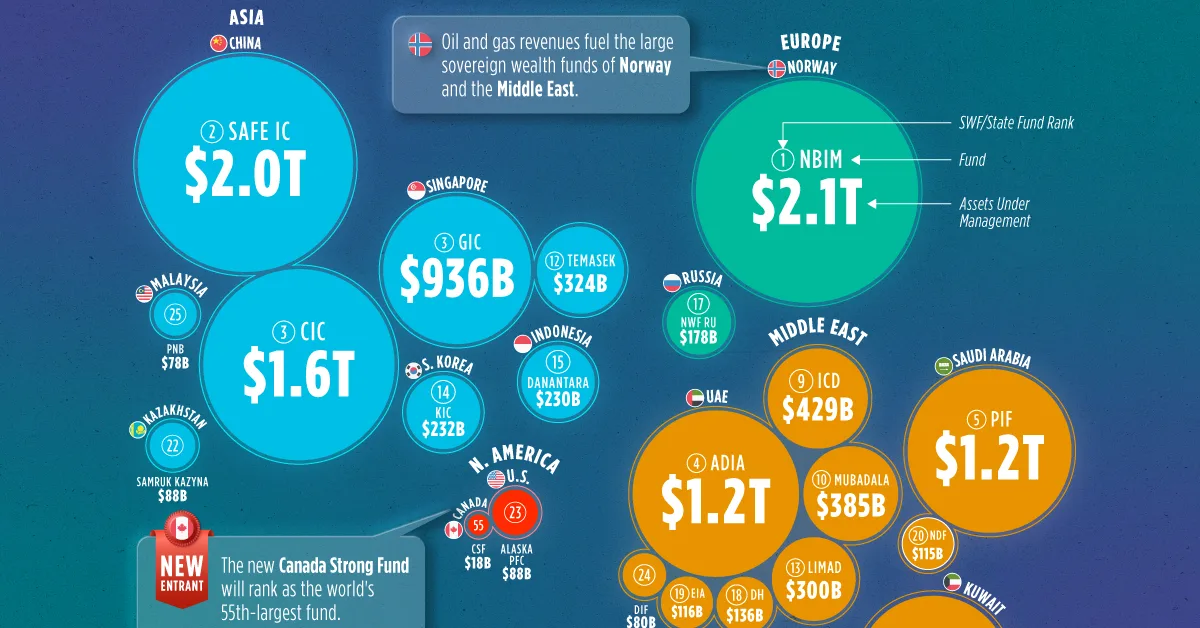
Where the World’s $13T in Sovereign Wealth Is Held
See visuals like this from many other data creators on our Voronoi app. Download it for free on iOS or Android and discover incredible data-driven charts from a variety of trusted sources.
Key Takeaways
- Asia and the Middle East control the majority of the world’s $13 trillion in sovereign wealth.
- Norway alone holds over $2.1 trillion, the largest sovereign wealth fund globally.
- Middle Eastern funds exceed $5 trillion, built largely on oil revenues.
Sovereign wealth funds now hold over $13 trillion in assets. But where is that capital actually concentrated?
Most of it sits in Asia and the Middle East, where export surpluses and energy revenues have fueled massive state-owned funds. At the same time, Norway stands apart as the single largest holder, with a fund that exceeds $2.1 trillion.
This graphic ranks the largest sovereign wealth funds using 2026 data from Global SWF, showing where the world’s state-owned capital is concentrated and which countries control the biggest pools of wealth.
Norway’s $2 Trillion Investment Fund
Norges Bank Investment Management (NBIM) was founded in 1990 to channel excess oil revenues into long-term investments. As of 2026, the fund has over $2.1 trillion in assets under management, making it the world’s largest sovereign wealth fund (SWF).
Given Norway’s relatively small population of just five million people, this translates to over $350,000 for each of the country’s citizens.
The table below shows how Norway’s fund compares with other major sovereign wealth funds, highlighting how concentrated global state-owned capital has become.
| Rank | SWF/State Fund | Country | AUM (USD Billions) |
|---|---|---|---|
| 1 | NBIM |  Norway Norway |
2,116 |
| 2 | SAFE IC |  China China |
1,988 |
| 3 | CIC | China |
1,567 |
| 4 | ADIA |  UAE – Abu Dhabi UAE – Abu Dhabi |
1,187 |
| 5 | PIF |  Saudi Arabia Saudi Arabia |
1,151 |
| 6 | KIA |  Kuwait Kuwait |
1,002 |
| 7 | GIC |  Singapore Singapore |
936 |
| 8 | QIA |  Qatar Qatar |
580 |
| 9 | ICD | UAE – Dubai |
429 |
| 10 | Mubadala | UAE – Abu Dhabi |
385 |
| 11 | TWF |  Turkiye Turkiye |
360 |
| 12 | Temasek | Singapore |
324 |
| 13 | LIMAD | UAE – Abu Dhabi |
300 |
| 14 | KIC |  South Korea South Korea |
232 |
| 15 | Danantara |  Indonesia Indonesia |
230 |
| 16 | Future Fund |  Australia Australia |
225 |
| 17 | NWF RU |  Russia Russia |
178 |
| 18 | DH | UAE – Dubai |
136 |
| 19 | EIA | UAE |
116 |
| 20 | NDF | Saudi Arabia |
115 |
| 21 | QIC | Australia – QLD |
89 |
| 22 | Samruk Kazyna |  Kazakhstan Kazakhstan |
88 |
| 23 | Alaska PFC |  USA – AK USA – AK |
88 |
| 24 | DIF | UAE – Dubai |
80 |
| 25 | PNB |  Malaysia Malaysia |
78 |
| New Entrant | Canada Strong |  Canada Canada |
18 |
Norway’s government has used NBIM to help the country avoid the “resource curse” that affects many oil-dependent economies. By investing in diversified global assets, the country has built a war chest for future public investment and sustainable development.
The Middle East’s Many Funds
Norway is far from the only country to invest its oil and gas revenues in a government-managed fund. Across the Middle East, similar SWFs have been set up in Saudi Arabia ($1.3 trillion), Kuwait ($1 trillion), and Qatar ($580 billion).
In the United Arab Emirates, both the national government and individual emirate governments have done the same, with over $2.6 trillion in assets under management as of 2026.
Even non-petrostates in the Middle East have opened SWFs in recent years. The Turkey Wealth Fund, founded in 2016, has over $360 billion in assets under management, including holdings across the country such as a sizable minority stake in Turkish Airlines and full ownership of the Port of İzmir.
The World’s Newest SWF
Canada is the latest country to join the club. In April 2026, Prime Minister Mark Carney announced the Canada Strong Fund, a new $18 billion SWF that, at the point of establishment, will be the world’s 55th-largest SWF of its kind.
The Canadian government hopes to use the Canada Strong Fund to invest in strategic priorities across the country as it seeks to diversify trade partners and reduce reliance on the United States.
Oil, mining, and gas revenues will likely play a role in bolstering the fund’s capital, similar to the nearby Alaska Permanent Fund ($88 billion), an American state-level SWF that pays out an annual dividend to Alaskan residents in what has been called the sole existing example of basic income.
Learn More on the Voronoi App 
What about the other side of the equation? See how much debt is held by governments on Voronoi.Use This Visualization