How Government Interest Costs Compare
Key Takeaways
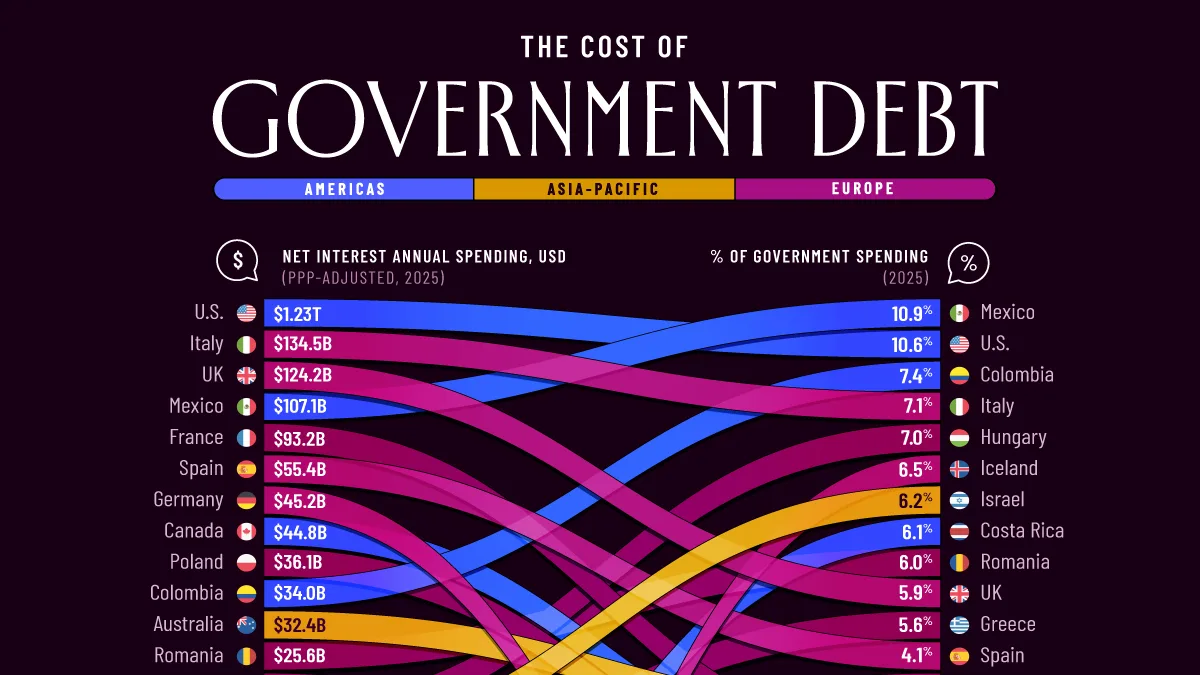
- Mexico has the OECD’s highest interest burden, with 10.9% of government spending going toward net interest, narrowly ahead of the U.S. at 10.6%.
- Italy’s 7.1% interest burden is roughly five times Germany’s 1.4%, despite both being major euro-area economies.
- Four countries devote less than 1% of government spending to net interest: the Netherlands, Lithuania, Finland, and Estonia.
The U.S. government’s annual net interest bill now exceeds $1.2 trillion, larger than the annual economic output of most countries around the world.
But the U.S. isn’t alone in facing a sizable interest burden. Across the OECD, the share of government spending absorbed by interest varies dramatically, showing how differently debt and borrowing costs are affecting national budgets.
Using the latest available OECD data, this graphic compares the cost of servicing government debt across countries. Dollar figures are adjusted for differences in purchasing power, using figures for 2025 or the latest year available.
Where Interest Takes the Biggest Bite
The dollar cost of government debt varies enormously, but its share of total spending reveals how much room interest payments take up in national budgets.
| Country | Net Interest Spending ($B, PPP) | Share of Gov. Spending |
|---|---|---|
 Mexico Mexico |
107.1 | 10.9% |
 U.S. U.S. |
1,230.6 | 10.6% |
 Colombia Colombia |
34.0 | 7.4% |
 Italy Italy |
134.5 | 7.1% |
 Hungary Hungary |
15.8 | 7.0% |
 Iceland Iceland |
1.0 | 6.5% |
 Israel Israel |
15.7 | 6.2% |
 Costa Rica Costa Rica |
3.7 | 6.1% |
 Romania Romania |
25.6 | 6.0% |
 UK UK |
124.2 | 5.9% |
 Greece Greece |
12.8 | 5.6% |
 Spain Spain |
55.4 | 4.1% |
 Portugal Portugal |
10.0 | 4.1% |
 Australia Australia |
32.4 | 4.0% |
 France France |
93.2 | 3.7% |
 Canada Canada |
44.8 | 3.5% |
 Poland Poland |
36.1 | 3.5% |
 Belgium Belgium |
16.0 | 3.3% |
 Chile Chile |
5.6 | 2.9% |
 Slovakia Slovakia |
3.0 | 2.3% |
 Austria Austria |
8.7 | 2.2% |
 Croatia Croatia |
2.1 | 2.1% |
 Czechia Czechia |
5.4 | 1.9% |
 Slovenia Slovenia |
1.1 | 1.7% |
 Latvia Latvia |
0.7 | 1.7% |
 Germany Germany |
45.2 | 1.4% |
 Ireland Ireland |
2.3 | 1.3% |
 Bulgaria Bulgaria |
1.5 | 1.3% |
 New Zealand New Zealand |
1.6 | 1.2% |
 Lithuania Lithuania |
0.6 | 0.9% |
 Netherlands Netherlands |
5.5 | 0.8% |
 Finland Finland |
1.2 | 0.6% |
 Estonia Estonia |
0.2 | 0.6% |
The rankings shift considerably depending on how interest costs are measured. The U.S. has by far the largest interest bill in dollar terms, while Mexico ranks first when interest is measured as a share of government spending.
Unlike spending on infrastructure or public services, interest largely reflects the cost of financing existing obligations. Across OECD countries, government interest payments reached 3.3% of GDP in 2024, exceeding spending on defense.
Why the Interest Bill Could Keep Growing
Today’s interest costs do not yet fully reflect current borrowing rates. Much of the outstanding debt was issued when rates were exceptionally low, but that debt gradually needs to be refinanced.
Nearly 45% of OECD sovereign debt is set to mature by 2027. Debt maturing between 2025 and 2027 carries an average yield below 2%, compared with a projected average 10-year rate of around 3.6% in 2025.
That large wave of cheap government debt could put further upward pressure on interest bills as it is refinanced at higher rates.
Why Some Countries Have Negative Interest Costs
Surprisingly, seven countries in the OECD data have negative net interest spending: Switzerland, Japan, Sweden, Luxembourg, Denmark, South Korea, and Norway.
In these countries, governments hold financial assets that generate interest income. When that income exceeds the interest paid on government debt, net interest spending turns negative. These countries are therefore excluded from the ranking.
This shows why debt alone doesn’t tell the full story. What governments own, what they owe, and the rates they pay all shape the true interest burden.
Learn More on the Voronoi App
To learn more about this topic, check out this graphic on the top foreign holders of U.S. debt.
- Source: https://www.visualcapitalist.com/ranked-countries-paying-the-most-interest-on-government-debt/