Where America’s College-Educated Adults Live
Key Takeaways
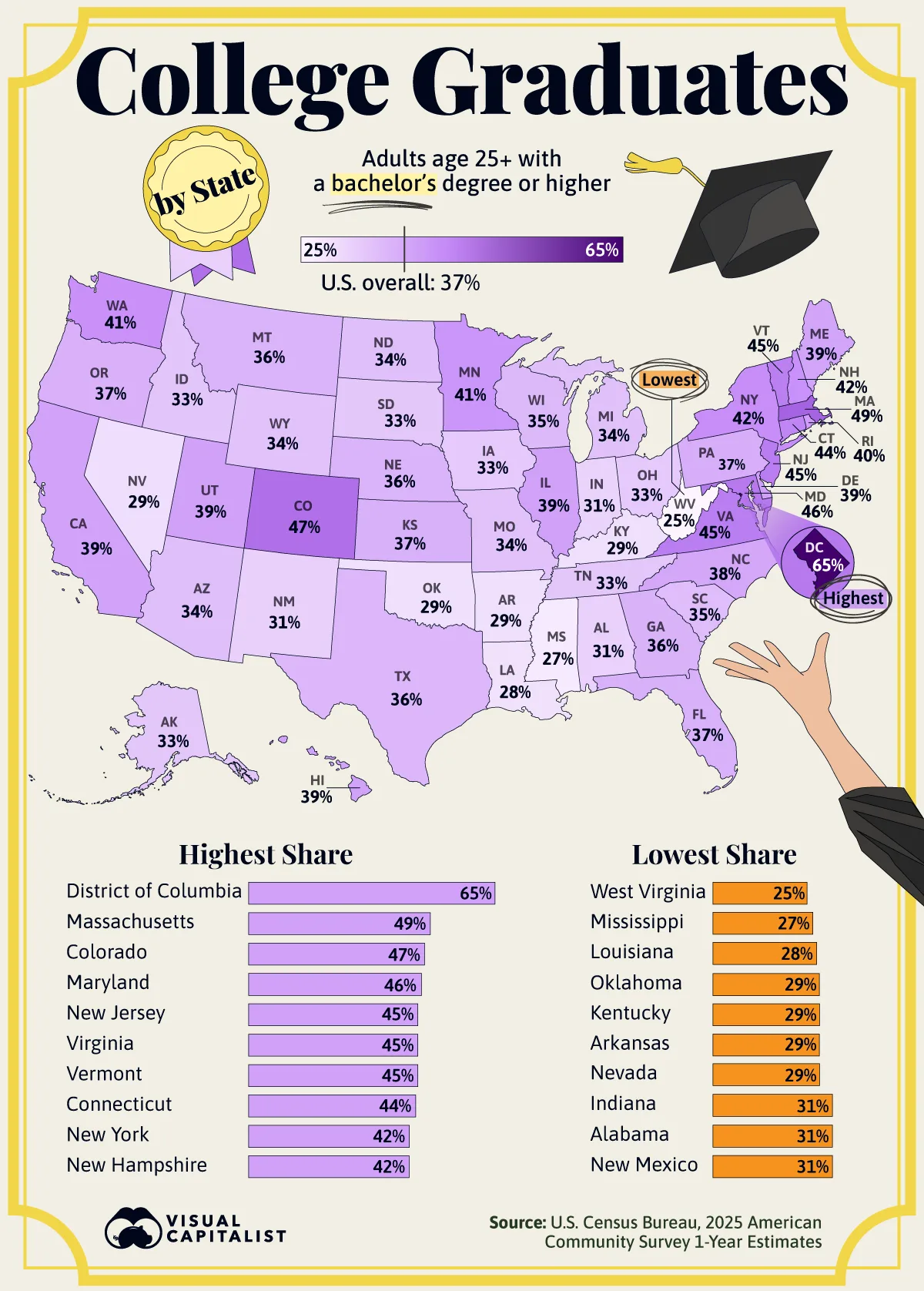
- Nearly two-thirds of Washington, D.C. adults age 25 and older (64.9%) hold at least a bachelor’s degree, well ahead of Massachusetts (49.2%), the highest-ranked state.
- Nine of the top 10 jurisdictions are in the Northeast or the Washington, D.C. region, with Colorado (47.1%) the lone exception.
- Seven states fall below 30%, with West Virginia ranking last at 24.7%, compared with the national average of 37.4%.
Where America’s college graduates live reflects more than the strength of local universities. Job opportunities, industry hubs, and interstate migration all help shape the country’s educational geography.
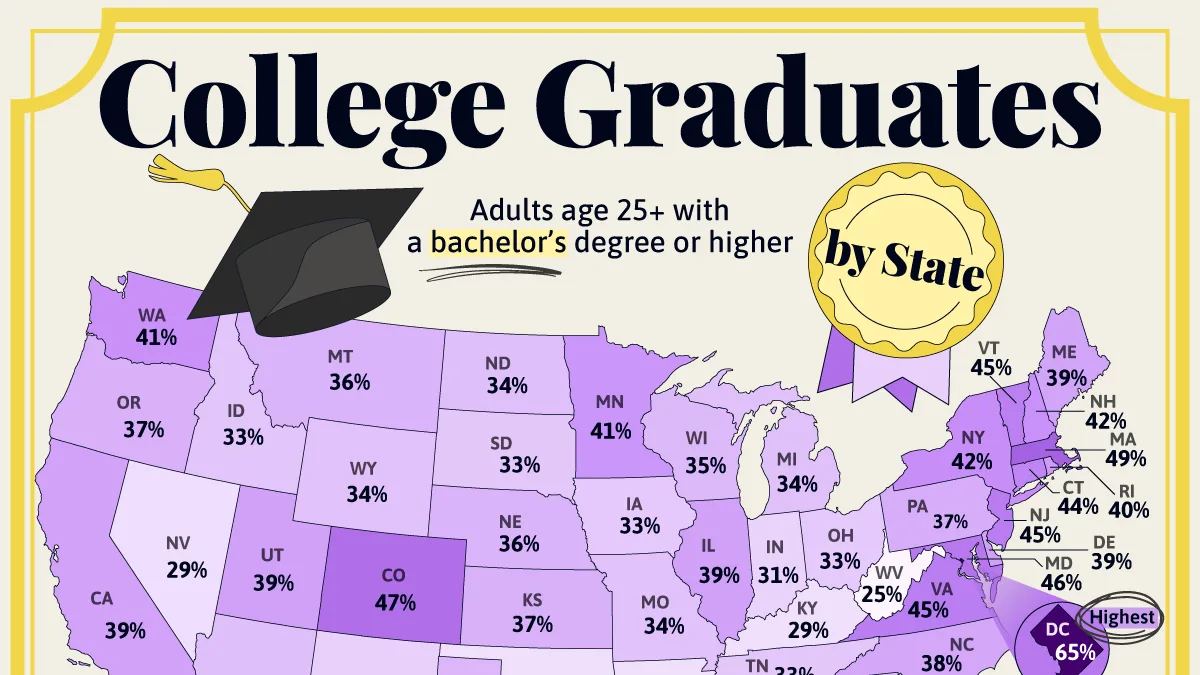
This map shows the share of adults age 25 and older with a bachelor’s degree or higher across all 50 states and Washington, D.C. in 2025, using American Community Survey estimates from the U.S. Census Bureau.
Washington, D.C. and the Northeast Lead in Education
Massachusetts has roughly twice the share of college-educated adults as West Virginia, highlighting the wide gap in educational attainment across the country.
The table below ranks all 50 states and Washington, D.C. by the share of adults age 25 and older with a bachelor’s degree or higher in 2025:
| Rank | State / District | Bachelor’s Degree or Higher (%) |
|---|---|---|
| 1 | District of Columbia | 64.9 |
| 2 | Massachusetts | 49.2 |
| 3 | Colorado | 47.1 |
| 4 | Maryland | 45.5 |
| 5 | New Jersey | 45.0 |
| 6 | Virginia | 44.7 |
| 7 | Vermont | 44.5 |
| 8 | Connecticut | 43.6 |
| 9 | New York | 42.0 |
| 10 | New Hampshire | 41.5 |
| 11 | Washington | 41.4 |
| 12 | Minnesota | 40.8 |
| 13 | Rhode Island | 39.9 |
| 14 | Utah | 39.1 |
| 15 | Illinois | 39.1 |
| 16 | Delaware | 39.0 |
| 17 | Hawaii | 38.9 |
| 18 | California | 38.8 |
| 19 | Maine | 38.6 |
| 20 | North Carolina | 38.1 |
| 21 | Pennsylvania | 37.1 |
| 22 | Florida | 36.7 |
| 23 | Kansas | 36.7 |
| 24 | Oregon | 36.6 |
| 25 | Georgia | 36.3 |
| 26 | Montana | 36.2 |
| 27 | Nebraska | 36.2 |
| 28 | Texas | 35.5 |
| 29 | Wisconsin | 35.2 |
| 30 | South Carolina | 34.5 |
| 31 | North Dakota | 34.3 |
| 32 | Arizona | 34.3 |
| 33 | Michigan | 33.9 |
| 34 | Wyoming | 33.7 |
| 35 | Missouri | 33.7 |
| 36 | Idaho | 33.2 |
| 37 | South Dakota | 33.0 |
| 38 | Alaska | 32.9 |
| 39 | Tennessee | 32.8 |
| 40 | Iowa | 32.6 |
| 41 | Ohio | 32.5 |
| 42 | New Mexico | 31.4 |
| 43 | Alabama | 31.1 |
| 44 | Indiana | 30.7 |
| 45 | Nevada | 29.0 |
| 46 | Arkansas | 28.8 |
| 47 | Kentucky | 28.7 |
| 48 | Oklahoma | 28.7 |
| 49 | Louisiana | 28.3 |
| 50 | Mississippi | 26.9 |
| 51 | West Virginia | 24.7 |
| — |  United States |
37.4 |
Unlike states, Washington, D.C. is an entirely urban jurisdiction. Its concentration of federal agencies, law firms, and policy organizations helps explain its unusually high educational attainment. Nearly 39% of D.C. adults age 25 and older hold a graduate or professional degree, more than double the national rate.
Massachusetts benefits from a dense network of universities, hospitals, and biotechnology firms. Life, physical, and social science occupations account for 2.5% of Boston-area employment, nearly three times the national share.
States with the lowest rates of college degree attainment are concentrated in the South and Appalachia, with Mississippi and Louisiana ranking just ahead of West Virginia.
Nevada is the only Western state below 30%, a distinction that may partly reflect its reliance on hospitality and service industries, where many jobs do not require a four-year degree.
How Migration Shapes Educational Attainment
Because Census figures record where adults live rather than where they went to school, a state’s ranking reflects migration patterns as well as the educational attainment of its existing residents. Colorado, which ranks second among states, offers a striking example.
Among adults age 25 and older who moved to Colorado from another state in 2025, 57% held at least a bachelor’s degree, well above the state’s overall rate.
Colorado’s aerospace, technology, and research industries may help attract highly educated workers, while states with fewer jobs requiring advanced education may struggle to retain graduates.
Four States Account for a Third of U.S. College Graduates
Texas and Florida both fall below the national average for educational attainment, yet together they are home to 13.7 million college graduates, more than Washington, D.C. and the five highest-ranked states combined.
Population size reshapes the picture considerably. California, Texas, Florida, and New York alone account for roughly one-third of America’s 89 million college graduates.
Learn More on the Voronoi App
If you enjoyed today’s post, check out The World’s Most Educated Countries on Voronoi.