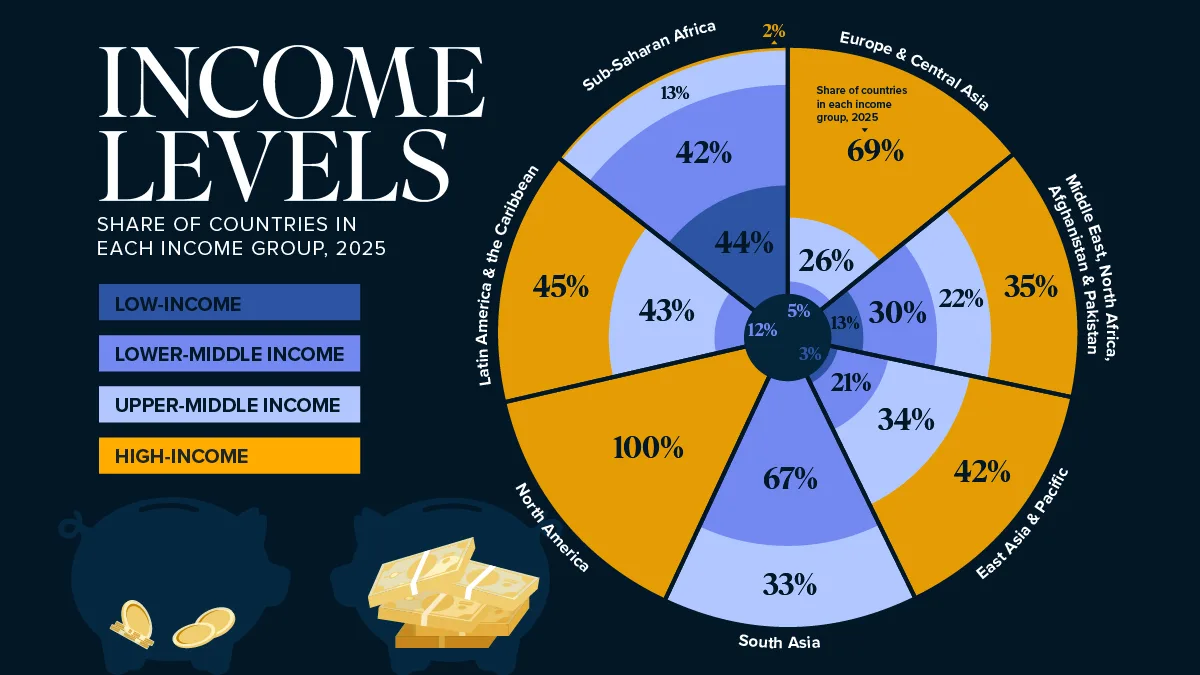
Which World Regions Have the Most High-Income Countries?
See visuals like this from many other data creators on our Voronoi app. Download it for free on iOS or Android and discover incredible data-driven charts from a variety of trusted sources.
Key Takeaways
- Europe and Central Asia has the highest share of high-income countries after the World Bank’s North America region, at 69%.
- Sub-Saharan Africa is the only region where low-income countries make up the largest share, at 44%.
- Latin America and the Caribbean is heavily concentrated in the upper-middle and high-income groups, which together account for 88% of countries.
The global distribution of income groups reveals sharp regional contrasts, from Europe and Central Asia’s high concentration of wealthy economies to Sub-Saharan Africa’s much larger share of low-income countries.
The World Bank classifies economies into four groups based on gross national income (GNI) per capita: low-income ($1,175 or less), lower-middle-income ($1,176–$4,635), upper-middle-income ($4,636–$14,375), and high-income (more than $14,375).
This visualization shows how countries in each World Bank region are distributed across those income groups in 2025. Under this regional framework, Mexico is included in Latin America and the Caribbean rather than North America.
Sub-Saharan Africa Remains the Lowest-Income Region
Sub-Saharan Africa is the only region where low-income countries represent the largest share.
| Region | Low-income ($1,175 or less) | Lower-middle income ($1,176 to $4,635) | Upper-middle-income ($4,636 to $14,375) | High-income (more than $14,375) |
|---|---|---|---|---|
| Sub-Saharan Africa | 44% | 42% | 13% | 2% |
| South Asia | 0% | 67% | 33% | 0% |
| North America | 0% | 0% | 0% | 100% |
| Middle East, North Africa, Afghanistan, and Pakistan | 13% | 30% | 22% | 35% |
| Latin America and the Caribbean | 0% | 12% | 43% | 45% |
| Europe and Central Asia | 0% | 5% | 26% | 69% |
| East Asia and Pacific | 3% | 21% | 34% | 42% |
Nearly half of Africa’s countries (44%) are classified as low-income, while another 42% fall into the lower-middle-income category.
Although several economies in the region have grown rapidly over the past two decades, many remain constrained by limited industrialization, infrastructure gaps, and fast population growth, slowing gains in income per person.
Seychelles is the only Sub-Saharan African country classified as high-income.
Its status is supported by a small population and a high-value economy centered on tourism and fisheries, which generate substantial income per person.
High-Income Economies Are Concentrated in Three Regions
Under the World Bank’s regional classification, North America consists of Canada, the U.S. and Bermuda, all of which are high-income economies. Mexico is grouped with Latin America and the Caribbean.
Europe and Central Asia also has a strong concentration of wealthy economies, with 69% of countries classified as high-income.
East Asia and the Pacific has a more varied profile, with 42% of countries in the high-income group and another 34% in the upper-middle-income category.
The region includes advanced economies such as Japan, Singapore, and Australia, alongside rapidly developing countries including China, Indonesia, Vietnam, and the Philippines.
Middle- and High-Income Economies Dominate Several Regions
In Latin America and the Caribbean, 88% of countries fall into the upper-middle or high-income categories.
South Asia has no low-income countries under the latest classification. Two-thirds of its countries are lower-middle-income, while the remaining third are upper-middle-income.
The Middle East, North Africa, Afghanistan, and Pakistan has the broadest distribution across all four income groups. The region includes some of the world’s wealthiest energy-exporting economies alongside lower-income countries facing slower development or prolonged instability.
Learn More on the Voronoi App 
To learn more about this topic, check out this graphic on the world’s richest countries by GDP per capita.