Why Tungsten Prices Soared 622% Since 2025
Key Takeaways
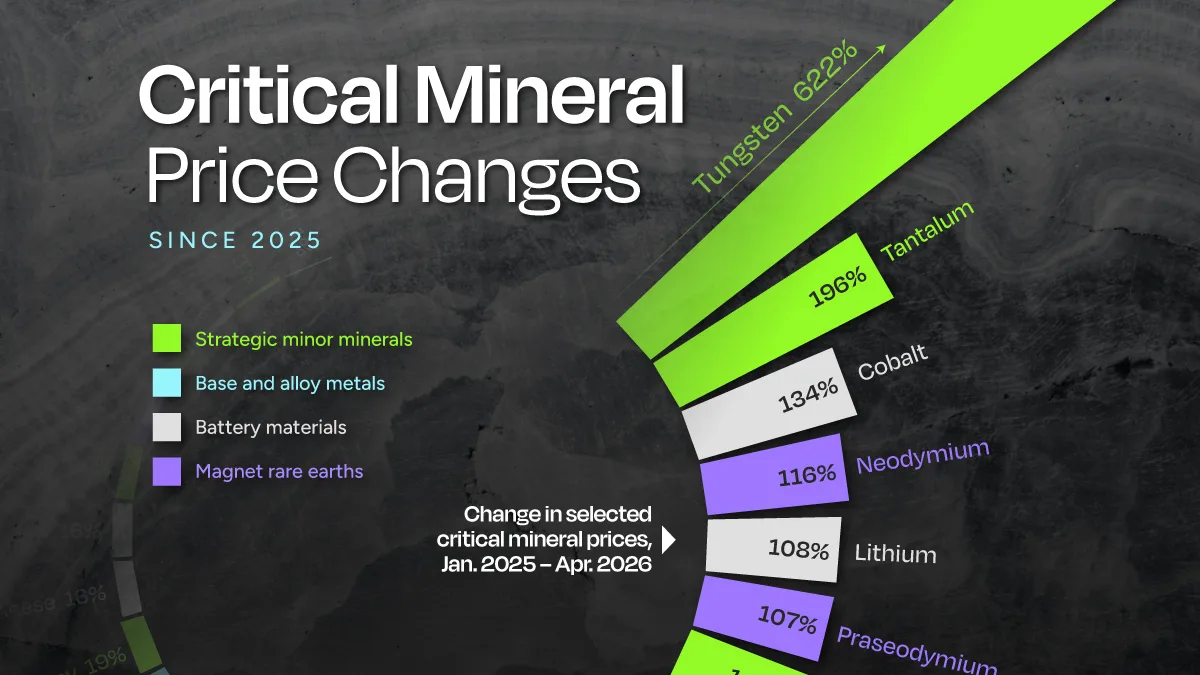
- Tungsten prices surged 622% between January 2025 and April 2026, more than three times the increase for any other mineral shown.
- Battery materials and magnet rare earths also posted major gains, led by cobalt, neodymium, lithium, and praseodymium.
- Export restrictions and concentrated supply chains contributed to sharp price increases across several critical minerals.
Critical mineral prices climbed rapidly between January 2025 and April 2026 after several years of weaker market conditions.
Rising demand from the energy, defense, and high-tech industries added pressure to markets already affected by supply constraints.
This visualization ranks 27 selected minerals by their price change over the period.
The data for this visualization comes from the International Energy Agency’s Global Critical Minerals Outlook 2026.
Tungsten Leaves the Rest Behind
Tungsten was the clear outlier, with prices rising 622% between January 2025 and April 2026. That increase was more than three times the gain recorded by second-ranked tantalum.
| Critical Mineral | Price Change (2025-2026) | Category |
|---|---|---|
| Tungsten | 622% | Strategic minor minerals |
| Tantalum | 196% | Strategic minor minerals |
| Cobalt | 134% | Battery materials |
| Neodymium | 116% | Magnet rare earths |
| Lithium | 108% | Battery materials |
| Praseodymium | 107% | Magnet rare earths |
| Indium | 102% | Strategic minor minerals |
| Bismuth | 95% | Strategic minor minerals |
| Tin | 65% | Base and alloy metals |
| Chromium | 53% | Base and alloy metals |
| Copper | 44% | Base and alloy metals |
| PPA | 42% | Battery materials |
| Aluminium | 39% | Base and alloy metals |
| Terbium | 37% | Magnet rare earths |
| Molybdenum | 34% | Base and alloy metals |
| Vanadium | 25% | Base and alloy metals |
| Tellurium | 24% | Strategic minor minerals |
| Zinc | 23% | Base and alloy metals |
| Antimony | 19% | Strategic minor minerals |
| Manganese | 16% | Battery materials |
| Nickel | 16% | Battery materials |
| Germanium | 14% | Strategic minor minerals |
| Dysprosium | 10% | Magnet rare earths |
| Titanium | 10% | Strategic minor minerals |
| Graphite | 5% | Battery materials |
| Gallium | 3% | Strategic minor minerals |
| Lead | 1% | Base and alloy metals |
Tungsten is widely used in cutting tools, aerospace components, electronics, and defense applications. Strong demand and China’s export controls placed further pressure on supplies, pushing prices sharply higher.
Battery Materials Rebound
Cobalt and lithium prices increased by 134% and 108%, respectively. Lithium benefited from strong demand for energy storage and constrained supply, while cobalt prices were affected by export restrictions imposed by the Democratic Republic of the Congo.
Purified phosphoric acid, or PPA, rose by 42%, while manganese and nickel each increased by 16%. Graphite posted a comparatively modest gain of 5%.
According to the IEA, global battery demand grew by more than 35% in 2025, surpassing 1.5 terawatt-hours and supporting demand for key battery materials.
Rare Earths and Supply Concentration
Magnet rare earths were also among the biggest gainers. Neodymium and praseodymium prices rose by 116% and 107%, respectively, while terbium increased by 37%.
These elements are essential for manufacturing the high-performance permanent magnets used in electric vehicles, wind turbines, industrial equipment, and consumer electronics. Growing demand for these technologies has increased the strategic importance of rare earth supply chains.
According to the IEA, China accounted for about 70% of refined production across key energy minerals in 2025. That concentration leaves global supply chains more vulnerable to export restrictions and other disruptions, contributing to greater price volatility.
Learn More on the Voronoi App 
If you enjoyed today’s post, check out this graphic showing which countries depend most heavily on China for rare earth metals.