

The Honda Super-One is proof positive that people really are, in the main, shallow fools who prize looks above practicality.
Or, perhaps, it shows that some of us never grow up and when we see something small, cute and toy-like, we just have to have it, even if it’s as useful, in real terms, as a Furby or a Labubu.
2026 Honda Super-One price and equipment
In a world in which customers can buy a car sight unseen — ordering online without ever visiting a showroom — it should come as no surprise that 130 Australians slapped down a deposit on this adorable-looking Honda, despite an asking price of $36,900 drive-away, a battery smaller than what you’d find in some PHEVs and a driving range officially classified as “stuff all” (with 96 per cent battery, we were showing a predicted 151km).
That 130 was the entire allocation Honda Australia could get its hands on for 2026, but it also received almost 7000 expressions of interest in buying one. More supply is due from early 2027, with the first Australian customer deliveries beginning on October 1, 2026.
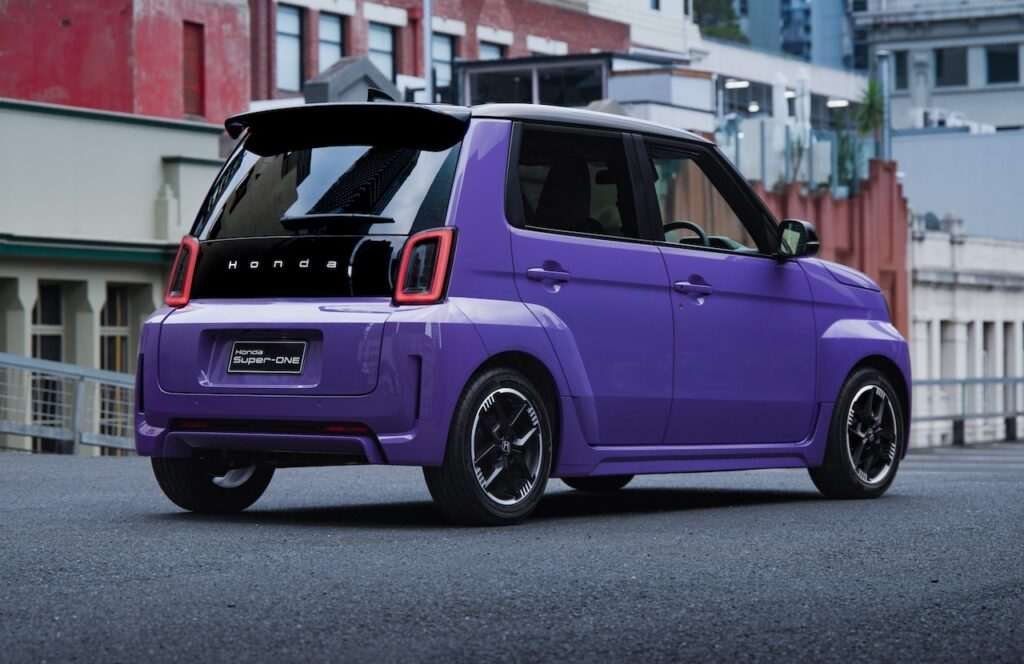
And it’s perhaps unfair to say Australians are buying the Super-One sight unseen. Seemingly everyone has visited Japan in the past five years, and most people who do so surely notice how cool-looking “kei” cars are (a class of vehicle sold there that must be built to certain tiny dimensions, with tax and ownership benefits, presumably because you can just store it under the bed).
Kei means “light” in Japanese, but the Super-One is not a kei car. Based on the Japanese-market N-ONE e:, it has a wider body and a Boost mode that allows you to up your power from 47kW to 70kW.
You can drive it entirely in that mode if you choose, although I’d be watching the range readout closely. Claimed range for this, Honda’s first BEV in our market, is 202km on the WLTP test cycle.
The Super-One has no published ANCAP rating, so we don’t know how it would score. But nor do the people who’ve lined up to buy one seem to care. That is not the same as Honda not crash testing it: Honda says the body has been adapted from its kei-car donor to meet standard passenger-car requirements.
READ MORE: Honda Super-ONE priced for Australia: Honda’s first EV takes on China’s affordable electric car army
READ MORE: Honda Prelude Aussie pricing confirmed: Legendary sports car returns as petrol-electric hybrid
READ MORE: Dead before arrival: Honda kills off pioneering 0 Series sedan and SUV just months before radical EVs are due to launch
For the money, the entry-level Mono gets 15-inch alloy wheels, a 9.0-inch touchscreen with wireless Apple CarPlay and Android Auto, a 7.0-inch driver display, an eight-speaker Bose audio system, single-zone climate control and a heated steering wheel. The Two-Tone costs $37,400 drive-away.
There are four seats and a 162-litre boot. Folding the rear Magic Seats expands that to 618 litres measured to the window line, or 967 litres loaded to the roof.
Safety equipment includes six airbags, autonomous emergency braking, adaptive cruise control, lane keeping assistance, front and rear parking sensors and a reversing camera.
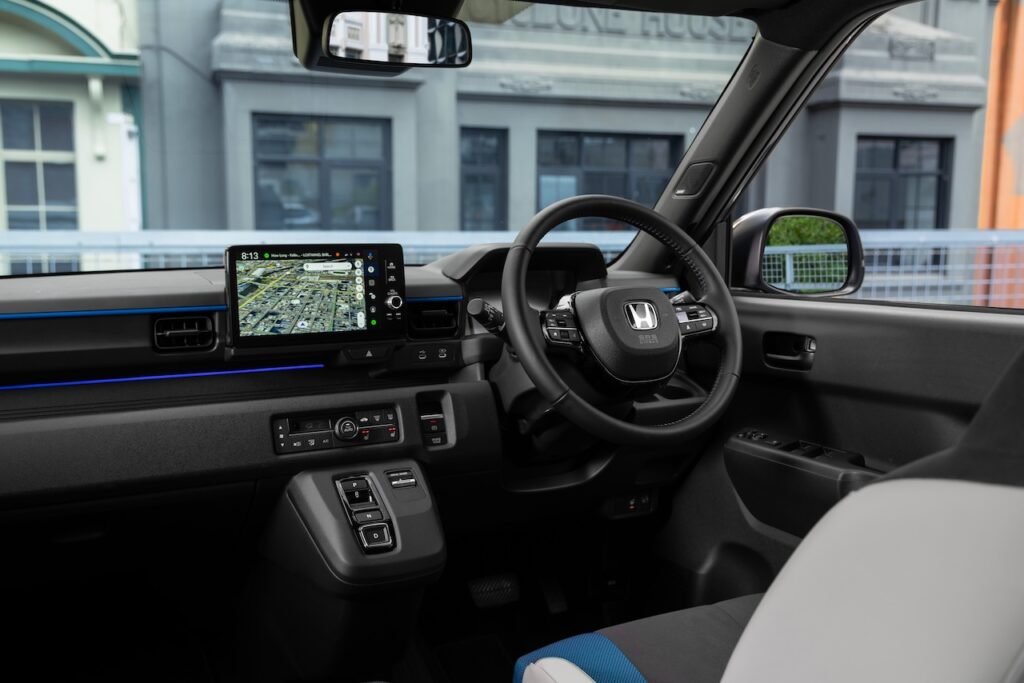
The 29.6kWh lithium-ion battery can charge at up to 6.6kW on single-phase AC or 10kW on three-phase AC. DC charging tops out at 50kW, with Honda quoting about 30 minutes for a 15–80 per cent charge.
The vehicle warranty is five years with unlimited kilometres, extendable to eight years through Honda Extend if the servicing conditions are met. The battery has a separate eight-year/160,000km warranty. Servicing is due every 12 months or 15,000km, with the first five scheduled services capped at $199 each.
2026 Honda Super-One: What we think
It might seem that I’m being mildly critical of the Super-One, but that’s just the hard-nosed scientist in me. But I’m not made of granite. I have eyes and I, too, am moved by just how cute it is – I think it’s called the Bambi Effect.
On many visits to Japan I’ve seen cars like this and wished that we could have them down under. But the range issue does bother me, and Honda Australia was obviously aware of it because they built a launch around us not being able to drive it too far.
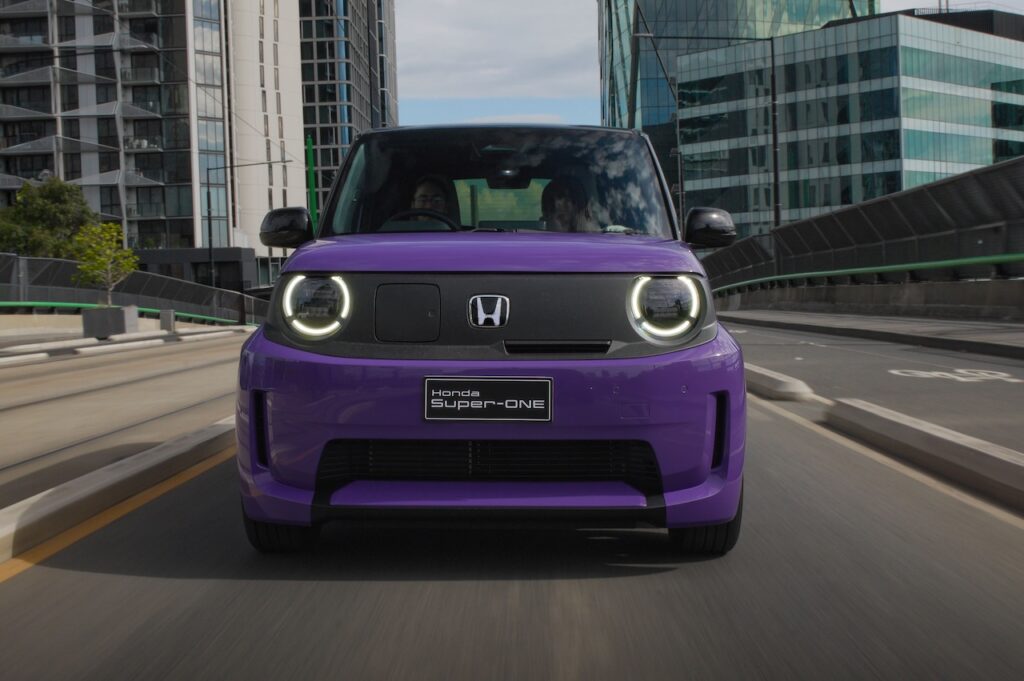
In fact, at just 13km, the launch drive – mainly through crowded inner-city Melbourne lanes, rarely at more than 40km/h – might be the shortest I’ve ever done.
I can report that, after the first half of this mini-drive, the battery was showing 96 per cent and the range was just 151km, and that was before I started playing with the Sport and Boost modes, which tempt you to use more of the available performance. That display was a prediction, rather than a measured full-battery range result; a 13km drive wasn’t enough to establish the latter.
Yes, it’s a city car and it’s not designed for long journeys, but I do think range anxiety would be your constant companion.
On the plus side, the Honda Super-One is fun to drive. It is light – for an EV – and zippy and go-kart-like, the steering is sharp and they really have gone the extra mile to put a smile on your face.
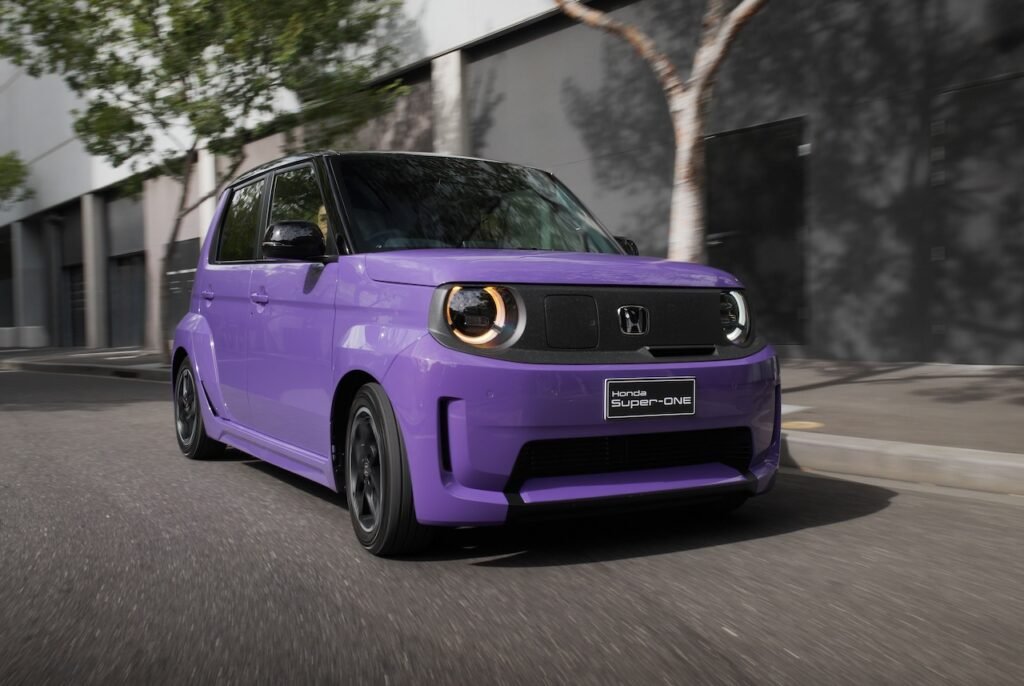
Much like the very clever Hyundai Ioniq N cars, Honda has gifted this car a fake seven-speed gearbox which you operate using real paddles while looking at a fake rev counter. It also makes fake noises, which, to my ears, don’t capture the magic of a Honda Integra Type R. They’re not awful, they’re just not that good.
Boost mode also gives this toy-sized conveyance a kick up the backside and it would be tempting to drive it like that at all times.
On the downside, it does feel thin on the road, and in the doors, and over expansion joints it leaps and clatters a bit.
Overall, though, it feels competent and composed, for a car of its size, and it’s difficult to drive it without feeling happy. Unless you’re pissed at how short the drive is.
2026 Honda Super-One: Verdict
It’s hard to argue with success and the Honda Super-One’s entire 2026 Australian allocation was spoken for before customer deliveries began.
I’m genuinely surprised that Honda didn’t charge more for it, and the price arguably makes it more attainable. I can’t see it being my only car, and effectively it’s a sexy shopping trolley for short trips, so the range might not be a huge issue, but it surely feels inadequate to me.
SCORE: 3.0/5.0
2026 Honda Super-One specifications
Price: $36,900 drive-away (Mono); $37,400 drive-away (Two-Tone)
Basics: EV, 4 seats, 5 doors, hatchback, FWD
Range: 202km (WLTP)
Battery capacity: 29.6kWh lithium-ion
Battery warranty: 8 years/160,000km
Motor: Front-mounted, 47kW (70kW in Boost mode)/162Nm
Drive: Front-wheel drive
AC charging: 6.6kW single-phase/10kW three-phase, Type 2
DC charging: 50kW, CCS2
Energy consumption: 12.1kWh/100km (claimed)
ANCAP rating: Unrated
0–100km/h: Not stated in the supplied Australian press kit or spec sheet
The post 2026 Honda Super-One Review: Cute, fun and sold out, but is 202km range enough? appeared first on EV Central.


