


Visualized: The $942 Billion Nature Investment Gap
Nature is one of the world’s most valuable assets, providing clean air, freshwater, and biodiversity that support economies and livelihoods.
But are the current financial flows into nature conservation and restoration enough to meet the needs?
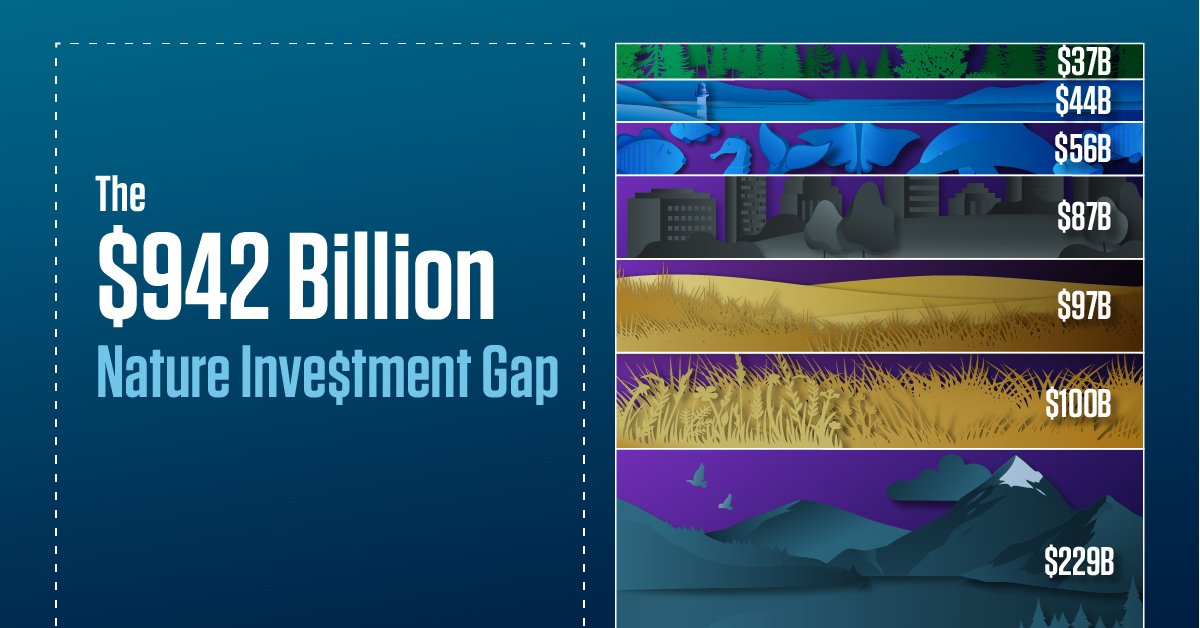
This graphic, sponsored by Zero Carbon Analytics, shows the total annual nature investment needed by 2030 for each nature category compared with the current finance flows using data from BloombergNEF.
Billions More Needed to Protect Nature
The total required investment in nature spans multiple categories, from protected areas to productive landscapes like croplands and rangelands.
| Category | Type | Annual Investment Needed by 2030 |
|---|---|---|
| Protected Areas | N/A | $229 billion |
| Productive Areas | Croplands | $500 billion |
| Invasive Species | $100 billion | |
| Rangelands | $97 billion | |
| Fisheries | $56 billion | |
| Coastal | $44 billion | |
| Forests | $37 billion | |
| Urban Areas | N/A | $87 billion |
Figures in real 2023 U.S. dollars and may not add up due to rounding.
Protected Areas, which are regions of land or water legally designated for conservation and biodiversity protection, require an estimated $229 billion annually to ensure conservation efforts can be sustained.
Productive Areas, including croplands, fisheries, and rangelands, need $753 billion annually to transition to more sustainable practices.
Additional investments are required to combat invasive species and support ecosystem restoration, totaling nearly $100 billion per year. Urban areas also require additional investments, with the category needing an extra $87 billion annually.
While the total nature investment gap amounts to $942 billion, the total annual expenditure harming nature is a much higher $7,000 billion according to the United Nations.
Scaling Up Finance for Nature
Despite these significant funding needs, global investments in biodiversity remain well below the levels necessary to close the gap.
The shortfall is particularly evident in areas like sustainable agriculture and marine conservation, where funding is a fraction of what is required. Encouragingly, recent global agreements have taken steps toward closing the gap.
At COP16 in February 2025, governments adopted the first global biodiversity finance strategy under the Convention on Biological Diversity. They aimed to close the $700 billion annual funding gap through investment, subsidy reform, and stronger financial mechanisms.
Nonetheless, more funding is needed to prevent the planet’s natural ecosystems from declining further.

-

 Environment2 months ago
How Much of the World’s Plastic Waste Actually Gets Recycled?
This chart breaks down plastic waste disposal, showing just how little recycling is happening at the global level.
-

 Environment3 months ago
Charted: Per-Capita CO2 Emissions by Global Region (1960-2022)
This infographic shows how per-capita CO2 emissions have changed across the world’s seven major regions.
-

 Environment6 months ago
The Number of Earths Needed for Different Countries’ Lifestyles
How many Earths would we need if the global population lived like Americans? This infographic answers this question and more.
-

 Environment11 months ago
Ranked: Top Countries by Total Forest Loss Since 2001
The country with the most forest loss since 2001 lost as much forest cover as the next four countries combined.
-

 Environment1 year ago
Charted: Share of World Forests by Country
We visualize which countries have the biggest share of world forests by area—and while country size plays a factor, so too, does the environment.
-

 Environment1 year ago
Which Countries Have the Largest Forests?
Together, the top five countries with the largest forests account for more than half of the world’s entire forest cover.

The post Visualized: The $942 Billion Nature Investment Gap appeared first on Visual Capitalist.



var disqus_shortname = “visualcapitalist.disqus.com”;
var disqus_title = “Visualized: The $942 Billion Nature Investment Gap”;
var disqus_url = “https://www.visualcapitalist.com/sp/visualized-the-942-billion-nature-investment-gap/”;
var disqus_identifier = “visualcapitalist.disqus.com-175820”;