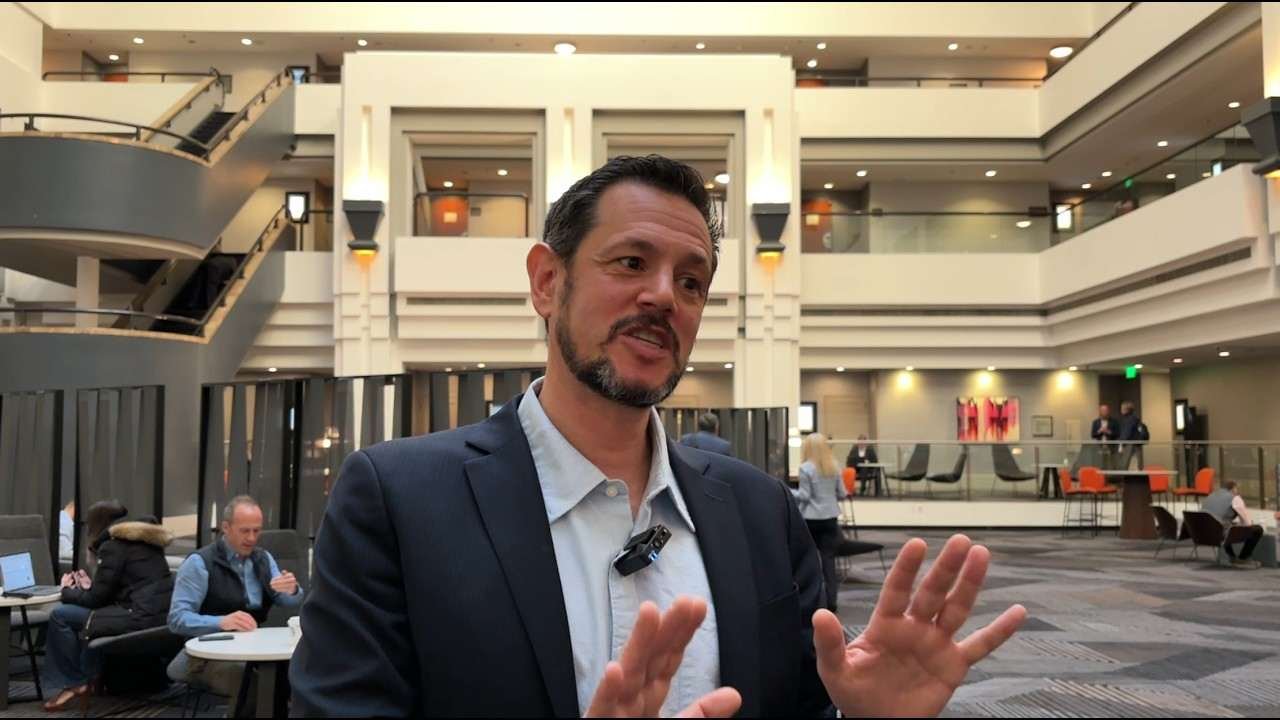
From new modes of action in crop protection to fleets of physical AI agents, founders at World Agri-Tech in San Francisco shared how converging technologies from AI and genomics to robotics are reshaping agriculture—compressing R&D timelines, boosting yields, and unlocking new modes of action in crop protection.
We’ll share the full interviews over the next couple of weeks, but here’s a quick mashup of our conversations with Heritable Agriculture (AI-powered crop breeding), Quercus Biosolutions (designer mini proteins for crop protection), Bindbridge (targeted protein degradation for next-gen herbicides), Polybee (physical AI agents), Meiogenix (targeted recombination in crop breeding), and AgriPass (robotic weeding).
👉 Brad Zamft, PhD, cofounder and CEO, Heritable Agriculture
We recognize that there really are three technological disruptions that are happening right now that enable the reduction in cost and the acceleration of crop improvement timelines.
First off, the decrease in cost of DNA and RNA sequencing, which has been precipitous, plus concomitant improvements in things like measuring proteins, epigenetics, metabolites…. We now live in an era of unprecedented information about biological systems.
Second. We now have drones. We have satellites covering every meter of the planet. We have sensing equipment on farm equipment. That’s the second technological revolution. We live in an era of unprecedented information about our planet, the weather, soil, etc.
But there’s a challenge with swimming in unprecedented levels of information, all this genomics data, all this environmental data, how do you make sense of it all?
Enter the third technological revolution, AI, which is especially good at integrating this disparate, heterogeneous data. You know weather data is inches of rain, heating degree days… AI is excellent at separating signals from noise. It’s excellent at understanding very complex nonlinear processes. So these are the three things that, when you put them together, really enable a new agricultural system that is lower cost with faster timelines.
👉 Jonathan Lightner, PhD, cofounder and CEO, Quercus Biosolutions
We think mini proteins are really exciting. I see proteins in general and small designed proteins specifically, really sitting in a great space that’s between chemical crop protection and biologicals.
Chemical crop protection has 95% of the market and strong COGS. It works. It’s consistent, but has its challenges. Biologicals can be more complex, where we go out and we find an exciting organism in nature, maybe a mycorrhizal fungus, maybe some interesting bacteria. When you go all the way to an organismal solution, you find amazing things because nature does amazing things, but turning that into a product can be really challenging. You’ve got a domestication problem. Nature often doesn’t think a lot about cost of goods as it builds solutions. Those mycorrhizal fungi are getting a free ride from their plant partners. Plants don’t worry much about energy. They have the opposite problem.
[In contrast] proteins are a defined molecular entity, just like a chemical, but they have many of the environmental benefits and regulatory advantages of a biological, so we think it’s a great segment and a great opportunity.
👉 George Crane, PhD, cofounder and CEO, Bindbridge
Our molecular glues act catalytically so one compound can degrade very many proteins, potentially reducing application rates by up to 100 times. Most ag chem products, and indeed, most drugs function by inhibiting a catalytic site, an active site.
Our approach is different. We target non catalytic sites to degrade rather than inhibiting the protein. So we are able to overcome resistance to existing targets. We’re able to drug the previously undruggable targets such as transcription factors and scaffold proteins, unlocking a new toolbox for targets for the industry.
👉 Siddharth Jadhav, founder and CEO, Polybee
At Polybee, we are building physical AI agents that turn unpredictable produce farms into data-driven factories. Now for centuries, produce farming has been helplessly unpredictable, and our thesis is that the root cause of that is lack of visibility and control on farming operations.
So our physical AI agent operates a fleet of autonomous drones that runs around the farm and scouts every single plant and gathers intelligence on it. We’re performing multiple jobs for farmers, such as forecasting yield, scouting for stress and performing jobs such as pollination.
We’ve already proven, time and again, across multiple crops varieties regions, that if our recommendations are followed for harvest timing, growers can walk away with 10-15% higher yield.
👉 Ricardo Garcia de Alba, CEO, Meiogenix
Meiogenix intervenes in [the genetic recombination process that occurs during] meiosis [when genes from two parents are shuffled to create reproductive cells]. Basically that’s where genetic diversity happens, and we can make that happen in a targeted and precise way.
Our proprietary breeding technology identifies where those genes and traits of interest are, and most importantly, the ones that would be otherwise unavailable with current breeding tools. We help breeders access them with our technology so that they can confer [desirable traits] to the next generation.
👉 Liron Cohen Yanay, CEO, AgriPass
[Via robotics], we do human weeding at the farm scale, because we know today there’s a lot of labor shortages, we also know that the current solutions have got to their limit, with resistance to herbicides, erosion coming from tillage over time, and people don’t want to come and work anymore in the field.
We’re replicating this [human weeding process] and making it affordable to adapt at scale. We’re using AI for contextual analysis and replicating the way an experienced farmer would [make decisions about which weeds to tackle and how]. So this is real time understanding and real time decision making in the field. And then we’re using robotic arms to actuate.
The post Ag’s new toolkit: AI, genomics, and robotics converge at World Agri-Tech appeared first on AgFunderNews.
- Source: https://agfundernews.com/ags-new-toolkit-ai-genomics-and-robotics-converge-at-world-agri-tech