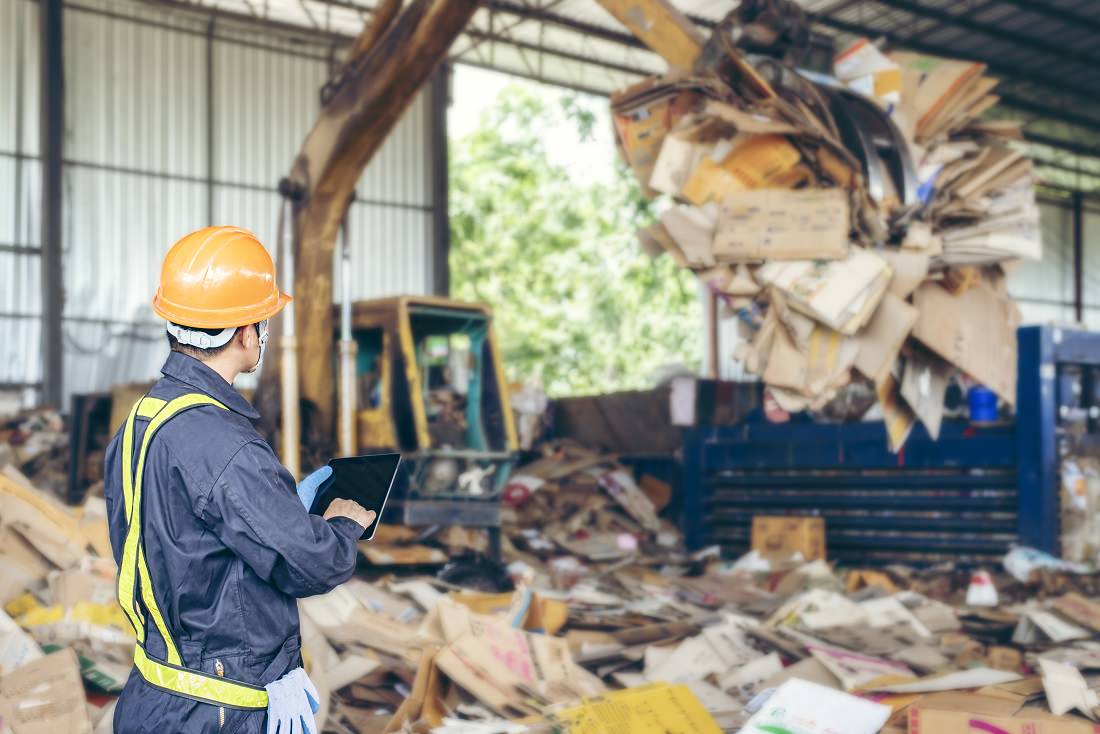
Corrugated cardboard makes its way from warehouse to mill in about two weeks. In contrast, plastic packaging can take centuries to break down, and even the most optimistic estimates say only 5 to 6 percent of U.S. plastic is actually recycled. This difference highlights both the promise and the challenges of creating a circular packaging economy.
Back in April 2020, when this article first appeared, the recycling industry was still struggling after China banned imported recyclables in 2018. Around that time, DS Smith opened its first North American recycling plant in Reading, Pennsylvania, marking the first closed-loop corrugated packaging system. Five years later, the circular packaging sector has become a$245 billion global market and is expected to nearly double by 2034.
However, growth does not always mean true circularity. The gap between what companies promise and what recycling systems actually deliver is under more scrutiny than ever.
How the Recycling Loop Works and Where It Breaks
Many people picture recycling as a simple process: items go from the curbside bin to a materials recovery facility (MRF) and then become new products. In reality, the process is more complicated. Mixed curbside collections have about a 25 percent contamination rate in baled recyclables from MRFs, so more sorting is needed before they can be turned into new materials. In the past, this extra sorting was often done cheaply in other countries.
After China stopped buying U.S. recyclables in 2018, the U.S. was left with about a third of its collected materials and no place to send them. This led to a crisis: many communities lost their recycling programs, and it became obvious that the U.S. needed more domestic processing and cleaner materials from better recycling programs.
Paper and corrugated cardboard are still the big success stories in circular packaging. In 2024, the U.S. recycled over 33 million tons of cardboard, or about 90,000 tons each day, reaching a recovery rate between 69 and 74 percent, according to the American Forest & Paper Association. The share of recycled paper used at U.S. mills has grown from 36.6 percent in 2005 to 44.4 percent in 2024.
Aluminum also does well, with the average beverage can containing about 73 percent recycled material.
Plastic is still a major challenge. Only about 5 to 6 percent of U.S. plastic packaging is recovered and made into new packaging or products.
A Growing Market With Caveats
Europe is leading the way in recycling growth, thanks to strict regulations. North America is catching up through corporate ESG commitments, extended producer responsibility programs, and state-level policies.
Paper-based packaging leads in circular packaging revenue, making up about 40 percent of the global market in 2024. This is due to advances in fiber recovery technology and the fact that consumers are used to recycling cardboard. Reusable and refillable packaging is growing quickly, but it is still a small part of the market. As a result, the food and beverage sector makes up nearly 47 percent of circular packaging demand, and packaging companies are teaming up with recyclers to meet this need.
Industry consolidation signals how seriously investors have bet on this sector. In July 2024, Smurfit Kappa completed its acquisition of WestRock to form Smurfit WestRock, one of the world’s largest paper-based packaging companies, with $32 billion in combined revenue and 100,000 employees across 40 countries. Separately, International Paper announced an agreement to acquire DS Smith in a deal valuing DS Smith at approximately $9.9 billion. These deals suggest that fiber-based, recyclable packaging is a durable growth market.
The DS Smith Model, Five Years Later
In March 2020, DS Smith opened its first North American recycling plant in Reading, Pennsylvania, right next to an existing paper mill and corrugated packaging facility. These three sites could make, use, collect, and recycle corrugated boxes in about two weeks, creating a true closed loop. DS Smith got clean materials from distribution centers, packaging facilities, and retailers instead of mixed curbside collections, which helped keep contamination low.
Since then, this model has grown significantly. DS Smith, now part of International Paper, and other companies have shown that fiber-based packaging circular systems can work on a large scale. The Ellen MacArthur Foundation’s 2024 Global Commitment Progress Report, which covers over 1,000 organizations representing 20 percent of global plastic packaging production, noted that companies like Amcor have “doubled the share of recycled content in their plastic packaging, making as much progress in four years as in the four decades before,” according to EMF leader Rob Opsomer.
Where Optimism Meets Reality
But the numbers are more complex than market growth projections suggest. The Ellen MacArthur Foundation (EMF) found that the 2025 targets set by its member companies in 2018—to cut virgin plastic use by 18 percent, reach 26 percent recycled content, and achieve 100 percent reusable, recyclable, or compostable packaging—are now mostly out of reach without major changes. Together, these companies have avoided using 9.6 million tons of virgin plastic since 2018, but that is less than 3 percent of annual plastic production. At the same time, the overall market increased plastic packaging use by 8 percent.
Scaling up reusable packaging has been especially hard. Even though 64 percent of EMF Commitment participants have started pilot programs, reuse models make up only 1.3 percent of packaging, according to the Foundation’s 2024 analysis. The main obstacles are structural: the U.S. lacks a shared reverse logistics system, does not offer enough consumer incentives, and has no binding policies to make reuse practical.
Greenwashing has made the credibility problem worse. In October 2024, the legal advocacy group ClientEarth released a report saying that vague plastic recycling claims, like “100-percent recyclable” and circular loop images, mislead consumers about the real environmental impact of products and violate UK and EU consumer protection laws.
“The thing that blew my mind,” said Myles Cohen, founder of consulting firm Circular Ventures, at the September 2024 Packaging Recycling Summit, “is that in the company’s defense, they argued, ‘Hey, our statements were just classic puffery.’” Cohen called greenwashing “a pet peeve that damages not just individual companies but the packaging and recycling industries as a whole.”
Consumer trust is clearly declining. According to 2024 data, 32 percent of Americans now doubt that curbside recycling works, up from 14 percent four years ago. A related trend called “greenhushing” has also appeared, where brands stop talking about their sustainability progress to avoid criticism.
What Actually Works
Not all circular packaging strategies are equally effective. The evidence shows a clear ranking of materials:
- Fiber-based packaging, like corrugated cardboard and paperboard, has proven circularity supported by real infrastructure. The DS Smith model is successful because it uses clean materials and relies on commercial, not residential, collection systems.
- Aluminum is the most valuable recyclable material. Recycling just one can saves as much energy as half a gallon of gas. Beverage cans contain 73 percent recycled content, and steel cans are recycled at an 80 percent rate, so metal packaging truly supports a circular system.
- Reusable packaging is most effective in closed-loop commercial settings, such as logistics, food service, and institutional supply chains. It does not work as well in consumer retail or quick-service restaurants, where returning packaging is expensive and unreliable.
- Compostable packaging is only a limited solution. More industry analysts are skeptical because most communities do not have home composting, industrial composting facilities often reject packaging, and composting creates greenhouse gases instead of recovering materials.
- Plastic recycling needs a very specific approach. PET bottles and HDPE containers are recycled more successfully than most other plastics. Flexible plastics like films, pouches, and sachets are still mostly unrecyclable on a large scale and often end up polluting the environment.
The EPA estimates that updating U.S. recycling infrastructure will cost between $36.5 and $43.4 billion, mainly for better packaging recovery, more composting capacity, and improved plastics processing. This investment has been slow to happen because there are no binding policy requirements.
The E.U. Regulatory Push and the U.S. Gap
Europe has moved decisively. The E.U.’s Packaging and Packaging Waste Regulation (PPWR) requires 70 percent of all packaging waste to be recycled by 2030, with plastics recycling rates targeted to double to 55 percent. Member states must cut packaging waste per capita by 15 percent by 2040 versus 2018 baselines. The European Commission is also requiring products claiming to be biobased, biodegradable, or compostable to meet minimum, verifiable standards to combat greenwashing.
In the U.S., California is leading the way with extended producer responsibility (EPR) laws and the new Voluntary Carbon Market Disclosures Act, both aimed at reducing greenwashing in sustainability claims. However, there is little action at the federal level.
At the November 2024 Busan negotiations for a UN Global Plastics Treaty, countries failed to reach a binding agreement. This has left a major policy gap and prevents a coordinated global effort.
What You Can Do
If you want to make a positive difference, it helps to be both a conscious shopper and an active citizen. Here are some steps you can take in your daily life:
- Choose fiber and aluminum products. Corrugated boxes, paperboard, and aluminum cans have real end-of-use recycling systems. Recycling these materials truly closes the loop.
- Don’t just trust the label. “Recyclable” does not always mean it can be recycled where you live. Check if your local program accepts the material, and use Earth911’s recycling search to see what is accepted in your area.
- Focus on reducing packaging, not just recycling. Buying products with less packaging, choosing concentrates, or picking refillable options has a bigger environmental impact than recycling alone.
- Support EPR policies. Extended producer responsibility moves recycling costs from cities and taxpayers to the companies that create packaging. This is a structural solution that market growth alone cannot achieve.
- Ask companies for details. If you see vague claims like “eco-friendly” or “100-percent recyclable,” ask questions: Where is it recyclable? What infrastructure is used? What percentage of the material is actually recycled? Demand clear, verifiable answers.
If you value the environment, keep a variation on Smokey Bear’s familiar advice in mind: Only you can prevent the economy from burning down the planet. Your response needs to combine thoughtful choices when shopping with active communication with friends, family, the businesses you frequent, and the representatives you elect.
Editor’s Note: This article, originally authored by Gemma Alexander on April 14, 2020, was substantially updated in April 2026.
The post Where Is The Circular Packaging Economy In 2026? appeared first on Earth911.