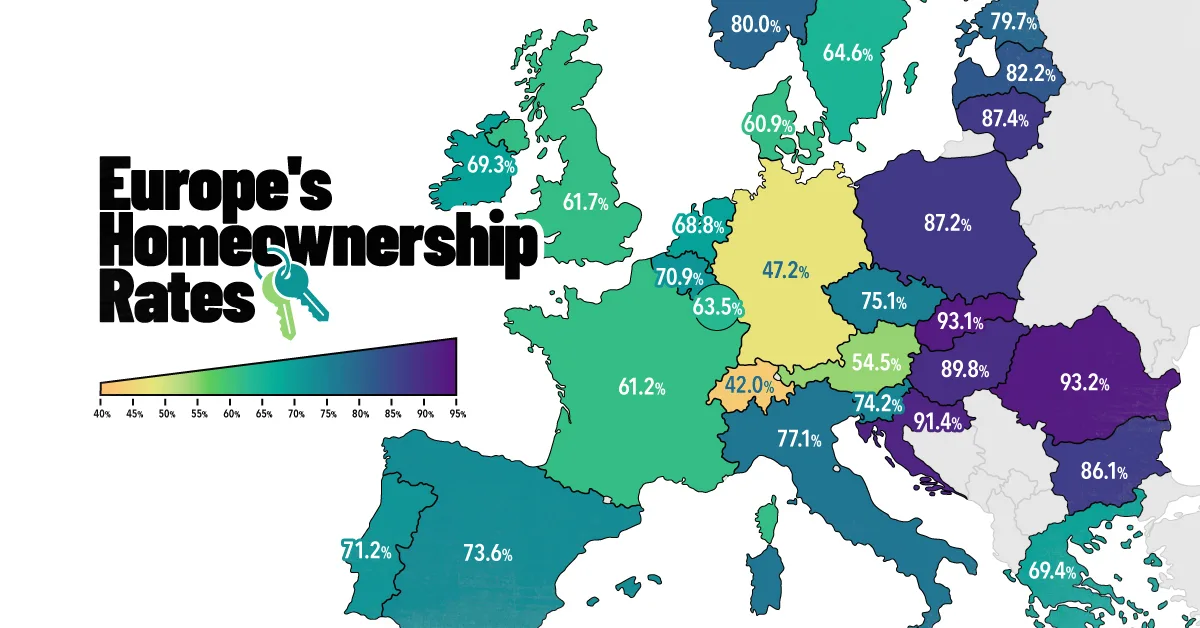
Mapped: Europe’s Homeownership Divide
See visuals like this from many other data creators on our Voronoi app. Download it for free on iOS or Android and discover data-driven charts from a variety of trusted sources.
Key Takeaways
- Homeownership ranges from over 90% in Eastern Europe to under 50% in Germany and Switzerland.
- Some of Europe’s richest countries have the lowest ownership rates.
- Mass privatization in the 1990s created a lasting East–West ownership gap.
Homeownership in Europe shows a stark contrast: in some countries, more than 9 in 10 households own their homes, while in others, fewer than half do.
That gap is not driven by income alone. In fact, some of Europe’s richest economies, like Germany and Switzerland, have the lowest ownership rates, where renting is far more common.
This map uses the latest available data from Eurostat and the UK Parliament to show how homeownership varies across Europe by share of households.
Why this matters: Homeownership is closely tied to wealth building, financial security, and long-term stability. Countries with lower ownership rates often have more developed rental markets, while higher rates can reflect historical policies rather than current affordability.
Europe’s Highest Homeownership Rates
The highest homeownership rates on the Old Continent are found in the eastern half of the European Union, led by Romania (93.2%), Slovakia (93.1%), and Croatia (91.4%).
On average, countries in Central and Eastern Europe have homeownership rates roughly 30% higher than their peers in Western Europe.
The following data table lists European countries alongside their household homeownership rate.
| Rank | Country | Homeownership Rate by share of households (%) |
|---|---|---|
| 1 |  Romania Romania |
93.2 |
| 2 |  Slovakia Slovakia |
93.1 |
| 3 |  Croatia Croatia |
91.4 |
| 4 |  Hungary Hungary |
89.8 |
| 5 |  Lithuania Lithuania |
87.4 |
| 6 |  Poland Poland |
87.2 |
| 7 |  Bulgaria Bulgaria |
86.1 |
| 8 |  Latvia Latvia |
82.2 |
| 9 |  Norway Norway |
80.0 |
| 10 |  Estonia Estonia |
79.7 |
| 11 |  Italy Italy |
77.1 |
| 12 |  Czechia Czechia |
75.1 |
| 13 |  Slovenia Slovenia |
74.2 |
| 14 |  Spain Spain |
73.6 |
| 15 |  Portugal Portugal |
71.2 |
| 16 |  Belgium Belgium |
70.9 |
| 17 |  Greece Greece |
69.4 |
| 18 |  Ireland Ireland |
69.3 |
| 19 |  Cyprus Cyprus |
69.2 |
| 20 |  Netherlands Netherlands |
68.8 |
| 21 |  Malta Malta |
68.1 |
| 22 |  Finland Finland |
66.9 |
| 23 |  Sweden Sweden |
64.6 |
| 24 |  Luxembourg Luxembourg |
63.5 |
| 25 |  UK UK |
61.7 |
| 26 |  France France |
61.2 |
| 27 |  Denmark Denmark |
60.9 |
| 28 |  Austria Austria |
54.5 |
| 29 |  Germany Germany |
47.2 |
| 30 |  Switzerland Switzerland |
42.0 |
| — |  EU EU |
68.4 |
A major driver of Eastern Europe’s high ownership rates is the mass privatization of housing in the 1990s. As governments sold off state-owned apartments, often at steep discounts, millions of residents became homeowners, creating a structural gap with Western Europe that persists today.
Homeownership in Western Europe
In contrast, Western Europe tends to have lower homeownership rates on average, including roughly 61.5% of households in France and the United Kingdom and approximately 68% across the Benelux countries.
In Western Europe, higher home prices and stricter lending standards have made ownership less accessible, especially for younger generations. At the same time, strong tenant protections and stable rental markets make long-term renting a more common and viable alternative.
Meanwhile, dynamic labor markets in major cities have also contributed to the growth of large rental markets, where property owners rent to working professionals and young families.
The Germanic Outliers
Low homeownership rates are most pronounced in the DACH region (Germany, Austria, and Switzerland), where high incomes and strong economies coexist with some of the lowest ownership levels in Europe.
In Switzerland, one of the wealthiest countries in the world, only 42% of households own the home in which they live. Germany similarly sees less than half of households classified as owner-occupiers (47.2%), while neighboring Austria is only slightly higher at 54.5%.
These countries’ low rates relative to the rest of Europe can be partly explained by cultural factors, such as young adults leaving home earlier than in Southern Europe. In addition, the post-socialist transition in places like East Germany followed a different path, with state-owned housing often sold to corporations rather than residents during the 1990s.
Learn More on the Voronoi App 
If you enjoyed today’s post, check out Share of European Households with Children on Voronoi.Use This Visualization