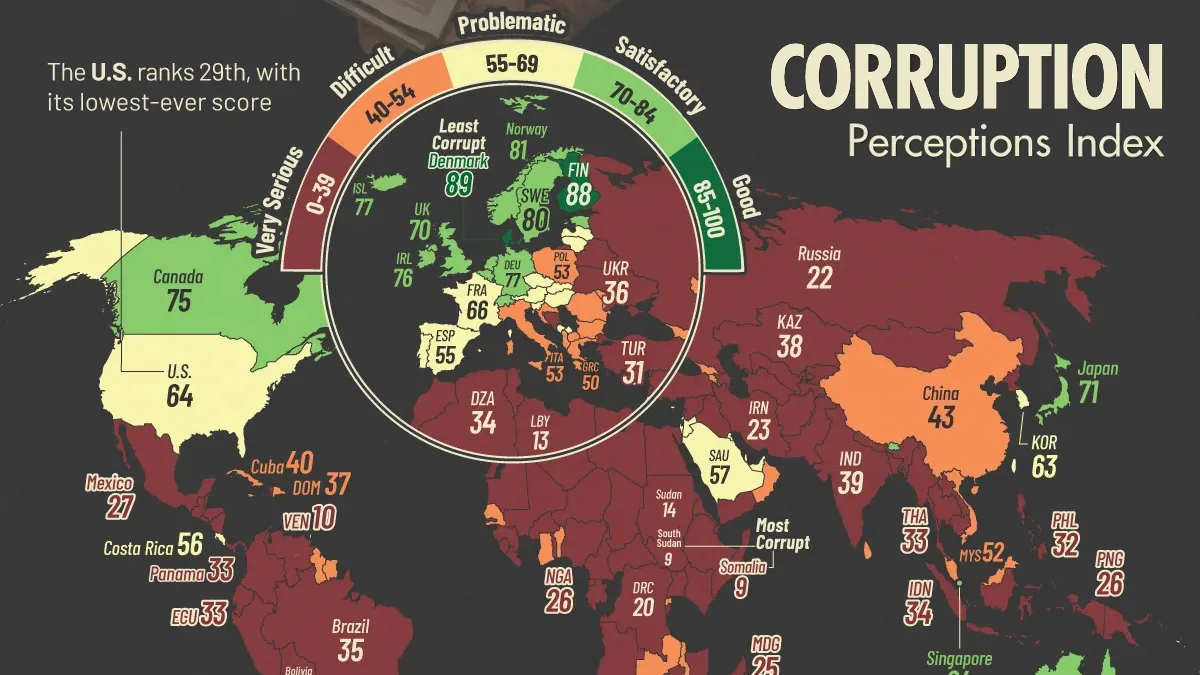
Mapped: The World’s Most and Least Corrupt Countries
See visuals like this from many other data creators on our Voronoi app. Download the app for free on iOS or Android and discover incredible data-driven charts from a variety of trusted sources.
Key Takeaways:
- The global average Corruption Perceptions Index (CPI) score fell to 42 out of 100, the first decline in more than a decade.
- Only five countries now score above 80, down from 12 a decade ago.
- The U.S. ranks 29th with a score of 64, its lowest-ever result in the index.
Corruption perceptions are worsening globally, according to the latest Corruption Perceptions Index (CPI) from Transparency International.
The index scores countries from 0 to 100, with higher scores indicating cleaner perceived public sectors. In 2025, the global average fell to 42, while 122 of 182 countries scored below 50.
This map shows how corruption perceptions compare worldwide, from Denmark’s score of 89 to Somalia’s score of 9.
Fewer Countries Are Considered “Clean”
One of the most striking findings is how rapidly the number of top-performing countries has shrunk. In 2015, 12 countries scored above 80 on the CPI. By 2025, that number had fallen to just five.
This shift suggests that even nations traditionally associated with strong democratic institutions are facing mounting governance pressures. Transparency International points to rising political polarization, weaker institutional trust, and pressure on checks and balances as factors weighing on scores in several advanced economies.
Here’s a look at the global rankings from the latest CPI data:
| Country | CPI Score (2025) |
|---|---|
 Denmark Denmark |
89 |
 Finland Finland |
88 |
 Singapore Singapore |
84 |
 New Zealand New Zealand |
81 |
 Norway Norway |
81 |
 Sweden Sweden |
80 |
 Switzerland Switzerland |
80 |
 Luxembourg Luxembourg |
78 |
 Netherlands Netherlands |
78 |
 Germany Germany |
77 |
 Iceland Iceland |
77 |
 Australia Australia |
76 |
 Estonia Estonia |
76 |
 Hong Kong Hong Kong |
76 |
 Ireland Ireland |
76 |
 Canada Canada |
75 |
 Uruguay Uruguay |
73 |
 Bhutan Bhutan |
71 |
 Japan Japan |
71 |
 United Kingdom United Kingdom |
70 |
 Austria Austria |
69 |
 Belgium Belgium |
69 |
 United Arab Emirates United Arab Emirates |
69 |
 Barbados Barbados |
68 |
 Seychelles Seychelles |
68 |
 Taiwan Taiwan |
68 |
 France France |
66 |
 Lithuania Lithuania |
65 |
 Bahamas Bahamas |
64 |
 United States of America United States of America |
64 |
 Brunei Darussalam Brunei Darussalam |
63 |
 Chile Chile |
63 |
 South Korea South Korea |
63 |
 Saint Vincent and the Grenadines Saint Vincent and the Grenadines |
63 |
 Cabo Verde Cabo Verde |
62 |
 Israel Israel |
62 |
 Dominica Dominica |
60 |
 Latvia Latvia |
60 |
 Czechia Czechia |
59 |
 Saint Lucia Saint Lucia |
59 |
 Botswana Botswana |
58 |
 Qatar Qatar |
58 |
 Rwanda Rwanda |
58 |
 Slovenia Slovenia |
58 |
 Saudi Arabia Saudi Arabia |
57 |
 Costa Rica Costa Rica |
56 |
 Grenada Grenada |
56 |
 Portugal Portugal |
56 |
 Cyprus Cyprus |
55 |
 Fiji Fiji |
55 |
 Spain Spain |
55 |
 Italy Italy |
53 |
 Poland Poland |
53 |
 Malaysia Malaysia |
52 |
 Oman Oman |
52 |
 Bahrain Bahrain |
50 |
 Georgia Georgia |
50 |
 Greece Greece |
50 |
 Jordan Jordan |
50 |
 Malta Malta |
49 |
 Mauritius Mauritius |
48 |
 Slovakia Slovakia |
48 |
 Croatia Croatia |
47 |
 Vanuatu Vanuatu |
47 |
 Armenia Armenia |
46 |
 Kuwait Kuwait |
46 |
 Montenegro Montenegro |
46 |
 Namibia Namibia |
46 |
 Senegal Senegal |
46 |
 Benin Benin |
45 |
 Romania Romania |
45 |
 Sao Tome and Principe Sao Tome and Principe |
45 |
 Jamaica Jamaica |
44 |
 Solomon Islands Solomon Islands |
44 |
 Timor-Leste Timor-Leste |
44 |
 China China |
43 |
 Cote d’Ivoire Cote d’Ivoire |
43 |
 Ghana Ghana |
43 |
 Kosovo Kosovo |
43 |
 Moldova Moldova |
42 |
 South Africa South Africa |
41 |
 Trinidad and Tobago Trinidad and Tobago |
41 |
 Vietnam Vietnam |
41 |
 Bulgaria Bulgaria |
40 |
 Burkina Faso Burkina Faso |
40 |
 Cuba Cuba |
40 |
 Guyana Guyana |
40 |
 Hungary Hungary |
40 |
 North Macedonia North Macedonia |
40 |
 Tanzania Tanzania |
40 |
 Albania Albania |
39 |
 India India |
39 |
 Maldives Maldives |
39 |
 Morocco Morocco |
39 |
 Tunisia Tunisia |
39 |
 Ethiopia Ethiopia |
38 |
 Kazakhstan Kazakhstan |
38 |
 Suriname Suriname |
38 |
 Colombia Colombia |
37 |
 Dominican Republic Dominican Republic |
37 |
 Gambia Gambia |
37 |
 Lesotho Lesotho |
37 |
 Zambia Zambia |
37 |
 Argentina Argentina |
36 |
 Belize Belize |
36 |
 Ukraine Ukraine |
36 |
 Brazil Brazil |
35 |
 Sri Lanka Sri Lanka |
35 |
 Algeria Algeria |
34 |
 Bosnia and Herzegovina Bosnia and Herzegovina |
34 |
 Indonesia Indonesia |
34 |
 Laos Laos |
34 |
 Malawi Malawi |
34 |
 Nepal Nepal |
34 |
 Sierra Leone Sierra Leone |
34 |
 Ecuador Ecuador |
33 |
 Panama Panama |
33 |
 Serbia Serbia |
33 |
 Thailand Thailand |
33 |
 Angola Angola |
32 |
 El Salvador El Salvador |
32 |
 Philippines Philippines |
32 |
 Togo Togo |
32 |
 Belarus Belarus |
31 |
 Djibouti Djibouti |
31 |
 Mongolia Mongolia |
31 |
 Niger Niger |
31 |
 Turkey Turkey |
31 |
 Uzbekistan Uzbekistan |
31 |
 Azerbaijan Azerbaijan |
30 |
 Egypt Egypt |
30 |
 Kenya Kenya |
30 |
 Mauritania Mauritania |
30 |
 Peru Peru |
30 |
 Gabon Gabon |
29 |
 Bolivia Bolivia |
28 |
 Iraq Iraq |
28 |
 Liberia Liberia |
28 |
 Mali Mali |
28 |
 Pakistan Pakistan |
28 |
 Mexico Mexico |
27 |
 Cameroon Cameroon |
26 |
 Guatemala Guatemala |
26 |
 Guinea Guinea |
26 |
 Kyrgyzstan Kyrgyzstan |
26 |
 Nigeria Nigeria |
26 |
 Papua New Guinea Papua New Guinea |
26 |
 Madagascar Madagascar |
25 |
 Uganda Uganda |
25 |
 Bangladesh Bangladesh |
24 |
 Central African Republic Central African Republic |
24 |
 Paraguay Paraguay |
24 |
 Congo Congo |
23 |
 Eswatini Eswatini |
23 |
 Iran Iran |
23 |
 Lebanon Lebanon |
23 |
 Chad Chad |
22 |
 Honduras Honduras |
22 |
 Russia Russia |
22 |
 Zimbabwe Zimbabwe |
22 |
 Guinea Bissau Guinea Bissau |
21 |
 Mozambique Mozambique |
21 |
 Cambodia Cambodia |
20 |
 Comoros Comoros |
20 |
 Democratic Republic of the Congo Democratic Republic of the Congo |
20 |
 Tajikistan Tajikistan |
19 |
 Burundi Burundi |
17 |
 Turkmenistan Turkmenistan |
17 |
 Afghanistan Afghanistan |
16 |
 Haiti Haiti |
16 |
 Myanmar Myanmar |
16 |
 Equatorial Guinea Equatorial Guinea |
15 |
 North Korea North Korea |
15 |
 Syria Syria |
15 |
 Nicaragua Nicaragua |
14 |
 Sudan Sudan |
14 |
 Eritrea Eritrea |
13 |
 Libya Libya |
13 |
 Yemen Yemen |
13 |
 Venezuela Venezuela |
10 |
 Somalia Somalia |
9 |
 South Sudan South Sudan |
9 |
The U.S. is one of the clearest examples of this shift. With a score of 64, it ranks 29th globally and has fallen to its lowest score in the index. The decline reflects growing concerns around transparency and institutional confidence.
Why Corruption Matters Economically
Corruption carries steep economic costs beyond political instability. Research published by the International Monetary Fund has linked corruption to lower investment, weaker economic growth, and reduced government effectiveness.
In many countries, corruption also distorts public spending priorities. Funds intended for infrastructure, health care, education, or climate adaptation can instead be siphoned away through bribery schemes or opaque procurement systems.
The effects are often most severe in lower-income countries, where weaker institutions leave governments more vulnerable to organized crime and state capture.
The Human Cost of Corruption
Beyond economics, corruption also creates significant human risks. Anti-corruption reporting remains especially dangerous in countries with weak governance protections. Since 2012, 150 journalists covering corruption stories outside of war zones have been murdered, with nearly all cases occurring in countries with high corruption levels.
International organizations including the United Nations Office on Drugs and Crime continue to emphasize that fighting corruption requires stronger legal institutions, independent media protections, and cross-border cooperation.
While some countries continue to improve transparency and accountability, the broader global picture suggests corruption remains deeply entrenched and increasingly difficult to reverse.
Learn More on the Voronoi App 
Explore more global governance and public opinion data on Voronoi, including this visualization of Which Countries Are The Most Corrupt?.