Mapped: How Japan Lost Its Economic Dominance in Asia
See visuals like this from many other data creators on our Voronoi app. Download it for free on iOS or Android and discover incredible data-driven charts from a variety of trusted sources.
Key Takeaways
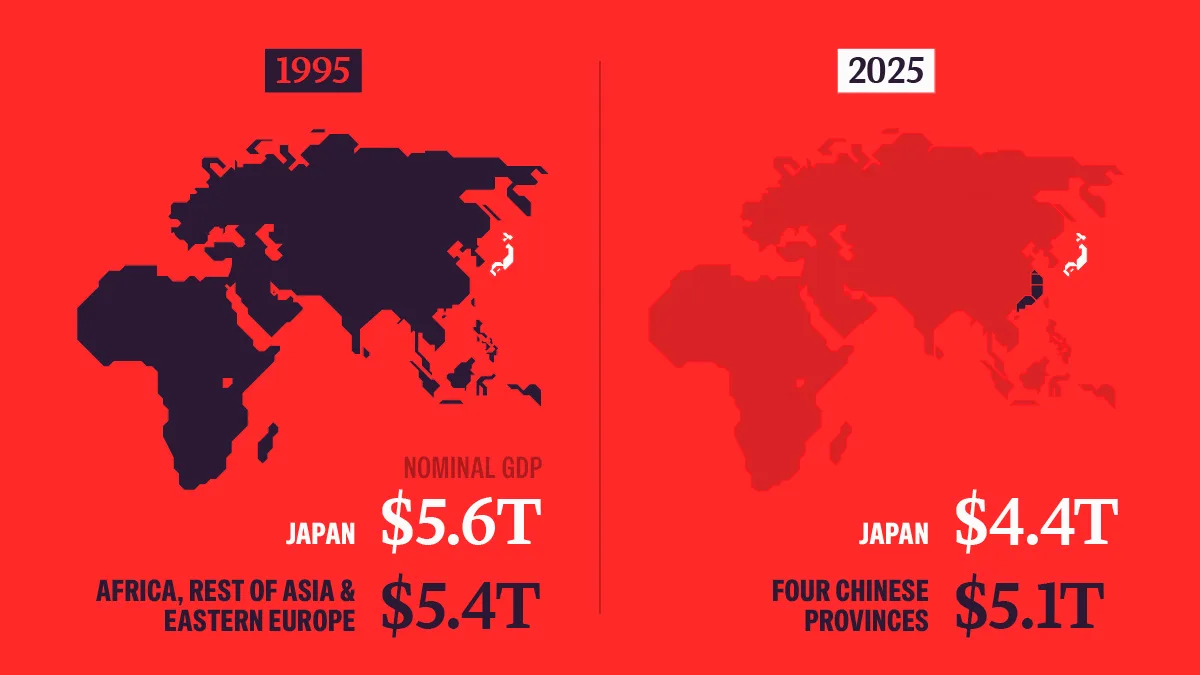
- In 1995, Japan’s economy was larger than the rest of Asia, Africa, and Eastern Europe combined.
- By 2025, the combined economies of four Chinese provincial regions exceeded Japan’s entire GDP.
- The comparison highlights one of the biggest shifts in global economic power over the last 30 years.
The story of modern Asia can be told through a single economic handoff.
For decades, Japan was the region’s dominant economic power and one of the world’s most influential economies. But while Japan’s growth slowed after the collapse of its asset bubble, China embarked on an expansion that reshaped global trade, manufacturing, and investment.
This graphic compares Japan’s nominal GDP in 1995 and 2025, using two striking snapshots to show how the balance of economic power in Asia has changed. National GDP figures come from the International Monetary Fund’s World Economic Outlook (April 2026), while Chinese provincial data comes from official statistical bulletins.
Japan: Big in the 90s
In 1995, the Soviet Union had just collapsed, and Japan was comfortably the world’s second-largest economy by nominal GDP after the United States.
As the first non-Western country to industrialize, Japan had long been the dominant economic power in its region, aided by postwar rebuilding and high-quality, high-value exports coveted around the world. By 1995, Japan’s economy was larger than the rest of Asia, Africa, and Eastern Europe combined.
This data table lists 1995 nominal GDP for Japan and selected global regions.
| Country/Region | 1995 GDP (trillions of USD) |
|---|---|
 Japan Japan |
5.6 |
| Asia (ex. Japan) | 3.9 |
| Eastern Europe | 0.8 |
| Africa | 0.8 |
Japan’s rise was so dramatic that many observers in the 1980s believed it could eventually challenge U.S. economic leadership. Japanese firms dominated industries ranging from consumer electronics to automobiles, while Tokyo became synonymous with corporate and technological excellence.
Washington responded with restrictions on Japanese car and semiconductor exports, as well as the Plaza Accord, which led to a sharp appreciation of the Japanese yen against the U.S. dollar and other currencies. Japan’s policy responses to the Plaza Accord have been cited in part for contributing to the country’s massive asset price bubble of the late 1980s.
Japan’s Decline and the Rise of China
Japan’s economy began to sputter after the collapse of the asset price bubble in 1990, and the following decades have often been referred to as the Lost Decades. During this period, Japan’s nominal GDP fell in part because of a weaker yen, real GDP growth slowed to a crawl, and national debt surged.
Meanwhile, across the East China Sea, another Asian giant emerged. Through its reform and opening-up era, China’s economy grew rapidly throughout the early 21st century, averaging at least 7% growth annually and reshaping global supply chains.
Despite having been an impoverished and underdeveloped country for much of the 20th century, China surpassed Japan in nominal GDP in 2010 and became the world’s second-largest economy.
Japan and the Chinese Century
In 1995, Japan outweighed most of Afro-Eurasia in nominal GDP. By 2025, however, China’s economic boom was visible even at the provincial level.
| Country/Province | 2025 GDP (trillions of USD) |
|---|---|
| Japan |
4.4 |
 Guangdong Guangdong |
2.1 |
| Fujian |
0.8 |
| Zhejiang |
1.4 |
| Shanghai |
0.8 |
China’s economy is a roughly $20 trillion powerhouse as of 2025, nearly five times larger than Japan’s. In fact, Japan’s nominal GDP is smaller than the combined GDP of Shanghai and the Chinese provinces of Fujian, Guangdong, and Zhejiang.
Just as Japan once towered over the rest of Asia, China now stands as the region’s dominant economic power.
Learn More on the Voronoi App 
If you enjoyed today’s post, check out The Rise of China and the Decline of Japan in Global Exports on Voronoi, the new app from Visual Capitalist.