
Privacy and ownership of farm data in artificial intelligence can be complicated, especially when data agreements are involved.
AI systems gain trust with input and participation from producers, but experts say the details around data use and privacy can still be hazy, largely due to unclear data agreements and privacy rules.
Why It Matters
As AI systems become more common in precision agriculture, it will be necessary to understand data ownership through regulations and privacy agreements.
What do we mean by privacy?
The rules AI systems operate under can be vague, sometimes uncomfortably so, says Rozita Dara, a professor of data strategy at the University of Guelph.
“Some farmers, because they have so many years of experience and they’re used to making decisions based on their experience or what they have learned, they don’t like this black box approach,” she said.
Dara’s research includes precision agriculture, data governance and machine learning.
She said she has heard many producers express concerns about farm data becoming compromised. What complicates the issue of privacy is that farm data is generally categorized as business data, which is treated differently than personal data.
“Privacy is all about personal data and compromising individual’s privacy,” Dara said. “And when we say compromising, it could be reputation laws, it could be financial loss, it could be something that negatively has impacted their job, their health, their family members.”
“In the context of agriculture, (that) regulation doesn’t apply,” she said. “In the context of farming, it’s slightly different, because the personal data that’s collected in the context of farming, it’s more of a business data.”
The problem with data agreements
Dara recommended producers pay close attention to data agreements, which she said companies can sometimes use to play dirty tricks with wording.
“Are they sharing (data)?” Dara said. “With whom they are sharing, and for what purpose is the third party agreeing to the original agreement that farmer is signing? Because is there a new agreement that farmer is not aware of? And then how long do they keep the data And then the list can go on.”
Before you sign a farm data agreement, ask:
- Is your data being shared — and if so, with whom?
- For what purpose, and is any third party bound by the original agreement?
- How long is the data kept?
- Can the company keep using your data after the agreement ends?
- Can the agreement change later without notice to you?
Many written agreements may not even include this kind of information.
Another concern is whether companies may keep using farmers’ data after the agreement is terminated.
“Unfortunately, in the majority of the cases, the answer is ‘yes.’”
Dara’s team worked on a study that found data agreements often had users automatically agree to any future changes to the agreement.
“That means they can change the policy, and they don’t need to send you a notice,” she said. “That’s very concerning, because you can go in with an agreement, and the agreement can change over time.”
The issue is not AI
Dara clarified these concerns are with data agreements and shady wording, not AI systems themselves. Systems that use on-farm data can be more reliable and trustworthy.
“AI learns with data,” she said. “The more diverse data you have, it learns better. The more data you collect from different farms, it becomes more accurate. So, I don’t want to blame AI.”
Artificial intelligence, after all, is only as intelligent as the data it draws from.
“AI is not magic; AI is not the Terminator movie that we have seen that’s smart on its own,” she said. “AI could be extremely dumb.”
Dara says she hears many producers say they think their data is valuable. This is true, but data on its own doesn’t have much value other than to the owner.
Why AI tools need farm data
Mohsen Yoosefzadeh Najafabadi, an Ontario Agricultural College dry bean breeder, developed a predictive AI tool called BeanGPT. The inputs for the system involved direct information from farmers, including data points on planting, weather, and plant growth going all the way back to the 1980s.
Najafabadi said a program like BeanGPT could theoretically work without input from farmers and draw purely on academia, but it would not be nearly as effective.
In other words, AI tools for farmers only work well if farmers contribute data.
For those skeptical of where their data is going, Najafabadi said the results can speak for themselves.
“In terms of applicability, and you don’t think that it’s good, test it,” he said. “If it does not work, throw it out. If it works, adopt it. There is no cost.”
Dara said systems are more reliable when farmers are using their own data and understanding where the inputs are coming from.
“If farmers are asked to provide the information, at least farmers know what goes into the system,” she said.
Mohamad Yaghi, vice-president of Farm Credit Canada’s Innovation Hub, said the purpose of AI tools driven by farm data is always to make better use of information that would be impossible without them.
“To actually start utilizing more advanced tools, you need to actually track what you’re doing digitally first in order to really see the benefits of, let’s say, more sophisticated artificial intelligence solutions in the future,” Yaghi said.
Yaghi, who recently appeared before the Senate Committee on Human Rights, said he thought too much rigidity in the application of AI tools could hinder their potential for productivity.
“While we do need a sandbox to operate in, we shouldn’t put the sandbox too small so that we’re not able to see the possibilities of what we’re able to build in the future.”
He added many farmers are already using AI, even if they don’t realize it.
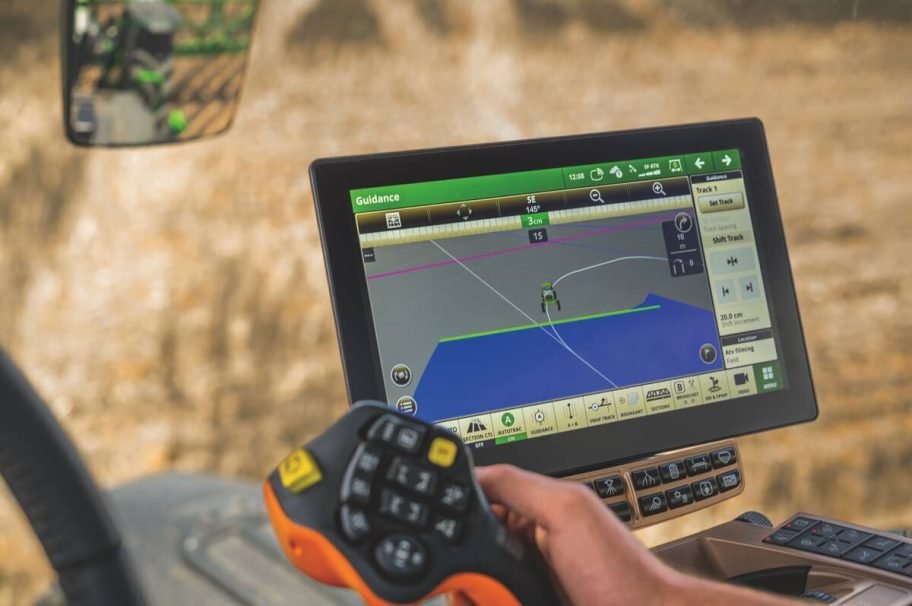
“Let’s say, see-and-spray technology that is used today. That’s a direct application of neural networks looking at images in real time to detect the right spray amount,” he said, adding, the most useful results will always come from data generated on the same farm the tools are being used on.
The post With AI in the field, farm data privacy comes down to the fine print appeared first on Farmtario.


