

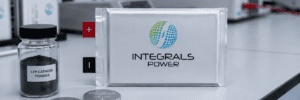
Integrals Power has begun external cell testing of its lithium iron phosphate (LFP) cathode active material at the University of St Andrews, and the company reports specific capacity above 153 mAh/g. The Milton Keynes company says that figure puts its UK-made cathode on par with the Chinese LFP material that dominates the market.
The program tests Integrals Power’s iron phosphate precursor, the feedstock for its LFP cathode, inside working cells rather than only at the material level. St Andrews assembles early-stage cell prototypes that pair the company’s LFP cathode with standard commercial anodes and a liquid electrolyte. The cells are run through hundreds of charge-discharge cycles, and the testing focuses on capacity retention, rate capability and long-term cycling stability.
LFP’s theoretical specific capacity is around 170 mAh/g, and commercial material works close to that ceiling. A measured result above 153 mAh/g places Integrals Power’s cathode within the competitive band, and the company says it reaches that level without a cost premium over Chinese material. Integrals Power produces the cathode at a UK pilot plant in Milton Keynes, and says it sources raw materials exclusively from European and North American suppliers.
Chinese manufacturers account for roughly 90% of global LFP production, by Integrals Power’s estimate. As Western governments and automakers look to cut their dependence on Chinese battery supply chains, independent validation of domestically produced materials has become a prerequisite for commercial adoption. Running the tests in an academic setting, the company says, gives the data the impartial weight customers and partners need for procurement and qualification decisions, and provides the foundational dataset for later scale-up to larger multi-layer pouch or prismatic cells.
“The battery industry has long been told that matching Chinese LFP performance from a Western supply chain is an ambition rather than a reality,” said Behnam Hormozi, founder and CEO of Integrals Power. “This collaboration with the University of St Andrews is about converting that ambition into independently verified evidence. Cell testing is the foundation on which commercial confidence is built.”
Source: Integrals Power


