

A rooftop solar system can reduce the electricity you buy from the grid, but the installation cost is paid upfront unless you use finance. A solar loan spreads that cost across monthly EMIs. The right loan is not necessarily the one with the lowest headline rate: fees, margin money, insurance, subsidy adjustment, rate type and tenure all affect what you finally repay.
As of 31 August 2026, the Government of India says eligible PM Surya Ghar borrowers can access collateral-free loans from nationalized banks at repo rate plus 50 basis points, currently 5.75% per year, for up to 10 years. Individual lender terms still vary, especially for loans above Rs 2 lakh.
Direct answer. The lowest clearly verified starting solar-loan rate in the reviewed official sources is 5.75% per year. SBI lists 5.75% for loans up to Rs 2 lakh and 7.90% for loans above Rs 2 lakh and up to Rs 6 lakh. Bank of India also advertises rates starting at 5.75%. Rates are floating or eligibility-dependent, so verify the final sanction letter before accepting a loan.
Quick Takeaways
- The current PM Surya Ghar reference rate for eligible loans from nationalized banks is 5.75% per year, according to a 28 July 2026 government release. [1]
- SBI publicly lists two slabs: 5.75% up to Rs 2 lakh and 7.90% above Rs 2 lakh up to Rs 6 lakh. [2]
- A longer tenure lowers the EMI but increases total interest. On a Rs 2 lakh loan at 7%, extending repayment from five to ten years cuts the estimated EMI from Rs 3,960 to Rs 2,322 but more than doubles total interest.
- The PM Surya Ghar subsidy and the loan are separate. CFA is Rs 30,000 for 1 kW, Rs 60,000 for 2 kW and capped at Rs 78,000 for 3 kW or more, subject to scheme rules. [2][5][6]
- “Collateral-free” generally means no separate property collateral; the financed solar equipment may still be hypothecated to the bank.
- Compare the annual rate, processing fee, margin, insurance, prepayment rules and subsidy treatment before choosing a lender.
What Is a Solar Loan?
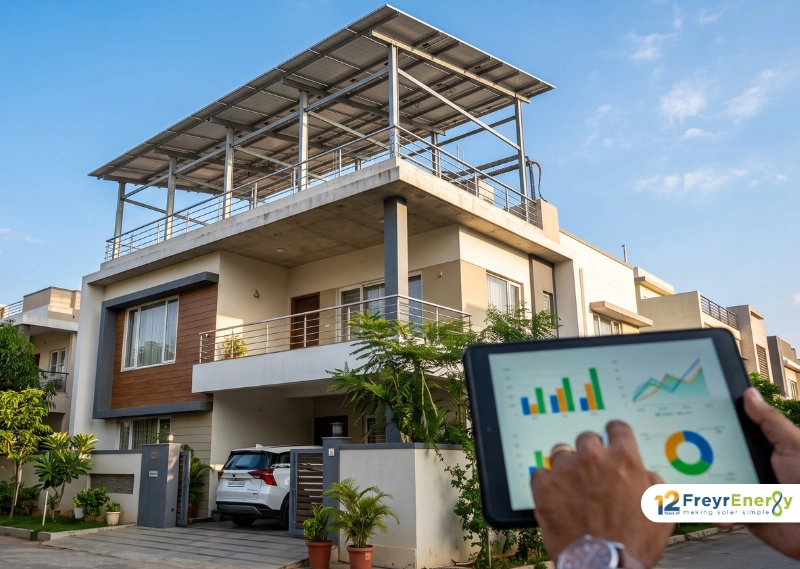
A solar loan is financing used to purchase and install a solar power system. Instead of paying the full project cost upfront, the borrower repays the sanctioned amount plus interest through equated monthly instalments, or EMIs.
Residential rooftop-solar loans may be offered as dedicated PM Surya Ghar products, home-loan-linked products or general green-energy loans. NBFC and personal-loan routes may also be available, but their price and underwriting can differ from a government-linked bank product.
Solar Loan Interest Rates In India In 2026
The table below includes only figures supported by an accessible official government or lender page. Rates and benchmarks can change after publication. “Starting from” does not mean every borrower will receive that rate.
| Lender | Published rate | Loan amount | Tenure | Important conditions |
| SBI | 5.75% up to Rs 2 lakh; 7.90% above Rs 2 lakh to Rs 6 lakh | Up to Rs 6 lakh | Up to 120 months | Floating; 10% margin; nil processing and prepayment charges on the scheme page. [2] |
| Bank of India | Starting at 5.75% | Individuals: up to Rs 6 lakh | Up to 120 months | Daily reducing balance; 5% individual margin; nil processing and prepayment charges. [3] |
| Indian Overseas Bank | 7% up to Rs 2 lakh; above Rs 2 lakh, 13% fixed for IOB Surya or housing-loan rate by rating for IOB HL Surya | Individuals: up to Rs 20 lakh | Up to 120 months | Official page updated 24 Aug 2026; no collateral for rooftop solar up to 10 kW, but equipment is hypothecated. [4] |
| Punjab National Bank | Up to Rs 2 lakh: repo rate + 0.50%; confirm the live numeric rate. Higher slab varies by credit score and home-loan relationship. | Up to Rs 6 lakh | Up to 10 years | Public page is dated 30 Jul 2025 and displays an older benchmark example; verify before publication or application. [5] |
| Canara Bank / Bank of Baroda | Current rate not confirmed from an accessible, current official product page during this review | Product-dependent | Product-dependent | Request the current product sheet and sanction terms. Do not rely on a comparison blog alone. |
Source note: rates verified on 31 August 2026 from government and lender pages [1]-[5]. The comparison is editorial information, not a loan offer. Confirm the current benchmark, spread and charges directly with the lender.
How To Read The Rate Table
Floating Versus Fixed Rate
A floating rate can change when the lender’s external benchmark or spread changes. That can alter the EMI, the remaining tenure or both. A fixed rate is stable for the stated period, but it may start higher. Ask the bank exactly what can change and when.
Interest Rate Versus Total Borrowing Cost
The advertised interest rate is only one cost. Add processing fees, documentation charges, insurance, taxes on fees and any prepayment cost. Compare the total amount repayable under the same loan amount and tenure.
Collateral-Free Does Not Always Mean No Security
PM Surya Ghar loans may not require separate property collateral for the eligible small-loan slab. However, a bank can take hypothecation over the solar equipment financed by the loan. Read the security clause in the sanction letter.
Solar Loan EMI Calculation
EMI depends on the principal, monthly interest rate and number of instalments. For a reducing-balance loan, the standard formula is: EMI = P x r x (1 + r)^n / ((1 + r)^n – 1), where P is the loan principal, r is the monthly interest rate and n is the number of monthly payments.
Example: a Rs 2 lakh loan at 7% for five years has an estimated EMI of Rs 3,960. Total interest is about Rs 37,614, excluding fees and insurance.
| Tenure at 7% | Estimated EMI | Estimated total interest | Trade-off |
| 5 years | Rs 3,960 | Rs 37,614 | Higher EMI; lower total interest |
| 7 years | Rs 3,019 | Rs 53,557 | Middle ground |
| 10 years | Rs 2,322 | Rs 78,660 | Lower EMI; much higher total interest |
Calculation assumptions: Rs 2,00,000 principal, 7% annual reducing-balance rate, monthly instalments and no fees, insurance or rate changes. Figures are rounded and illustrative.
How Much Solar Loan Can You Get?

There is no universal amount. The bank considers the project cost, system capacity, your margin contribution, income, credit profile and scheme limits. SBI and PNB list up to Rs 2 lakh for rooftop systems up to 3 kW and up to Rs 6 lakh for systems above 3 kW and up to 10 kW. [2][5]
Bank of India lists up to Rs 6 lakh for individual borrowers, while IOB’s current page lists up to Rs 20 lakh for individuals under its broader IOB Surya scheme. These products are not identical, so compare purpose, eligible capacity and security rather than only the maximum amount. [3][4]
PM Surya Ghar Loan And Subsidy: How They Work Together
Eligible residential households can use both a solar loan and PM Surya Ghar central financial assistance. The subsidy is not a zero-interest loan and it is not a lender discount.
| Eligible residential capacity | Central financial assistance |
| 1 kW solar panel | Rs 30,000 |
| 2 kW solar panel | Rs 60,000 |
| 3 kW solar panel or more | Rs 78,000 maximum |
The amount is subject to current scheme rules, system eligibility, installation and verification. [2][5][6]
Important. Do not assume the subsidy will be handed to you as unrestricted cash or reduce the sanctioned loan immediately. SBI and PNB instruct borrowers to provide the loan account for subsidy credit, and IOB states that the subsidy is adjusted to the loan account. Confirm the exact treatment with your lender before deciding the principal or tenure. [2][4][5]
Solar Loan Eligibility
Basic PM Surya Ghar eligibility includes Indian citizenship, ownership of a home with a suitable roof, a valid electricity connection and no prior solar-panel subsidy for the household under the applicable condition. [6]
Loan approval is a separate decision. A lender may assess:
- age and repayment period at loan maturity;
- ownership or rooftop rights;
- credit history and any default or write-off;
- income and repayment capacity, especially above Rs 2 lakh;
- margin contribution and bank-account relationship;
- vendor quotation, site feasibility and portal registration.
For example, SBI states that there is no minimum CIBIL score for loans up to Rs 2 lakh, while loans above Rs 2 lakh require a minimum score of 650; applicants with a default or write-off are not considered. SBI also requires a savings account. These are SBI terms, not universal eligibility rules. [2]
Documents Commonly Required for solar loan
- KYC and address documents;
- PAN where required by the loan slab;
- Latest electricity-bill details;
- Proof of rooftop rights or property ownership;
- Bank statements, salary slips, Form 16 or income-tax returns for applicable slabs;
- Vendor quotation or invoice, site-feasibility report and vendor-customer agreement;
- Loan application and portal-generated records.
The exact list varies by lender. SBI, PNB and IOB publish different documentation rules by loan size and borrower type. [2][4][5]
How To Apply For A PM Surya Ghar Solar Loan
- Register the household and electricity connection on the official PM Surya Ghar portal. [7]
- Check DISCOM feasibility and select an eligible registered vendor through the applicable portal journey.
- Obtain a detailed quotation showing system capacity, equipment, installation scope and project cost.
- Compare lenders using the same principal and tenure. Check rate type, spread, margin, fees, insurance, prepayment and subsidy treatment.
- Apply through JanSamarth or the lender’s specified channel and submit the requested documents. [8]
- Review the sanction letter before accepting. Confirm where the lender will disburse funds and how subsidy credit will affect the loan.
- Complete installation, DISCOM inspection, commissioning and the subsidy claim under the current government process.
Solar Loan Versus Personal Loan
| Factor | Dedicated solar loan | Personal loan |
| Purpose | Dedicated rooftop-solar installation | General-purpose borrowing |
| Rate | May use concessional, benchmark-linked scheme pricing | Usually based on the lender’s personal-loan pricing and borrower profile |
| Tenure | Can extend up to 10 years on reviewed PM Surya Ghar products | Often shorter, depending on lender |
| Project checks | May require registered vendor, feasibility and portal documentation | Usually does not use the PM Surya Ghar lender workflow |
| Best use | First route to compare for an eligible residential rooftop system | Fallback when dedicated finance is unavailable or unsuitable |
Do not assume that a personal loan blocks subsidy eligibility; subsidy depends on the government scheme and installation process. However, the lender workflow and how subsidy proceeds are treated can differ. Confirm both sides before borrowing.
How To Choose The Best Solar Loan

- Ask for the effective rate and whether it is fixed or floating.
- Compare total repayment, not just EMI or the starting rate.
- Check margin money and whether the subsidy changes the outstanding principal or tenure.
- Add processing, documentation, insurance and tax costs.
- Read prepayment and foreclosure terms; early repayment can materially reduce interest.
- Confirm vendor and system eligibility before paying a non-refundable amount.
- Keep an emergency buffer. Electricity savings vary with consumption, generation, tariffs and net-metering treatment, while EMI is contractual.
Is A Solar Loan Worth It?
A solar loan can be sensible when the system is appropriately sized, the roof is suitable, the quotation is competitive and the repayment fits comfortably within the household budget. It is risky to justify a loan only by assuming that the EMI will always be lower than the electricity saving.
Use a conservative test: compare the EMI with expected savings after allowing for seasonal generation, consumption changes, lender charges and maintenance. Then check whether you can still pay the EMI during months when solar output or household use is lower than expected.
How Freyr Energy Can Support The Financing Journey
A reliable quotation and site assessment come before the loan comparison. Freyr Energy provides customized solar design, a detailed project report, 3D preview and shadow analysis. Eligible customers can explore financing options through available partners, subject to lender assessment and current terms. Freyr Energy does not determine government subsidy approval or bank-loan approval.
Use the Freyr Energy solar calculator to estimate system size and project economics, then review the guides to banks offering PM Surya Ghar solar loans and solar loan versus solar subsidy before discussing the current financing options for your project.
Conclusion
Solar loan interest rates in India in 2026 start at a verified 5.75% for eligible PM Surya Ghar-linked borrowing in the reviewed official sources, but that number is only the beginning of the decision. The loan slab, benchmark, credit profile, margin, fees, insurance, subsidy treatment and tenure determine the real cost.
Start with a suitable rooftop-solar design and a detailed quotation. Compare at least two lenders using the same principal and tenure, calculate total interest, and read the sanction letter before accepting. A well-structured loan can make rooftop solar affordable; an overly long or poorly understood loan can absorb much of the expected saving.


