How Much Pay Do Workers Actually Take Home?
Key Takeaways:
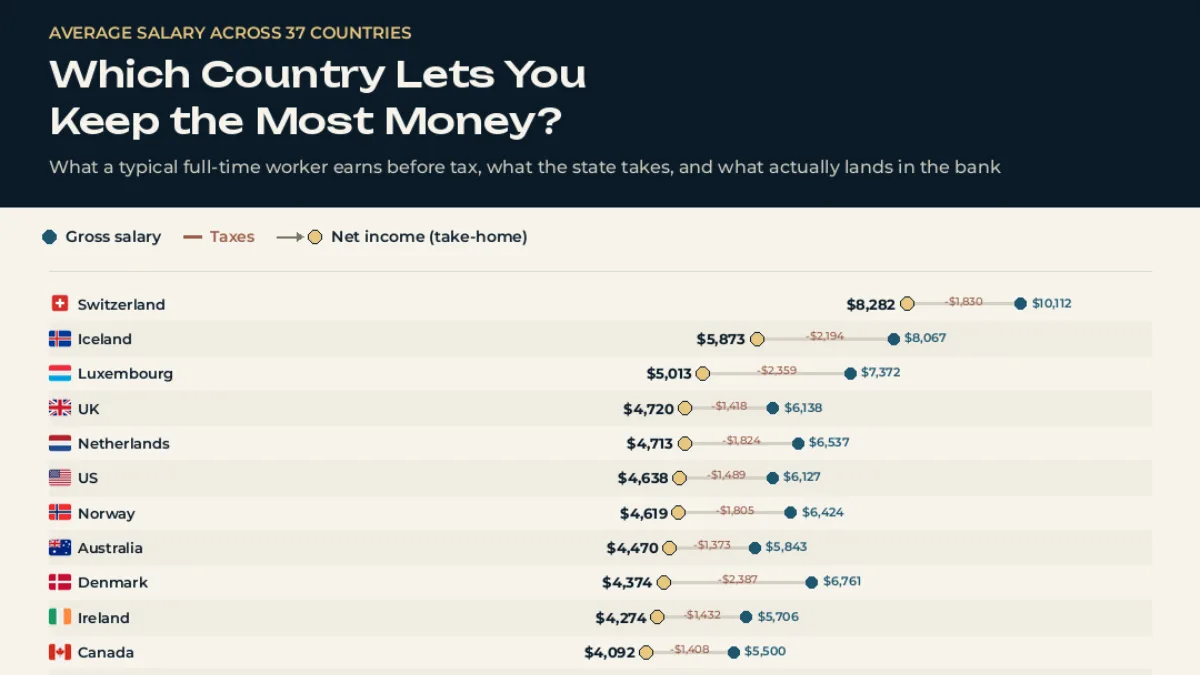
- Switzerland leads the ranking with $8,282 in monthly take-home pay, from a gross salary of $10,112.
- Germany has one of the largest deductions in the dataset at $2,444 per month, leaving workers with $3,872.
- Monthly take-home pay ranges from $8,282 in Switzerland to $649 in Colombia, a nearly 13-fold difference.
A paycheck can look very different depending on where you live.
Using OECD 2025 average wage data, Valerii Emelianov compares gross monthly salaries, deductions, and estimated take-home pay across 37 countries, with figures converted to U.S. dollars at market exchange rates.
The Countries With the Highest Take-Home Pay
The table below ranks monthly earnings and deductions using OECD wage data and Emelianov’s calculations.
| Country | Net Income (Monthly USD) | Gross Salary (Monthly USD) | Taxes (Monthly USD) |
|---|---|---|---|
 Switzerland Switzerland |
8,282 | 10,112 | 1,830 |
 Iceland Iceland |
5,873 | 8,067 | 2,194 |
 Luxembourg Luxembourg |
5,013 | 7,372 | 2,359 |
 UK UK |
4,720 | 6,138 | 1,418 |
 Netherlands Netherlands |
4,713 | 6,537 | 1,824 |
 US US |
4,638 | 6,127 | 1,489 |
 Norway Norway |
4,619 | 6,424 | 1,805 |
 Australia Australia |
4,470 | 5,843 | 1,373 |
 Denmark Denmark |
4,374 | 6,761 | 2,387 |
 Ireland Ireland |
4,274 | 5,706 | 1,432 |
 Canada Canada |
4,092 | 5,500 | 1,408 |
 Austria Austria |
4,030 | 5,971 | 1,941 |
 Israel Israel |
3,980 | 5,063 | 1,084 |
 Germany Germany |
3,872 | 6,316 | 2,444 |
 Sweden Sweden |
3,659 | 4,727 | 1,068 |
 Finland Finland |
3,640 | 5,252 | 1,612 |
 Belgium Belgium |
3,572 | 5,904 | 2,332 |
 New Zealand New Zealand |
3,188 | 4,025 | 837 |
 France France |
3,134 | 4,353 | 1,219 |
 South Korea South Korea |
2,776 | 3,325 | 549 |
 Italy Italy |
2,474 | 3,465 | 991 |
 Japan Japan |
2,458 | 3,176 | 718 |
 Spain Spain |
2,367 | 3,095 | 727 |
 Estonia Estonia |
1,862 | 2,425 | 562 |
 Greece Greece |
1,859 | 2,515 | 657 |
 Slovenia Slovenia |
1,821 | 2,854 | 1,033 |
 Poland Poland |
1,771 | 2,343 | 572 |
 Czechia Czechia |
1,753 | 2,227 | 474 |
 Portugal Portugal |
1,725 | 2,297 | 572 |
 Lithuania Lithuania |
1,653 | 2,696 | 1,044 |
 Costa Rica Costa Rica |
1,544 | 1,712 | 168 |
 Latvia Latvia |
1,494 | 2,019 | 525 |
 Slovakia Slovakia |
1,404 | 1,855 | 451 |
 Hungary Hungary |
1,327 | 1,995 | 668 |
 Turkiye Turkiye |
1,244 | 1,760 | 516 |
 Mexico Mexico |
795 | 915 | 121 |
 Colombia Colombia |
649 | 649 | 0 |
Switzerland stands well ahead at the top, with monthly take-home pay more than $2,400 higher than second-place Iceland. Luxembourg ranks third at $5,013, while the UK, Netherlands, and U.S. round out the next three spots.
Why Do Taxes Differ So Much?
The deduction shown in the graphic is the difference between gross and net pay, while the OECD’s broader tax wedge also includes employer social security contributions. In 2025, the OECD average tax wedge for a single worker earning the average wage was 35.1%, ranging from 52.5% in Belgium to 0% in Colombia.
Tax burdens reflect different mixes of income tax and social insurance, along with choices about public services and transfers. These differences also help explain why tax revenue as a share of GDP varies substantially between countries.
Why Are Salaries Much Lower in Some Countries?
Nominal wages depend on productivity, economic structure, labor market conditions, and exchange rates. The OECD’s measure of low and high pay also shows how wage distributions differ across economies.
Importantly, the comparisons in the graphic and table above are based on nominal incomes converted into U.S. dollars and do not adjust for purchasing power. Exchange rates and differences in local living costs can significantly affect how far a paycheck goes.
Learn More on the Voronoi App
Explore more wage comparisons in Average Annual Wages in OECD Countries.