
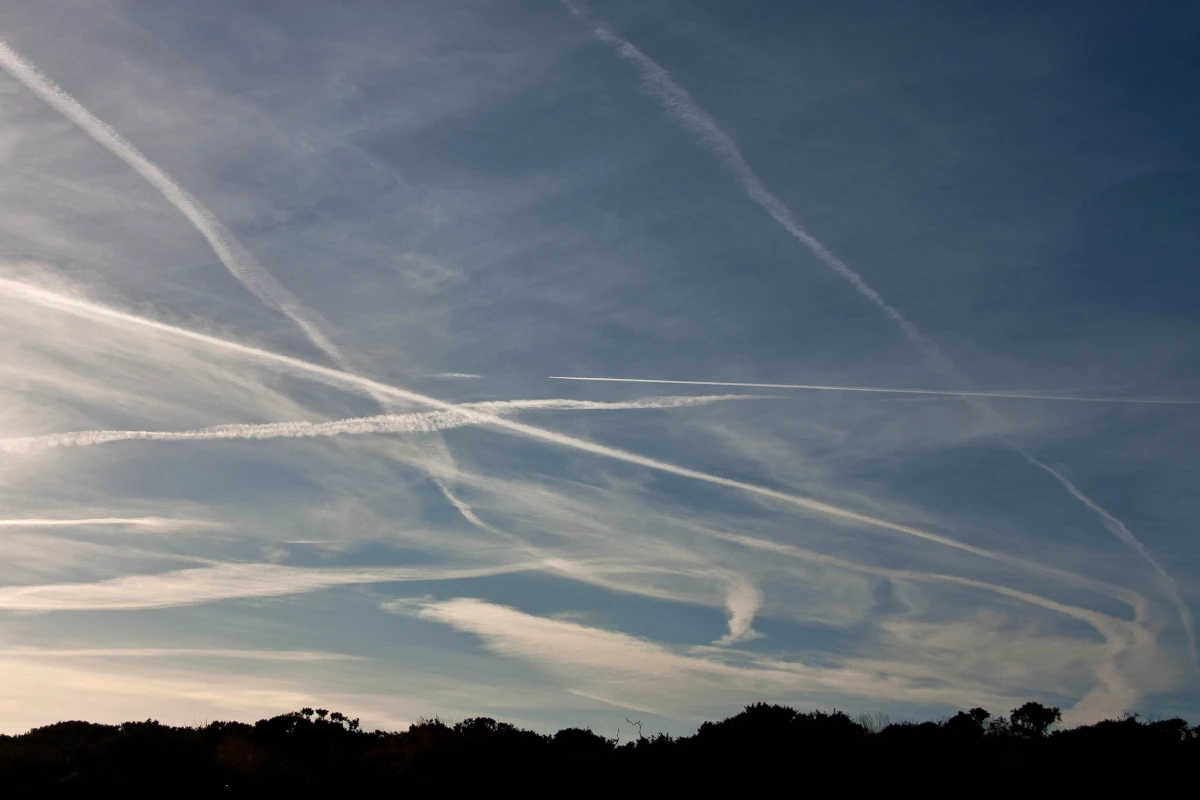
Targeted changes to aircraft flight paths to prevent warming contrails could effectively delay aviation-related global warming by around a decade, according to a new scientific review commissioned by campaign group Transport & Environment (T&E).1
The study, produced by Klima Consulting, estimates that contrail mitigation introduced from 2030 and scaled up to achieve a 50% reduction in contrail warming by 2040 could avoid around 0.025°C of global temperature rise by 2050 and 0.049°C by 2070.2
Under one of the aviation scenarios modelled, the temperature increase attributable to aviation that would otherwise be reached in 2048 would not be reached until 2061. The researchers describe this as postponing aviation-induced temperature increases by “on the order of a decade”.3
The report, Defining a way forward for the science and technology of contrail mitigation, was written by Klima Consulting. It reviews current understanding of contrail formation and climate effects and identifies research and technological priorities for deploying avoidance measures at scale.4
Contrails form when water vapour in aircraft exhaust mixes with sufficiently cold and humid air at altitude. Some disappear quickly, while persistent contrails can spread to form contrail-induced cirrus clouds, which affect the Earth’s radiation balance.5
Although these clouds reflect some incoming solar radiation, producing a cooling effect, they also trap outgoing terrestrial heat. Overall, persistent contrails and contrail-induced cirrus are considered to exert a net warming effect.6
The report says the radiative forcing associated with contrails and contrail-induced cirrus is comparable in magnitude to that caused by aviation’s accumulated CO₂ emissions. Unlike CO₂, however, contrails are short-lived, meaning reductions could produce climate benefits relatively quickly.7
Their warming effect is also highly concentrated. An estimated 2–3% of flights are responsible for around 80% of contrail warming globally, suggesting that mitigation could focus on a relatively small proportion of aircraft movements rather than requiring changes to every flight.8
One approach involves adjusting the altitude or route of aircraft predicted to encounter ice-supersaturated regions in which persistent contrails are likely to develop. The researchers note that the additional fuel consumption caused by rerouting can be around 1% for an individual flight and is generally small compared with the estimated climate benefit of avoiding a strongly warming contrail.9
Evidence that such interventions can work under normal airline operations is growing. A trial involving 2,400 transatlantic flights operated by American Airlines found a 62% lower contrail formation rate among 112 flights that successfully followed avoidance plans compared with a control group. The study found no statistically significant difference in fuel use between the groups.10
More recently, Air France reported results from a trial covering nearly 4,300 commercial flights over the North Atlantic between February and April. Of 245 flights identified as having a high potential climate impact, 130 were rerouted. Air France said the changes reduced contrail-related climate impact across the trial by 8%, with 3% of flights accounting for 25% of the contrail impact observed.11
Larger-scale testing is also planned. The UK-backed Operation Blue Skies programme will test coordinated contrail avoidance in the Shanwick Oceanic airspace over the eastern North Atlantic during the winters of 2026/27 and 2027/28. Around 10,000 flights are expected to pass through the airspace during trial hours each year, with selected aircraft making small deviations to avoid conditions associated with strongly warming contrails.12
The Klima report nevertheless identifies significant uncertainties that need to be addressed before mitigation can be deployed widely. These include the radiative impact of contrails, interactions between overlapping contrails, atmospheric adjustments and the ability of weather models to forecast the vertical location of ice-supersaturated regions accurately.13
It recommends large-scale trials involving thousands of flights and lasting at least a year, alongside improved numerical weather prediction, greater use of open-access contrail datasets and investigation of permanently installed humidity sensors on commercial aircraft. It also proposes developing a “digital twin” capable of simulating and verifying the climate effects of avoidance measures.14
The researchers also stress that contrail avoidance is not an alternative to reducing aviation’s CO₂ emissions. Because contrails are short-lived, the temperature benefit from avoiding them persists only while mitigation continues; sustained reductions in CO₂ are therefore required to address aviation’s longer-term climate impact.15
T&E said the findings indicate that the science is sufficiently mature for carefully designed mitigation to proceed, while further research focuses on uncertainties that could materially affect its effectiveness.16
Notes
[1] Transport & Environment, “Tackling contrails could avoid 10 years of aviation-related climate warming – new research”, 22 September 2026. T&E article; [2] Olivier Boucher, Audran Borella, Grégoire Dannet and Matteo Mirolo, Defining a way forward for the science and technology of contrail mitigation, Klima Consulting, May 2026, p. 16; [3] Boucher et al., Defining a way forward, p. 17; [4] Ibid; [5] Ibid; [6] Ibid; [7] Ibid; [8] Ibid; [9] Ibid; [10] Sankar, T. et al., “Efficacy of Scalable Airline-led Contrail Avoidance”, Journal of Environmentally Compatible Air Transport System, 2026 (to appear). The trial found a 62.0% lower contrail formation rate among 112 per-protocol flights and no statistically significant difference in fuel use. Google Research publication page; [11] Air France, “Research: Air France shares the results of a large-scale testing program aimed at better understanding and reducing the impact of contrails”, 17 September 2026. Air France announcement; [12] Met Office, “Operation Blue Skies: advancing weather intelligence for aviation”, 18 August 2026; Google, “Operation Blue Skies: Reducing aviation climate impact with AI”, 18 August 2026. Met Office account of Operation Blue Skies Google account of Operation Blue Skies; [13] Boucher et al., Defining a way forward; [14] Ibid; [15] Ibid; [16] Transport & Environment, “A way forward for contrail mitigation”, 22 September 2026.


