
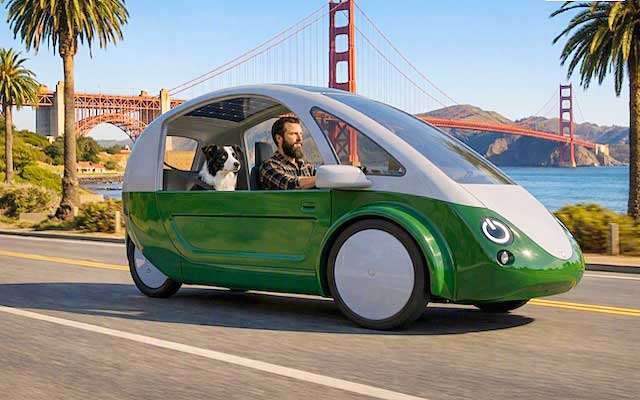
In a world where electric vehicles are growing larger and heavier, one North Carolina company is heading in the opposite direction. Organic Transit, the Durham-based manufacturer behind the world’s first commercially produced solar vehicle, has returned with a third-generation velomobile designed to replace short car trips with something radically more efficient: a three-wheeled, solar-charged, pedal-assisted pod called the ELF 3.0.
A Track Record of Efficiency
The original ELF (which stands for Electric, Light, Fun) launched in 2012 and went on to become a cult classic in the micromobility world. Over its production run, Organic Transit shipped more than 850 units to all 50 U.S. states and 15 countries, accumulating over 10 million miles of real-world use. The company reports zero serious injuries across 25+ documented accidents, including truck collisions, and zero frame failures, a safety record that any vehicle manufacturer would envy.
Now, after a pause in production due to a change in ownership, the original creators are back. Founder Rob Cotter, a former Porsche and BMW race car technician who served as VP of the International Human Powered Vehicle Association, has reimagined the ELF for a new era of urban mobility.
Designed for the 50% of Trips We Actually Take
The ELF 3.0’s design philosophy rests on a simple observation: half of all car trips in the United States are under three miles. Using a two-ton vehicle for these short journeys is absurdly inefficient. The ELF 3.0 targets that gap directly offering weather protection, cargo capacity, and passenger space without the weight, cost, and regulatory burden of a conventional automobile.
The vehicle is legally classified as a bicycle, meaning no license, registration, or insurance is required. Yet it offers features that bicycle commuters can only dream of: a weather-protective shell, a recumbent seat, cargo space for a week of groceries, and the ability to carry a passenger.
Technical Specifications That Impress
The ELF 3.0 represents a significant upgrade over its predecessors. The solar roof now generates up to 400 watts at peak, double the capacity of earlier models. This solar array can add approximately 30 kilometers of range per day when parked in the sun.
The powertrain combines a 750-watt electric motor with pedal power and a 48V, 30Ah battery pack (approximately 1.4 kWh). The result is a claimed range of up to 322 kilometers per charge, a figure that would have seemed impossible for a vehicle in this class just a few years ago. A full charge takes about 2.5 hours from a standard outlet, with 80% capacity achievable in just 45 minutes.
Top speed varies depending on classification. In electric-assist mode, the vehicle can reach approximately 32 km/h. With pedal power combined, speeds up to 48 km/h are possible depending on regulatory classification. The programmable drivetrain allows the ELF 3.0 to be configured as different vehicle classes from a standard e-bike to a neighborhood electric vehicle, making it adaptable to varying regulations across jurisdictions.
Comfort and Practicality for Everyday Use
Perhaps the most significant upgrade in the 3.0 is the two-seat configuration. The original ELF was a solo vehicle; the new model adds a rear passenger seat or additional cargo space, with a total payload capacity of 250 kilograms. This transforms the ELF from a personal commuter into a genuine car-replacement for families.
Suspension has been upgraded to full front and rear systems, smoothing out road imperfections that would rattle lesser velomobiles. The new fuselage-frame design integrates structural strength into the body panels themselves, reducing weight while creating a more open interior. Other practical touches include regenerative braking to recapture energy during deceleration, a reverse gear for tight maneuvers, lockable storage, LED lighting with turn signals, and optional heating and cooling for the ergonomic seat.
The ELF 3.0 weighs approximately 73 kilograms, making it heavy by bicycle standards but remarkably light compared to any automobile. Its width of roughly 42 inches allows it to use bike paths and greenways while still being visible and stable on roads.
The Economics of Radical Efficiency
Organic Transit claims the ELF 3.0 achieves the equivalent of 2,300 miles per gallon of gasoline-equivalent (MPGe). For context, the average new car in the United States achieves around 30 MPG. Even the most efficient electric vehicles struggle to exceed 150 MPGe. The ELF’s efficiency comes from its light weight, aerodynamic shape, and the fact that solar and human power supplement grid electricity.
The base price is estimated at $7,500, with reservations available for $50. That places it in the mid-range of the velomobile market more expensive than budget canopy trikes but significantly less than premium European velomobiles like the Podbike Frikar or high-end racing models. When compared to the cost of owning and operating a car often estimated at $9,000 or more annually, the economics become compelling for households willing to replace even a portion of their car trips.
Organic Transit is also developing an “ELF-to-home” feature: the removable battery with a built-in inverter can power a home during grid outages, adding another layer of practical value.
Challenges and Realities
The ELF 3.0 is not without limitations. It is not a highway vehicle; it is designed for urban and suburban use. Its top speed, while adequate for city streets, makes it unsuitable for long-distance travel on interstates. The vehicle also faces the same infrastructure challenges as any velomobile: bike lanes in many cities are too narrow or poorly maintained, and drivers may not know how to interact with a vehicle that is neither bicycle nor car.
Organic Transit is funding the ELF 3.0’s production through a Regulation CF crowdfunding campaign via WeFunder, targeting $380,000 to complete manufacturing-ready prototypes and tooling. The company’s previous track record of delivering 850 vehicles provides credibility, but the velomobile market remains small and niche.
A Compelling Alternative for the Right Rider
The ELF 3.0 is not for everyone. It is for the commuter who lives within a few miles of work and wants to arrive without sweating through a suit. It is for the parent dropping kids at school on a route too long to walk but too short to drive. It is for the person who cannot or does not drive but needs more than a bicycle can offer.
In a transportation landscape dominated by ever-larger EVs, the ELF 3.0 represents a different path: radical efficiency, human-scale design, and a recognition that the best vehicle for most trips is the lightest one that gets the job done. For those willing to embrace its limitations, it offers a genuinely practical alternative to the two-ton machines that dominate our roads.
The post Solar-Powered ELF 3.0 Velomobile: A Vehicle Between Bicycle and Car first appeared on Green Tech Gazette.


