

A group of researchers from Italy’s Mediterranea University of Reggio Calabria and Italian startup AMPS Srl has developed a double-layer PV system for potential use in utility-scale and agrivoltaic projects.
“The system superimposes two layers of photovoltaic modules and dynamically manages their orientation to increase energy yield from the same surface area,” corresponding author and AMPS founder Cosimo Borrello told pv magazine. “Additional potential lies in optimizing the daily production profile: coordinated management of the two layers could produce a broader output curve, with generation less concentrated around peak midday hours, even compared with conventional single-axis trackers.”
“We have built a scaled prototype, and initial experimental results demonstrate greater solar irradiance capture than a fixed, single-layer bifacial configuration with the same footprint,” Borrello added. “We now aim to develop a pilot plant using commercial modules to further evaluate the system’s performance and practical applicability.”
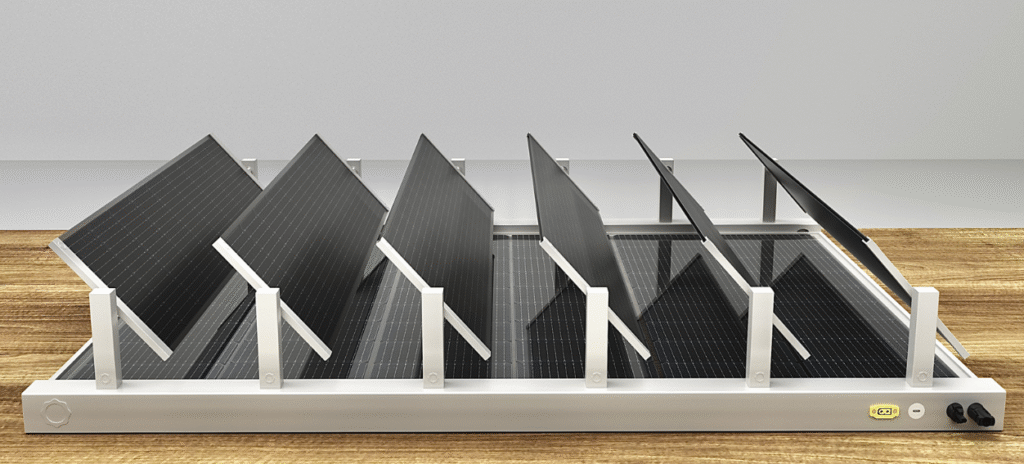
The researchers developed the prototype to validate the double-layer PV concept under outdoor operating conditions. The system consists of two vertically stacked PV layers, each equipped with independent single-axis tracking. Coordinated rotation enables the overlapping surfaces to capture direct, diffuse and reflected solar radiation while limiting mutual shading.
According to the research team, the approach differs from static 3D PV configurations because module orientation can be adjusted as solar conditions change throughout the day.
The prototype, installed in Reggio Calabria, southern Italy, occupies the same ground footprint as an equivalent single-layer installation while providing twice the active PV surface. It incorporates 12 custom bifacial TOPCon mini modules, with six modules in each layer. The modules were specifically designed to isolate the behavior of the overlapping PV surfaces from constraints associated with conventional module electrical architectures.
Each module can be independently monitored and rotated. The two layers are vertically separated by 25 cm, a configuration deliberately selected to create severe mutual-shading conditions for the experimental tests. An automated control and data-acquisition system synchronizes module rotation, current measurements and remote data collection.
The researchers benchmarked the prototype against an adjacent fixed single-layer system using identical modules and the same footprint, orientation and tilt, with both systems operating simultaneously under the same environmental conditions.
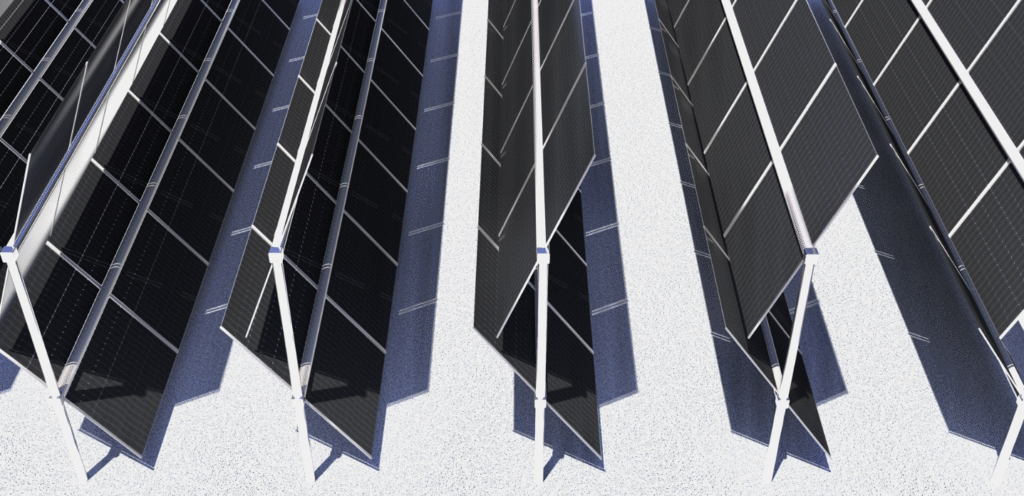
Each mini module rotates from 0 degrees, corresponding to an east-facing position, through 90 degrees, with the front surface facing upward, to 180 degrees, corresponding to a west-facing position. The researchers investigated three operating modes intended to provide different trade-offs between performance and practical implementation.
In Mode 1, the bottom layer remained fixed while the top layer tracked the sun. In Mode 2, the top layer remained fixed while the bottom layer tracked. In Mode 3, both layers remained fixed in orthogonal orientations.
Outdoor measurements were performed from 9:00 to 17:00, with short-circuit current recorded every 30 seconds. The researchers assessed performance by comparing the cumulative short-circuit current of a representative central double-layer module pair with that of the simultaneously operated single-layer reference occupying the same footprint.
Field tests under clear-sky conditions showed that the double-layer configuration could increase solar irradiance capture per unit of occupied land area, according to the researchers.
Mode 1 achieved an short-circuit current-based gain of around 27% compared with the bifacial single-layer reference and 42% compared with the monofacial reference. Mode 2 produced a gain of approximately 21% over the bifacial reference. Mode 3 achieved gains of around 14% over the bifacial reference and 28% over the monofacial reference.
“The observed gains arise from the combined interception of solar radiation by two superimposed active PV surfaces,” the researchers explained. “The top layer captures direct and diffuse radiation as a function of its angular position, while the bottom layer intercepts the radiation not blocked by the top layer. Dynamic management of the top-layer angle modulates this balance, achieving a combined output that exceeds that of a fixed single layer occupying the same area. Module bifaciality further contributes, especially for the bottom layer that benefits from radiation reflected by the ground and by the underside of the top-layer modules.”
The researchers said the architecture is largely independent of the PV conversion technology used, meaning that its mechanical design and tracking strategy could potentially be adapted to emerging technologies such as perovskite and tandem solar cells.
Looking ahead, AMPS plans to validate the system under a broader range of operating and meteorological conditions and investigate configurations in which both layers are dynamically controlled, with the aim of further increasing energy yield per unit of occupied land.
Future development work will also focus on utility-scale and agrivoltaic applications, compact plug-and-play designs, optimized module architectures and artificial intelligence-based strategies for tracking and mutual-shading management.
The researchers also plan industrial-scale pilot projects and longer-term testing to support a comprehensive techno-economic assessment, including the trade-off between the additional investment required for a second active PV surface and the potential gains in energy production and land-use efficiency.
The system was described in the study “Experimental validation of a dynamic double-layer photovoltaic,” published in Renewable Energy.
The post Italian startup unveils double-layer PV system prototype for space-constrained applications appeared first on pv magazine Global.


