
The Back to Basics column explores key farm business management concepts and strategies that we should all periodically review and assess, no matter the farm sector, size or business growth stage.
Successful farm businesses often use financing strategically — not just to address short-term cash-flow needs, but to support growth, manage seasonal expenses and capitalize on opportunities when they arise. Selecting the right financing option can also help improve flexibility while keeping borrowing costs under control.
Two of the most common short-term options available to producers are lines of credit and working capital loans. While both can help fund operating expenses, they are designed for different situations.
“The key is matching the financing tool to the need,” says Tanya MacDonald, vice-president, commercial banking, RBC. “A line of credit is generally best for short-term cash-flow gaps, while a working capital loan is better suited to larger expenses that can be repaid over a longer period.”
Two tools, two purposes
At first glance, lines of credit and working capital loans may seem similar. Both provide access to cash when it’s needed. The difference lies in how the money is accessed and repaid.
MacDonald explains that a line of credit functions much like a credit card for a business. A lender approves a borrowing limit, and the producer can draw funds as needed up to that amount. Interest is charged only on the money that is actually used. As the balance is repaid, those funds become available to borrow again.
A working capital loan, by contrast, provides a lump sum up front. The loan is repaid over a predetermined period through regular payments that include both principal and interest.
“A line of credit gives producers flexibility because they can borrow, repay and borrow again,” says MacDonald. “A working capital loan offers more structure and predictability because there is a defined repayment schedule.”
Managing seasonal cash flow
Cash-flow management can be challenging on the farm due to the seasonal nature of agriculture, with expenses often occurring long before revenue is realized and large, unexpected expenses required to maintain productivity and workflow.
MacDonald notes that’s where a line of credit can be valuable, helping bridge short-term cash-flow gaps and support fluctuating needs, such as covering payroll during a slow season or buying supplies before harvest revenue kicks in.
“Working capital loans are typically a better fit when there is a larger, known expense that will provide value over a longer period,” she explains.
For example, a producer facing an unexpected but significant repair bill may choose a working capital loan if the expense cannot reasonably be repaid in the short term. The structured repayment schedule allows the cost to be spread over several years rather than put pressure on current cash flow.
Understanding the cost
One of the biggest differences between a line of credit and a working capital loan is how interest is charged. Interest on a line of credit is charged only on the outstanding balance. If a producer has access to $200,000 but uses only $50,000, interest is paid only on the $50,000.
“Keep in mind that rates are often variable, meaning borrowing costs can change as interest rates rise or fall,” explains MacDonald, who also advises producers to repay a line of credit aggressively when cash flows in to minimize interest.
Working capital loans typically have fixed repayment schedules and may offer either fixed or variable interest rates, depending on the lender and loan structure. Because payments are predetermined, producers may find it easier to budget for loan repayments.
Questions to ask before borrowing
Before choosing between a line of credit and a working capital loan, MacDonald recommends asking a few basic questions:
- Is this a one-time expense or an ongoing cash-flow need?
- How quickly can the borrowed funds be repaid?
- Is flexibility more important or would a structured repayment schedule be preferable?
“The answers can help determine which financing option is the better fit,” she says, noting that lenders will also evaluate several factors before recommending the right financial product, including cash-flow stability, existing debt levels, available security and the seasonality of the farm operation.
Common mistakes
“One of the most common financing mistakes is using a line of credit for long-term investments,” warns MacDonald. “Because lines of credit are intended for short-term borrowing, carrying large balances for extended periods can become expensive, particularly when interest rates increase.”
Another frequent issue is borrowing without a clear repayment strategy. MacDonald reminds producers that financing works best when there is a plan for how and when the debt will be repaid. She encourages producers to keep a close eye on interest rates and review their financing arrangements regularly, especially during periods of market volatility.
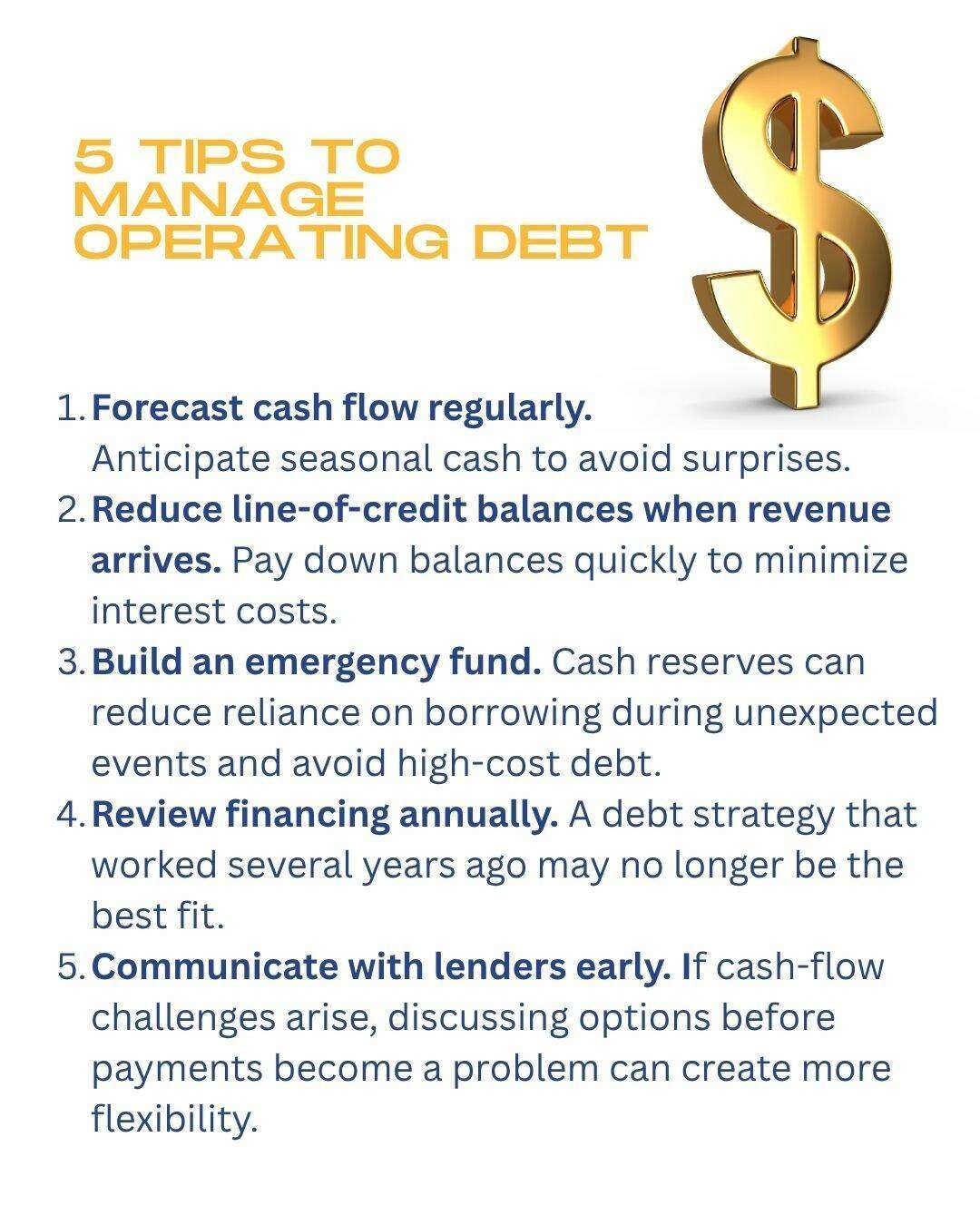
Graphic: April Stewart/Canva Graphic: April Stewart/Canva
Debt isn’t always a bad thing
“Not all debt is bad debt,” she says, addressing a common misconception in farm financing. “In reality, strategic borrowing can support growth, improve efficiency and help a farm operation achieve its goals.”
She reminds farmers that the important factor is to ensure the financing matches the purpose and that repayments fit comfortably within the farm’s cash flow.
For producers weighing financing options, MacDonald’s advice comes back to a simple rule: use a line of credit for short-term cash-flow needs and a working capital loan for longer-term expenses. “By understanding these tools and leveraging the advice of your business banker, farmers can turn financial flexibility into a competitive edge,” she says.


