
All drainage pipe installed for agricultural purposes in Ontario could soon meet one of two established standards for durability and strength testing, if the Land Improvement Contractors of Ontario are successful in instituting a voluntary standard.
Concerns about pipes cracking and deteriorating has contractors questioning what they often refer to as a lifetime guarantee on drainage systems.
A voluntary pipe standard was developed by LICO in 2006.
WHY IT MATTERS: Installing tile drainage is expensive and farmers don’t want to face that cost more frequently than expected due to the use of poorly performing or substandard products.
But Melisa Luymes, LICO’s executive director, told Farmtario in a recent interview that the idea of an enhanced compliance regime has been under discussion with the board of directors and membership ever since she came joined more than five years ago.
LICO is concerned that mergers and the arrival of new suppliers have raised questions about whether new standards are needed.
A committee — including LICO’s manufacturing members, a few contractors and an engineer — was struck to explore what enhancements, if any, were needed to the regime.
For the organization’s 2025 annual convention, the committee arranged a presentation by Dr. Michael Pluimer of the University of Minnesota – Duluth’s Advanced Materials Centre.
Through the consulting firm he also heads, Pluimer first started researching underground pipe deterioration in 2002 when the Florida Department of Transportation, as he explained in his LICO presentation, “wanted to develop a 100-year service life for their products.”
“I went out and looked at a lot of their pipe and behold, I found a lot of those little, brittle cracks in polyethylene culverts,” he continued. “That was not a good thing from a performance standpoint so Florida said ‘what do we need to do to make sure those pipes do not have that type of cracking over 100 years?’”
Sara Stone, a University of Minnesota – Duluth graduate student, then spoke about stress cracking. Stone described it as the straightening out over time of the polyethylene fibres so they’re no longer entwined with each other and holding each other together. Cracks aren’t necessarily due to one large load that exceeds the weight-bearing capacity of the pipe, she explained, but due rather to repeated small loads of the same type over and over, year after year.
Pluimer assured the LICO audience that the technology exists to manufacture drainage products that meet the requirements Florida outlined back in 2002.
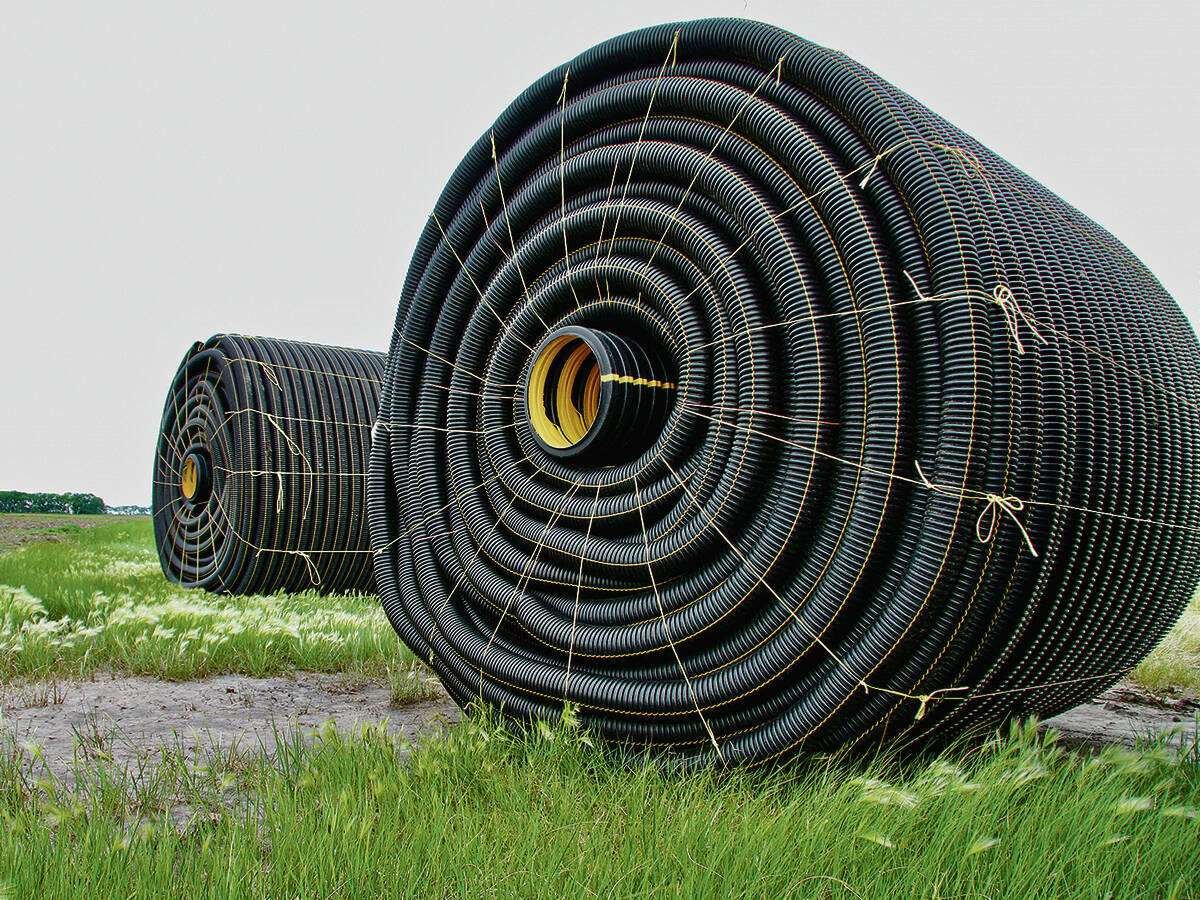
“You can make both products, from virgin (plastic) or recycled, to last in excess of 100 years. You just have to make sure that you do it with the right materials. And we know how to do that.”
Using existing standards
Two standards – one from Quebec and one from the United States – exist in North America stipulating the quality of the source material and necessary tests taken throughout the manufacturing process to ensure a very low risk of cracking or failure. Given the variation of where Ontario-based drainage pipe manufacturers obtain their source materials, the LICO committee decided to accept either standard in the organization’s updated voluntary compliance regime.
Luymes stressed that complying with certification standards is nothing new for some of the province’s manufacturers, particularly those also building municipal or industrial infrastructure like the Ohio-based Advanced Drainage Systems — which purchased Thorndale-based Ideal Pipe in 2015 — and Guelph-based Armtec, which got into the agricultural sector when it bought Walkerton-based Bruce Tile in 2008.
Others involved in pipe manufacturing in Ontario include the relative newcomer Bluewater Pipe of South Huron. Bluewater Pope was started by the son of the founder of the once-dominant “Big-O” brand and now owned by Soleno Inc. of Quebec, and a handful of small-scale operators clustered within midwestern Ontario’s Mennonite community.
Ask questions about certifications
LICO is now encouraging farmers to ask if their drainage contractor has factored in drainage pipe that meets either the Quebec or U.S. standard into the quoted price for a proposed project. There is no enforcement process, but Luymes says there’s a consensus among LICO members that compliance is crucial to ensure the reputation of the province’s farm drainage sector remains strong.
“Despite competition among the manufacturers, they all agreed that pipe quality should not be compromised, and the recommendation (to upgrade the voluntary regime) was passed unanimously by both the committee and LICO’s general membership,” she said.
For farm landowners, Luymes describes it as now being able to ask one question, “is the pipe certified to one of the two standards?” instead of, in the past, having to ask numerous questions about the quality, origin and strength of the pipe.
“Healthy competition benefits farmers, contractors and pipe manufacturers alike,” LICO president Jeremy Reaume of Comber-based Reaume Drainage said in the news release. “But not if it comes at the expense of quality or risks our industry’s reputation.”


