
Apple started fiscal 2026 with a powerful performance. The company reported record revenue, strong earnings growth, and accelerating demand across major regions. At the same time, Apple doubled down on its climate roadmap, highlighting renewable energy use, carbon credits, and ambitious emissions reduction targets. Together, these results show how Apple is balancing profit growth with sustainability leadership.
This analysis breaks down Apple’s Q1 2026 financial performance, regional growth drivers, market reaction, and its climate strategy in simple, easy-to-read language.
In Tim Cook’s words.
“iPhone had its best-ever quarter driven by unprecedented demand, with all-time records across every geographic segment, and Services also achieved an all-time revenue record, up 14 percent from a year ago. We are also excited to announce that our installed base now has more than 2.5 billion active devices, which is a testament to incredible customer satisfaction for the very best products and services in the world.”
Apple’s Q1 2026 Financial Results Show Strong Momentum
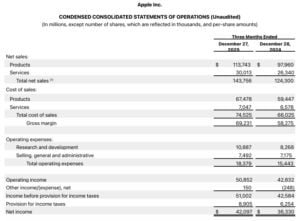
Apple reported $143.8 billion in revenue for its fiscal first quarter ended December 27, 2025. That was up 16% year over year, showing strong demand for its products and services.
The company also reported earnings per share (EPS) of $2.84, up 19% from last year. Net income reached $42.1 billion, up from $36.33 billion a year earlier. The board also approved a $0.26 per share dividend, reinforcing its commitment to returning cash to shareholders.
Overall, it beat market expectations on both revenue and profits, signaling strong execution across hardware and services.
Greater China and India Drive Regional Growth
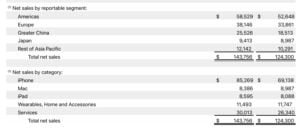
Apple saw broad growth across regions, but Greater China stood out as the top performer. Revenue from the region surged 38% year over year to $25.5 billion. Record iPhone sales and strong store traffic drove the jump.
Other regions also posted solid gains:
- Americas: Revenue grew 11%
- Europe: Up 13%
- Rest of Asia Pacific: Up 18%
- Japan: Up 5%
India was another highlight. Apple achieved quarterly records for iPhone, Mac, iPad, and Services in India. The installed base also grew at a double-digit pace, showing rising brand loyalty and expanding market penetration.
Tim Cook said iPhone demand was strong across all geographies, helping ease earlier concerns about slowing sales in China.
AAPL Stock Positive but Measured
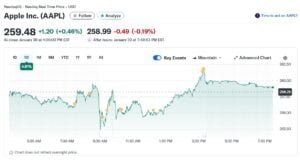
Apple’s stock (AAPL) reacted positively after the earnings release on January 29. Shares rose about 1–2% in after-hours trading, reflecting investor confidence in Apple’s performance.
At the time of reporting, Apple stock traded around $259.48, up slightly during the day. Investors seemed encouraged by strong execution but remained cautious about rising AI-related spending and broader tech market uncertainties.
Apple’s Climate Strategy: A Core Part of Its Business Model
Apple continues to position sustainability as a strategic priority. The company said it supports climate policies and works with policymakers and businesses to align with the Paris Agreement goal of net zero emissions by 2050.
Apple’s long-term goal is to become carbon neutral across its entire global footprint by 2030. The plan focuses on renewable energy, recycled materials, and low-carbon transportation.
It aims to:
- Reduce emissions by 75% compared with its 2015 baseline
- Address the remaining 25% through high-quality carbon removal projects
- Use 100% renewable energy across its supply chain
- Increase recycled materials in products, including 99% recycled rare earth elements in magnets
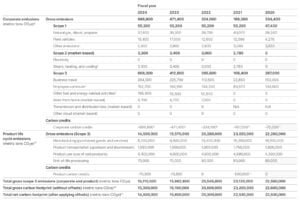
Significantly, Apple already achieved carbon neutrality for corporate operations in 2020, making it one of the first major tech firms to reach that milestone.
The company also promotes science-based targets, transparent emissions reporting, and high-quality carbon removal standards. Apple supports strict ESG criteria for carbon credits to ensure real environmental and community benefits.
Renewable Energy and Supplier Decarbonization
Apple reported that renewable energy procured by suppliers avoided about 21.8 million metric tons of greenhouse gas emissions in 2024.
Many semiconductor and display suppliers pledged to cut fluorinated greenhouse gas emissions by at least 90% by 2030. These gases are extremely potent, so reducing them can significantly lower the tech sector’s climate impact.
Apple also supports policies to expand renewable electricity globally, improve grid infrastructure, and invest in energy storage and transmission. The company encourages life cycle emissions assessments and high-integrity mitigation standards.
Use of Carbon Credits and Nature-Based Projects
Apple has used carbon credits to maintain carbon neutrality for its corporate emissions. The company retired credits from multiple certified projects, including: Chyulu Hills project (Kenya), Guinan afforestation project (China), Alto Mayo project (Peru), Cispatá Mangrove project (Colombia), and REDD+ forest conservation project (Guatemala)
These projects follow VCS and CCB standards, which aim to ensure environmental integrity and social benefits. Apple said it regularly updates its life cycle assessment models to improve transparency and accuracy.
Why Apple’s Financial and Climate Performance Matters
Apple’s strong Q1 2026 results highlight how sustainability and profitability can move together. The company’s revenue growth in China and India shows expanding global demand, while its climate strategy positions it as a leader in corporate decarbonization.
However, Apple’s reliance on carbon credits may attract scrutiny as regulators and investors push for deeper emissions cuts rather than offsets. The tech giant will need to show real reductions across manufacturing, logistics, and product life cycles to maintain credibility.
In conclusion, Apple’s fiscal Q1 2026 marked a powerful start to the year. Revenue and profits surged, driven by strong global demand and regional growth in China and India. Investors responded positively, though cautiously.
At the same time, Apple reinforced its climate ambitions with renewable energy investments, supplier decarbonization efforts, and carbon credit programs. With Apple 2030 approaching, the company faces a critical test: can it continue delivering record financial growth while cutting emissions at scale?
If Apple succeeds, it could set a blueprint for how Big Tech aligns growth with climate leadership in the coming decade.
- Apple (AAPL) Expands Renewable Energy Projects Across Europe to Power Its 2030 Carbon-Neutral Vision
The post Can Apple Balance Explosive Q1 2026 Growth with Its Net-Zero Promise? appeared first on Carbon Credits.


