
In-field soil and crop sensing technology continues to proliferate, with more products on the market.
The question is how farmers will interact with those technologies, but judging from mature soil sensing technologies and the price point for new in-field technologies, it will likely mean they will be mostly purchased by farm service providers.
A recent technology is mobile leaf tissue sensing to understand crop status around disease and the need for more nutrients.
At Innovation Farms Ontario, run by Haggerty Creek and Haggerty AgRobotics near Bothwell, a demonstration day recently included four in-field sensing technologies being tested at the farm.
Innovation Farms Ontario is part of the new Agriculture Innovation, Validation and Adoption (AIVA) network, which connects research farms validating technology across the country. It was founded by FCC, the Enterprise Machine Intelligence and Learning Initiative (EMILI) in Manitoba, and the Wabash Heartland Innovation Network, based in Indianapolis.
Understand soil stable metrics
The most developed technology of the four shown at the demonstration day was SoilOptix, a soil mapping technology now used around the world. Paul Raymer, the founder and president of the company, said SoilOptix allows a farmer to “strategize inputs”.
The Tavistock-based company has been in business for 12 years and measures the stable factors in soil, compared to regular soil tests, which are dynamic.
The SoilOptix instruments use a gamma-ray spectrometer to pick up isotopes in the field, including thorium, uranium, potassium and cesium.
That enables the user to create maps, which help in the understanding of soil composition, including soil type and water-holding capacity.
“The gamma data acts like a scaffolding for being able to try to optimize the prediction of each and every soil property,” said Raymer.
SoilOptix is now mostly used by companies and consultants to provide the service to farmers, as fields are usually mapped once every six to eight years, depending on what’s being grown in the field.
Grant Elgie from Haggerty Creek, a farm supply retailer, and Haggerty AgRobotics, said the SoilOptix technology helps manage further soil sampling.
“On the operational side, it takes out a lot of guesswork from the soil sampling operation,” he said.
Measuring carbon
A new technology from the United States is looking at how to sense carbon levels in the soil, but the technology could do the work of traditional soil samples.
S4 Mobile Laboratories was created from technology developed at the University of Akron, in Ohio, for a researcher to prove to the Turkish government that there were no human remains before he started an archaeological dig.
When funders looked at what the sensor was measuring, they wanted to expand its use beyond looking for burial sites.
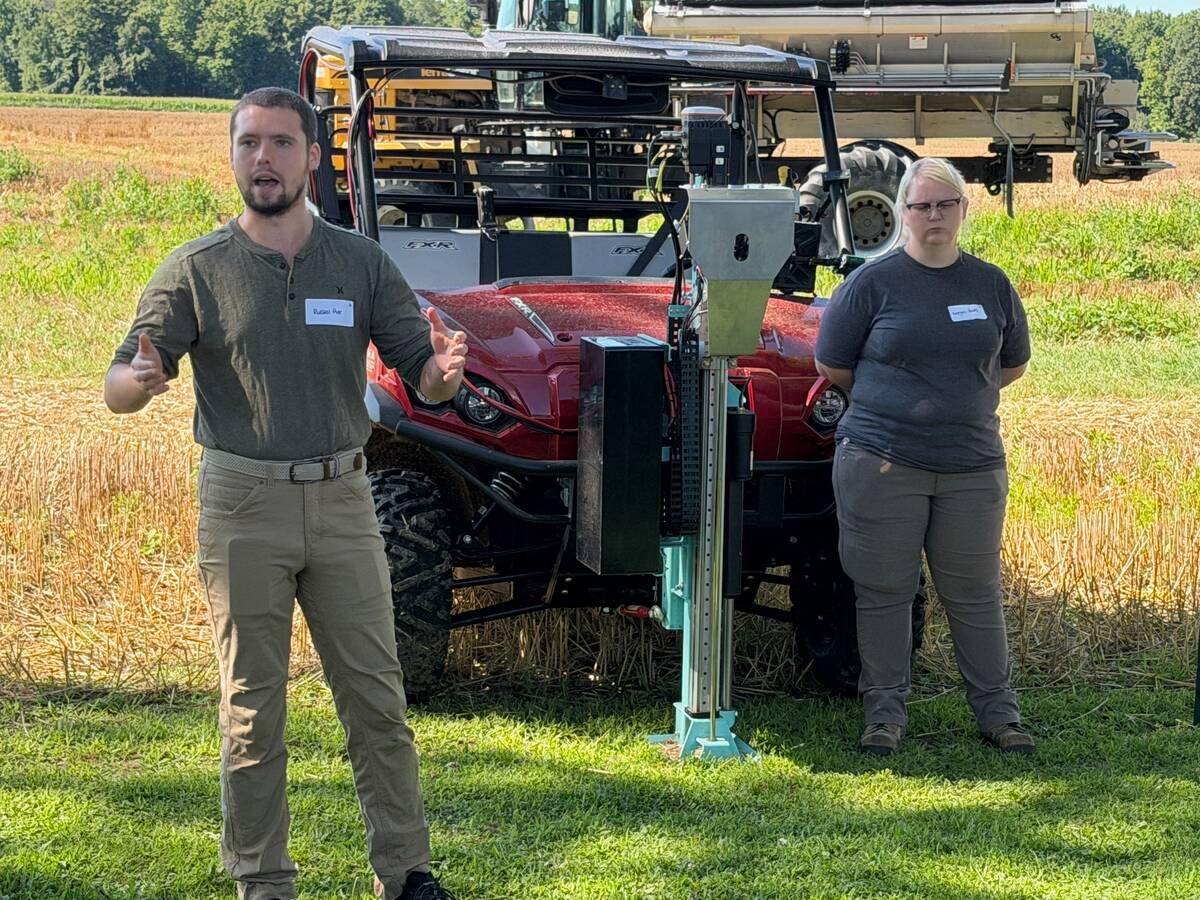
“We detect carbon in real time with high precision with this technology,” said Russell Pier, of S4 Mobile Laboratories.
The interest in carbon markets has cooled off, but in addition to carbon, the sensor can measure properties in soil and could be a replacement for soil sampling.
The probe sticks into the ground about 90 cm and can take samples as it travels through the ground. Light is shone through a small sapphire window at the tip. Spectrometry is used to interpret what the light sees.
There’s a lot of validation to be done in different regions, and S4 Mobile Laboratories is working to do that work for southern Ontario, starting at the Innovation Farm at Bothwell.
In-field diagnostics
CredoSense is a Canadian company quickly moving to bring its in-field monitoring and test sensors to the market.
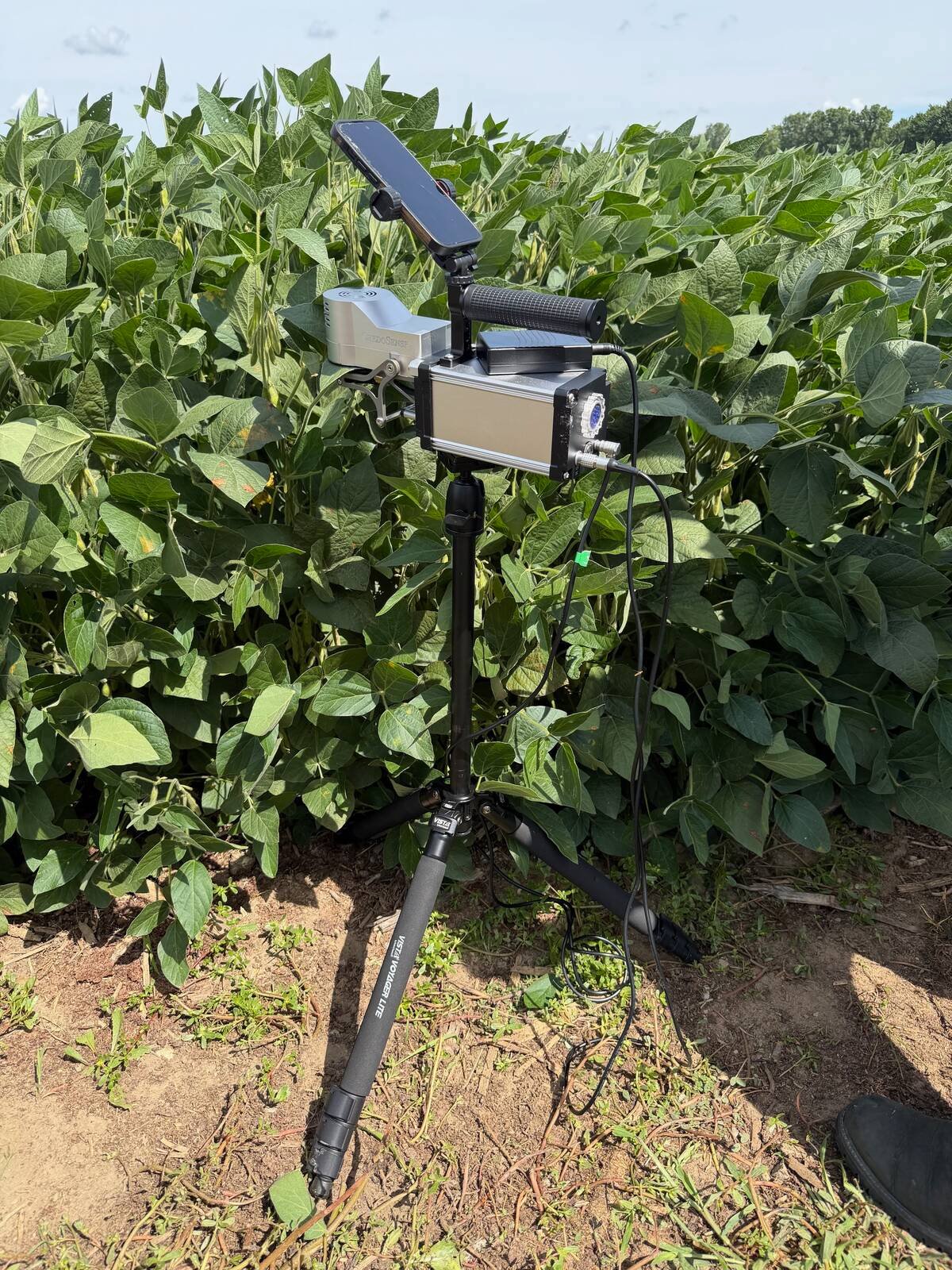
At Innovation Farms Ontario, the company had a disease monitoring unit in the field and also demonstrated its crop health sensor.
The parts of the system together measure 25 different plant and soil parameters to detect stress levels in the crop.
Currently, they have an AI agent trained to interpret results from corn, wheat, soybean, canola, some beans and potatoes.
The goal is to enable decision-making when patterns are detected in the field.
The handheld leaf diagnostic system and the in-field monitoring work together to combine environmental information and leaf-level diagnostics for a more accurate determination of what’s going on in the field.
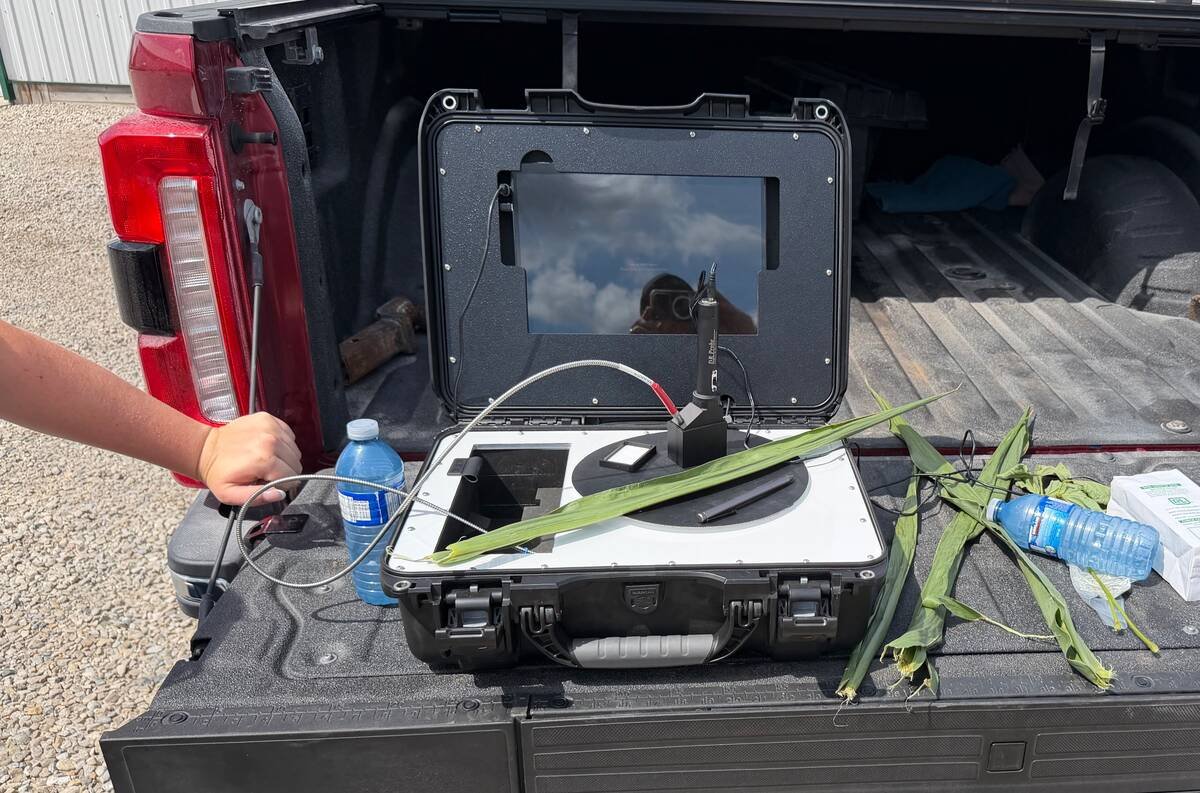
Photo: John Greig
In-field tissue testing
Picketa Systems is another Canadian company that has developed a portable, in-field tissue testing option.
The company is selling its systems, and Innovation Farms Ontario is working with that system, comparing about 180 in-field tests to plant tissue tests sent to a laboratory.
Farmers attending the demonstration day were encouraged to bring crop leaves for testing by the system.
Kaya Moore, who manages research at Innovation Farms Ontario, said that while the system can be taken to the field, they will often take samples from plants in the field and then evaluate them at one time in an office or shed.
“Essentially, it’s a sensor that scans tissue from your crops, and it gives you immediate results about the nutrients that are in the plants,” she said.
The immediate results can replace plant tissue lab testing, which has become popular to help determine which nutrients need to be spread on the field as the crop is growing. That’s especially been useful for late-season nitrogen application.
The Picketa lens can produce readings for potatoes, corn, soy, wheat and canola.
The post Farmers’ in-field soil and plant sensor options multiply appeared first on Farmtario.


