
The U.S. House of Representatives has passed the DOMINANCE Act, a bipartisan bill designed to strengthen America’s access to critical minerals and reduce its dependence on China. Lawmakers say the legislation will help secure supply chains for key industries, including electric vehicles (EVs), clean energy, semiconductors, and defense manufacturing.
The bill, formally known as the Developing Overseas Mineral Investments and New Allied Networks for Critical Energies (DOMINANCE) Act, was introduced by Representatives Young Kim and Ami Bera. It passed the House by voice vote and now moves to the Senate for consideration.
The legislation comes as governments worldwide race to secure supplies of critical minerals that power the energy transition and advanced technologies. At the same time, concerns continue to grow over China’s overwhelming control of global mineral processing and refining.
The Supply Chain Challenge Facing the U.S.
Critical minerals have become the backbone of the modern economy. They are essential for manufacturing batteries, electric vehicles, solar panels, wind turbines, semiconductors, and military equipment.
As demand for these technologies grows, access to reliable mineral supplies has become a strategic priority.
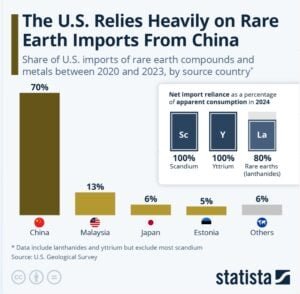
The United States currently depends heavily on imports for many of these materials. It remains 100% import-reliant for 11 critical minerals, including graphite, gallium, scandium, and yttrium.
This dependence has raised concerns among policymakers who fear that supply disruptions could affect both economic growth and national security.
- READ MORE: US and Australia Boost Critical Minerals Support with $3.5B Alliance, Challenging China’s Grip
Targeting the Minerals Behind EVs, Batteries, and National Security
The bill does not identify a specific list of priority minerals. Instead, it focuses broadly on critical minerals and energy minerals that support national security and advanced manufacturing.
However, the legislation clearly targets materials where China maintains a dominant position in production or processing.
These include:
- Rare earth elements used in magnets, electronics, and defense systems
- Lithium for EV and energy storage batteries
- Cobalt for battery production and military applications
- Nickel used in batteries and industrial manufacturing
- Graphite, a key battery material
- Gallium and other specialty minerals used in semiconductors and advanced technologies
The bill generally aligns with the U.S. Department of the Interior’s critical minerals list, which identifies resources that face high supply disruption risks while serving essential economic and security functions.
China Still Controls the Market
A major driver behind the DOMINANCE Act is China’s strong position in global mineral supply chains.
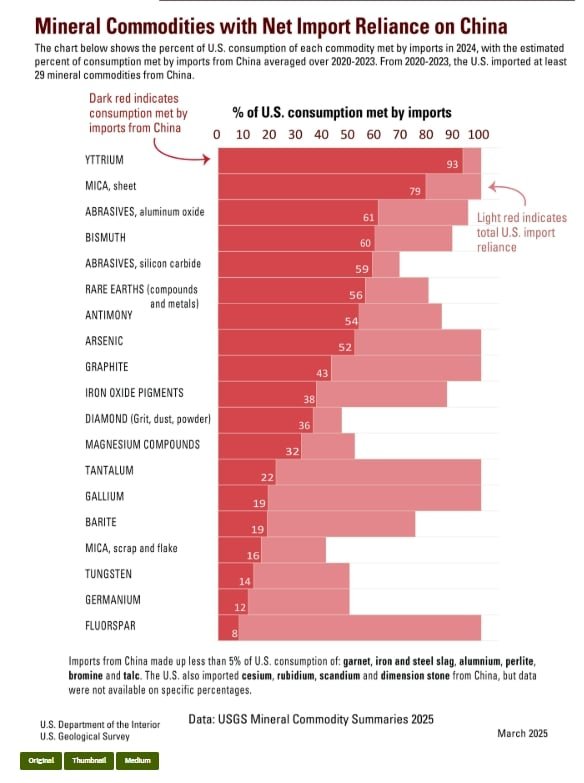
Congressional documents supporting the legislation state that China controls more than 70% of global rare earth mining and nearly 90% of rare earth processing capacity. Rare earth elements are crucial for manufacturing EV motors, advanced electronics, renewable energy equipment, and defense technologies.
Lawmakers argue that this concentration creates significant risks for the United States and its allies.
Those concerns have intensified in recent years as China expanded export controls on several critical materials. U.S. officials say Beijing has repeatedly demonstrated its willingness to use its market position as leverage during geopolitical disputes.
Meanwhile, China’s rare earth exports continue to rise. According to customs data cited by Reuters, the country exported 62,600 metric tons of rare earth products in 2025, up from 55,400 metric tons in 2024.
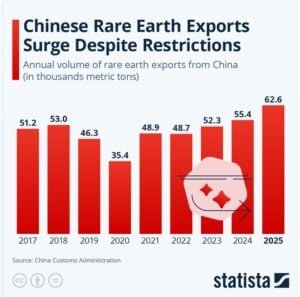
The figure marked the highest annual export volume in at least a decade and highlighted China’s continuing influence over global supply chains.
The Core Problem the U.S. Wants to Solve
The DOMINANCE Act is built around one central idea: the United States cannot secure its future industries if it depends on a geopolitical rival for essential materials. Lawmakers say the current system leaves U.S. companies vulnerable to:
- Supply disruptions: A single export restriction or trade dispute could slow production across multiple industries.
- Higher costs: Limited supply and geopolitical tensions can drive up prices for manufacturers.
- National security risks: Defense systems, advanced weapons, and military technologies require reliable access to rare earths and other critical minerals.
- Slower clean energy growth: EVs, batteries, wind turbines, and grid storage all depend on minerals such as lithium, cobalt, nickel, and graphite.
What the DOMINANCE Act Will Do
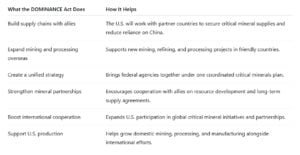
The bill does not seek to block Chinese exports. Instead, it aims to reduce U.S. dependence on China by building stronger supply chains with allies.
A key part of the legislation is creating a coordinated national strategy for energy and critical minerals. Supporters say current efforts are spread across multiple agencies, slowing responses to supply chain risks.
Representative Young Kim said the approach would create a single strategy and command center for America’s critical mineral efforts.
The move comes as demand for minerals continues to rise. Electric vehicles, battery storage systems, solar panels, and wind turbines all rely on these materials. As a result, supporters believe the legislation can help secure supplies, support clean energy growth, and strengthen U.S. manufacturing competitiveness.
Here’s a summary of the DOMINANCE Act and how it helps to secure supply chains
Looking Ahead
The House vote marks another step in Washington’s effort to strengthen mineral security and reduce strategic vulnerabilities.
If the Senate approves the legislation, the United States will gain new tools to build partnerships, support overseas mineral development, and strengthen supply chains for the materials that power modern economies.
While the bill will not eliminate China’s influence overnight, it signals a long-term strategy to create alternative sources of supply and reduce reliance on a single dominant player.
As competition for critical minerals intensifies, the DOMINANCE Act underscores a growing consensus in Washington: securing access to these resources is now as important as securing energy supplies. The outcome could shape global mineral markets, clean energy supply chains, and industrial competitiveness for years to come.
- FURTHER READING: Trump-Linked Kazakhstan Tungsten Mega Deal Could Break China’s Grip on Critical Minerals
The post Inside the DOMINANCE Act: America’s Push to Secure Critical Minerals Beyond China appeared first on Carbon Credits.


