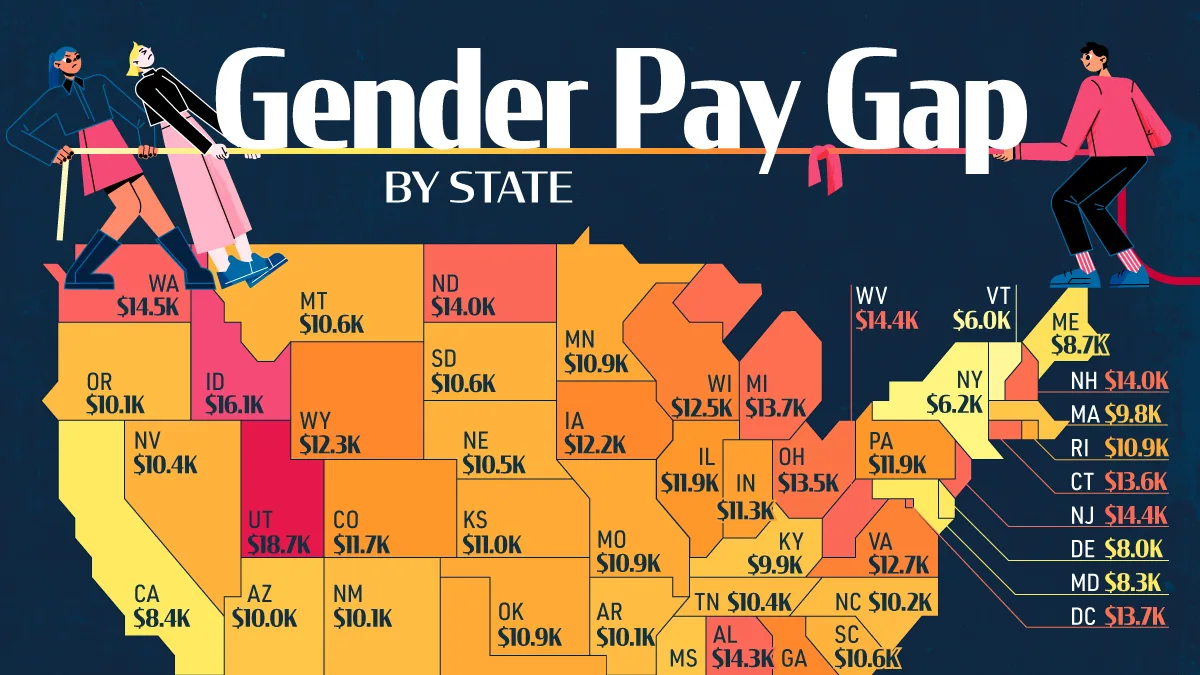
Mapped: America’s Gender Earnings Gap by State
See visuals like this from many other data creators on our Voronoi app. Download the app for free on iOS or Android and discover incredible data-driven charts from a variety of trusted sources.
Key Takeaways
- Men earn at least 20% more than women in 13 states, with the widest earnings gaps concentrated in the South and Mountain West.
- Louisiana, Utah, and Idaho report some of America’s largest gender earnings gaps, driven partly by male-dominated industries like energy, manufacturing, and technology.
- Northeastern and coastal states, including Vermont, New York, and California, tend to show smaller earnings gaps between men and women.
Men working full-time in the U.S. still earn significantly more than women on average, but the size of that earnings gap varies dramatically depending on where Americans live and work.
This map uses data from the U.S. Census Bureau’s American Community Survey (ACS) to compare median annual earnings for male and female full-time workers across all 50 states.
While national conversations often focus on equal pay for equal work, economists point out that broader factors like industry mix, occupational concentration, caregiving patterns, and leadership representation also shape statewide earnings differences.
Where the Median Earnings Gap by Gender is Largest
The table below highlights the states with the widest gender earnings gaps and the economic forces behind them.
| Rank | State | Median earnings gap ($) | Earnings Gap (%) |
|---|---|---|---|
| 1 | Utah | 18,740 | 35.9 |
| 2 | Louisiana | 16,746 | 36.7 |
| 3 | Idaho | 16,147 | 32.2 |
| 4 | Washington | 14,534 | 21.6 |
| 5 | West Virginia | 14,392 | 31.2 |
| 6 | New Jersey | 14,374 | 21.6 |
| 7 | Alabama | 14,301 | 30.4 |
| 8 | North Dakota | 14,013 | 27.1 |
| 9 | New Hampshire | 13,955 | 22.7 |
| 10 | Michigan | 13,739 | 26.2 |
| 11 | District of Columbia | 13,661 | 13.9 |
| 12 | Connecticut | 13,605 | 20.6 |
| 13 | Ohio | 13,524 | 26.1 |
| 14 | Virginia | 12,721 | 20.8 |
| 15 | Wisconsin | 12,518 | 23.5 |
| 16 | Wyoming | 12,317 | 24.6 |
| 17 | Georgia | 12,313 | 23.7 |
| 18 | Iowa | 12,227 | 23.9 |
| 19 | Pennsylvania | 11,939 | 21.4 |
| 20 | Illinois | 11,893 | 20.0 |
| 21 | Colorado | 11,668 | 17.8 |
| 22 | Indiana | 11,257 | 22.0 |
| 23 | Texas | 11,148 | 21.7 |
| 24 | Missouri | 10,927 | 21.6 |
| 25 | Oklahoma | 10,923 | 23.8 |
| 26 | Minnesota | 10,913 | 17.9 |
| 27 | Kansas | 10,962 | 21.5 |
| 28 | Alaska | 10,798 | 17.7 |
| 29 | South Carolina | 10,615 | 21.1 |
| 30 | Montana | 10,589 | 20.9 |
| 31 | South Dakota | 10,558 | 20.8 |
| 32 | Nebraska | 10,452 | 20.3 |
| 33 | Nevada | 10,426 | 20.7 |
| 34 | Tennessee | 10,388 | 20.6 |
| 35 | North Carolina | 10,159 | 19.6 |
| 36 | Arkansas | 10,097 | 22.4 |
| 37 | Oregon | 10,095 | 16.7 |
| 38 | New Mexico | 10,070 | 20.1 |
| 39 | Arizona | 9,969 | 18.7 |
| 40 | Mississippi | 9,914 | 22.7 |
| 41 | Kentucky | 9,888 | 20.1 |
| 42 | Massachusetts | 9,784 | 13.5 |
| 43 | Florida | 9,638 | 19.1 |
| 44 | Maine | 8,712 | 15.5 |
| 45 | California | 8,390 | 13.2 |
| 46 | Maryland | 8,317 | 11.7 |
| 47 | Delaware | 7,985 | 14.0 |
| 48 | Hawaii | 7,608 | 13.8 |
| 49 | New York | 6,228 | 9.5 |
| 50 | Vermont | 6,048 | 9.9 |
The widest earnings gaps are concentrated in the South and Mountain West, while Northeastern and coastal states generally report smaller differences. Louisiana and Utah stand out at opposite ends of the country, but for surprisingly similar structural reasons.
Stand Out States
Louisiana consistently ranks among the states with the largest gender earnings gaps. A major reason is the state’s concentration of high-paying energy and petrochemical jobs, sectors that remain heavily male-dominated.
Oil, gas, and industrial employers along the Gulf Coast help drive high median earnings for men, while women working full-time are more concentrated in healthcare, education, and administrative support roles that generally pay less on average.
Utah highlights how fast-growing high-income industries can widen earnings gaps when top-paying technical and leadership roles remain disproportionately male. Women working full-time are also more concentrated in clerical, healthcare-support, retail, and service occupations that typically offer lower pay growth.
Research from organizations like the AAUW and Status of Women Data shows that occupational segregation, where men and women cluster in different industries and job types, remains one of the biggest drivers of wage disparities nationwide.
Educated Service Economies Fare Better
At the other end of the spectrum, states like New York, Vermont, Maryland, California, and Massachusetts report some of the narrowest earnings gaps in the country.
States with smaller earnings gaps tend to have larger professional-service economies, higher female college attainment, and more women working in higher-paying occupations. At the same time, extraction industries and heavy manufacturing, which often generate very high wages for men, play a smaller role in the local economy.
In many of these states, women are also more represented in higher-paying professional occupations, including law, finance, medicine, and management. While disparities still exist, the earnings gap narrows when women have greater access to sectors tied to overall wage growth.
Can the Gender Earnings Gap Continue to Narrow?
Importantly, this data measures overall median earnings differences between male and female full-time workers, not unequal pay for the exact same job. Federal law requires equal pay for equal work under many circumstances, including protections enforced by the U.S. Department of Labor.
However, economists and labor researchers point to several broader forces that continue to influence earnings differences. Career interruptions resulting from caregiving responsibilities and unequal representation in leadership positions significantly contribute to the gender earnings gap.
Nonetheless, there are also signs of gradual progress. Younger women now outpace men in college attainment nationally, and the long-term gap has steadily narrowed over time. Expanding access to higher-paying industries and improving representation in leadership roles could help further reduce disparities in the years ahead.
Learn More on the Voronoi App 
If you enjoyed today’s post, check out Countries with the Biggest Gender Disparities in Their Workforces on the Voronoi app.Use This Visualization