Mapped: Which European Countries Pay the Highest Salaries
See visuals like this from many other data creators on our Voronoi app. Download it for free on iOS or Android and discover incredible data-driven charts from a variety of trusted sources.
Key Takeaways
- Luxembourg has Europe’s highest average full-time salary, at nearly €83,000.
- Nordic and Western European countries dominate the top of the ranking.
- Salaries in many Eastern and Southern European countries are less than half those seen in the highest-earning countries.
Salaries across European countries vary widely, with the contrast especially apparent between Eastern and Western Europe.
While some European workers earn salaries comparable to those in the United States, others take home less than €20,000 (roughly $23,700) a year, highlighting the wide income gap within Europe’s economy.
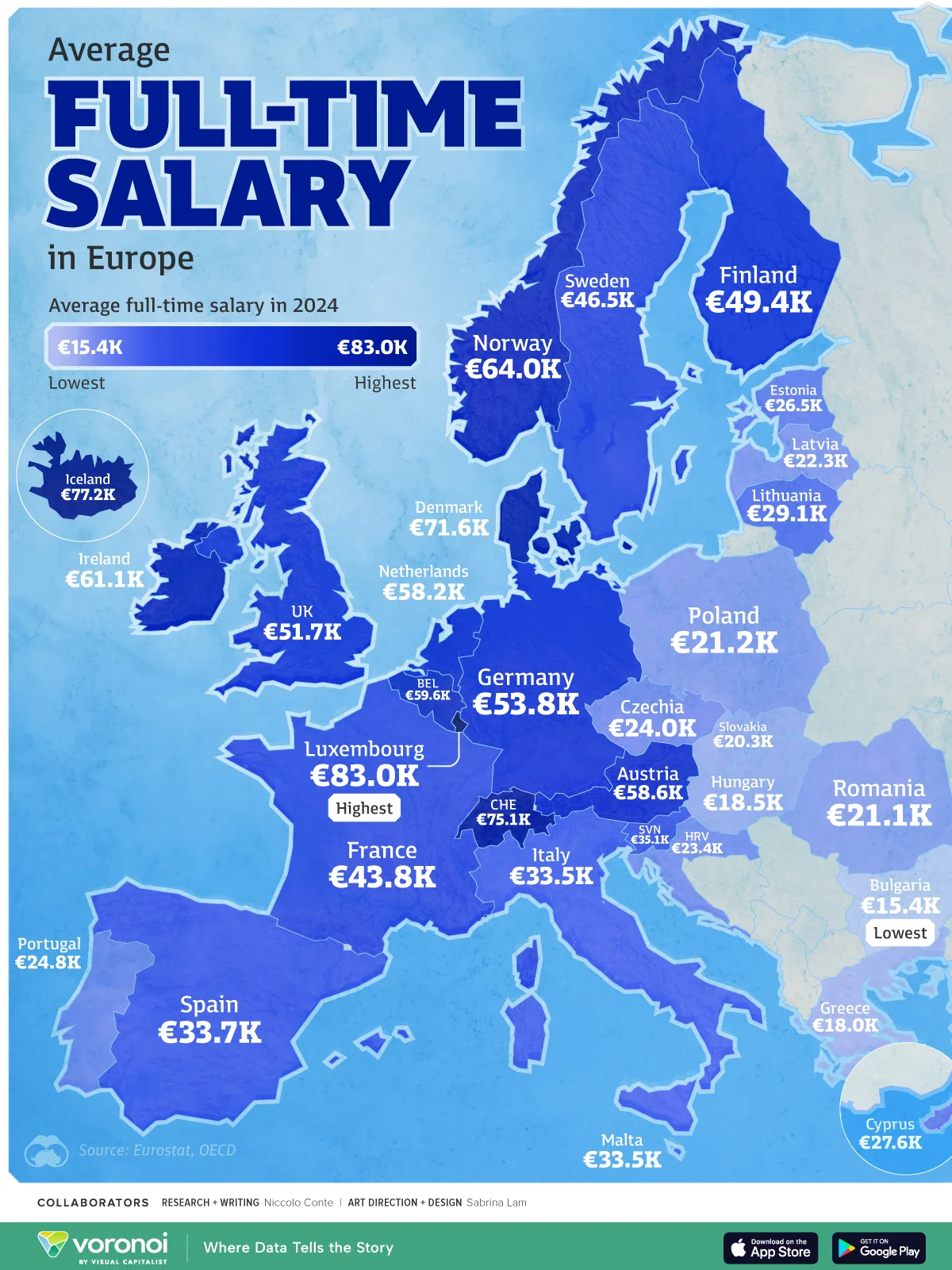
This visualization shows the average annual full-time salary in every European country in 2024, using data from Eurostat and the OECD. OECD figures have been converted to euros using 2024 exchange rates.
Europe’s Highest-Paying Countries
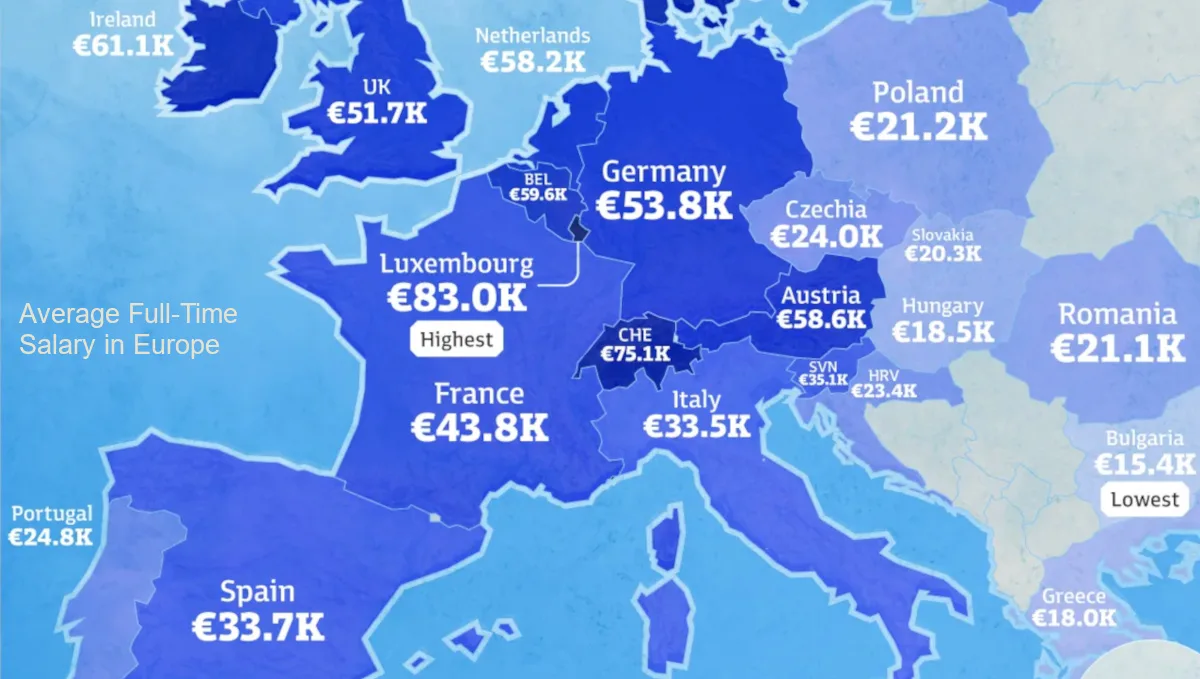
Luxembourg ranks first in Europe, with an average full-time salary of around €83,000, also placing it among the highest-paying countries in the world.
Besides being driven by high-paying industries such as IT and finance, Luxembourg also uses a wage indexation system that automatically adjusts salaries in line with inflation to maintain purchasing power.
Here’s a look at average full-time salaries across 31 European nations:
| Rank | Country | Average full-time salary in 2024 (euros) |
|---|---|---|
| 1 |  Luxembourg Luxembourg |
€82,969 |
| 2 |  Iceland Iceland |
€77,189 |
| 3 |  Switzerland Switzerland |
€75,062 |
| 4 |  Denmark Denmark |
€71,565 |
| 5 |  Norway Norway |
€64,029 |
| 6 |  Ireland Ireland |
€61,051 |
| 7 |  Belgium Belgium |
€59,632 |
| 8 |  Austria Austria |
€58,600 |
| 9 |  Netherlands Netherlands |
€58,248 |
| 10 |  Germany Germany |
€53,791 |
| 11 |  United Kingdom United Kingdom |
€51,657 |
| 12 |  Finland Finland |
€49,428 |
| 13 |  Sweden Sweden |
€46,525 |
| 14 |  France France |
€43,790 |
| 15 |  Slovenia Slovenia |
€35,133 |
| 16 |  Spain Spain |
€33,700 |
| 17 |  Italy Italy |
€33,523 |
| 18 |  Malta Malta |
€33,499 |
| 19 |  Lithuania Lithuania |
€29,104 |
| 20 |  Cyprus Cyprus |
€27,611 |
| 21 |  Estonia Estonia |
€26,546 |
| 22 |  Portugal Portugal |
€24,818 |
| 23 |  Czechia Czechia |
€23,998 |
| 24 |  Croatia Croatia |
€23,446 |
| 25 |  Latvia Latvia |
€22,262 |
| 26 |  Poland Poland |
€21,246 |
| 27 |  Romania Romania |
€21,108 |
| 28 |  Slovakia Slovakia |
€20,287 |
| 29 |  Hungary Hungary |
€18,461 |
| 30 |  Greece Greece |
€17,954 |
| 31 |  Bulgaria Bulgaria |
€15,387 |
Iceland ranks second among Europe’s highest-paying countries with the average worker taking home just over €77,000. The country has also has strong union coverage, with around 90% of all employees covered by a trade union—potentially allowing for greater leverage in wage negotiations.
Several Nordic and Western European countries also rank highly. Switzerland, Denmark, and Iceland all report average salaries above €70,000 per year. Meanwhile, Germany and France—Europe’s two largest economies—sit near the middle, with average full-time wages of €53,791 and €43,790, respectively.
The East–West Divide in European Salaries
Moving south and east within Europe, average salaries drop significantly.
While Southern European countries such as Spain, Italy, and Portugal cluster closer to the €30,000 mark, Eastern European nations sit at the bottom of the ranking. Bulgaria reports Europe’s lowest average full-time salary at just €15,387, preceded by Greece, Hungary, Slovakia, and Romania.
However, while headline salaries are useful for comparison, they don’t tell the full story. Countries with higher wages also tend to have higher living costs, especially for housing, childcare, and services. Meanwhile, lower-wage countries often benefit from cheaper housing and everyday expenses, partially offsetting income gaps.
Learn More on the Voronoi App 
How have median incomes changed in the world’s largest economies from 1994 to 2024? Find out in this visualization on Voronoi.
- Source: https://www.visualcapitalist.com/mapped-which-european-countries-actually-pay-the-highest-salaries/