
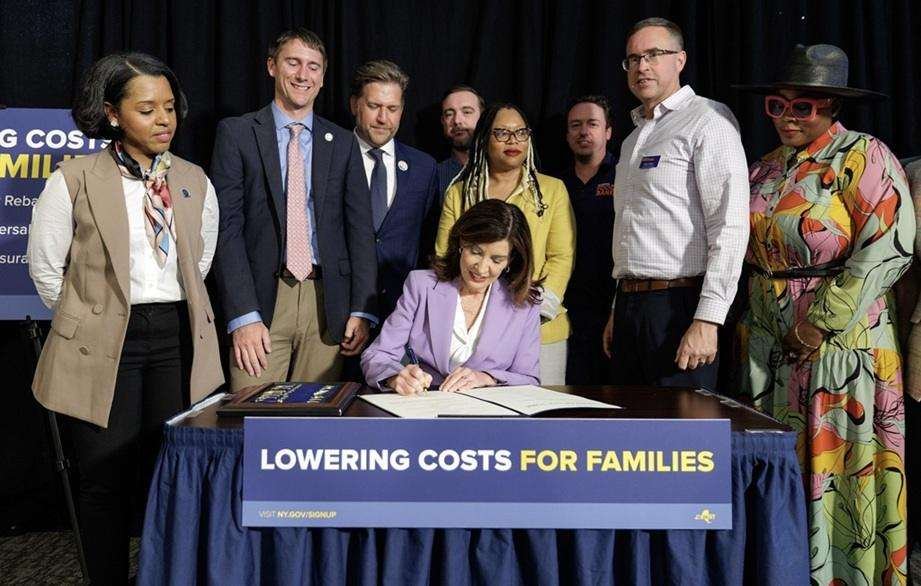
New York Governor Kathy Hochul signed New York’s 2027 budget on Thursday, following approval by state legislators of the legislation that includes changes to the state’s climate law to significantly push back the state’s key emissions reduction goals, replacing its 2030 target with a new 2040 goal.
The changes to New York’s Climate Act follows warnings from Hochul earlier this year that the state’s climate goals had become “costly and unattainable,” and would impose “crushing costs on New York businesses and residents,” in light of geopolitical changes, including “a full-on assault on renewables and the tax incentives” by the Trump administration and Republican politicians.
New York’s 2019 Climate Leadership and Community Protection Act (CLCPA) set mandatory targets for the state to achieve at least 85% in economy-wide emissions greenhouse gas (GHG) emissions reductions by 2050, with the remaining residual emissions to be addressed through carbon removal and offsets, and an interim target of a 40% reduction by 2030.
The law also required New York’s Department of Environmental Conservation (DEC) to adopt regulations to enforce the emissions targets by 2024, which the state has not yet done. In late 2025, the Supreme Court of New York ordered DEC to issue the regulations by early 2026, unless the law is changed.
Under the revised legislation, however, the state will amend the law to push out the requirement to issue regulations to reduce GHG emissions by 2028, with the new regulations to be tied to a new target to reduce emissions by 60% by 2040, on a 1990 basis.
The new budget also, however, required DEC to consider the implementation of a cap-and-invest program, keeping alive the potential for a key program to place a price on greenhouse gas emissions from large emitters, with proceeds to be invested in climate initiatives. Hochul unveiled plans for the cap-and-invest program in 2023, but subsequently pushed out the program’s implementation, and did not include it in last year’s budget.
Environmental groups criticized the changes to New York’s climate law, with the Natural Resources Defense Council (NRDC) calling the move “deeply disappointing.”
Jackson Morris, Director of State Power Sector, Climate & Energy at the NRDC said:
“This action is likely to increase costs for many New Yorkers in the long run, while prolonging harmful pollution and fossil fuel dependence. While the budget stops short of dismantling New York’s core climate obligations under the CLCPA, it substantially weakens key elements, undercutting the law’s ambition, accountability, and enforceability at a critical moment.”


