

A research team from Morocco has designed a novel mooring system for floating PV (FPV) systems that automatically follows water-level changes while reducing platform motion. The new system, which was numerically simulated and tested on a laboratory scale, is based on a counterweight-and-pulley mechanism.
“FPV systems face two simultaneous mechanical challenges: they must follow water-level variations that can span several meters seasonally, while remaining as stable as possible against wave-induced motion,” corresponding author Nouhayla Sahlaoui told pv magazine. “The novelty of our work lies in a counterweight-pulley passive mooring mechanism that solves both problems in a single, mechanically simple design.”
Sahlaoui explained that when the water level rises or falls, the counterweight descends or ascends along a central vertical bar, keeping the platform at the correct depth without any active control or power input. “The same bar acts as a physical stop that blocks the counterweight, and with it the entire platform, from excessive horizontal drift,” she added. “The mechanism is entirely passive: it requires no sensors, no motors, and no external energy, which is a key advantage for the remote, low-maintenance environments where FPV plants are typically deployed.”
To evaluate the system, the group first created a full-size laboratory 3D model in CATIA V5 software. The floating platform measured 0.662 m × 0.382 m × 0.027 m and had a mass of 1.6 kg. It was supported by 11 floats, each with a volume of 3.64 × 10⁻⁴ m³, with a combined immersed volume of 2.67 × 10⁻³ m³. The central counterweight had a mass of 1 kg and a volume of 4.12 × 10⁻⁴ m³, while the calculated tension in the mooring lines was 6.76 N.
The system was designed to operate in a 1.0 m × 0.5 m × 0.8 m laboratory basin, corresponding to a total volume of 0.4 m³.
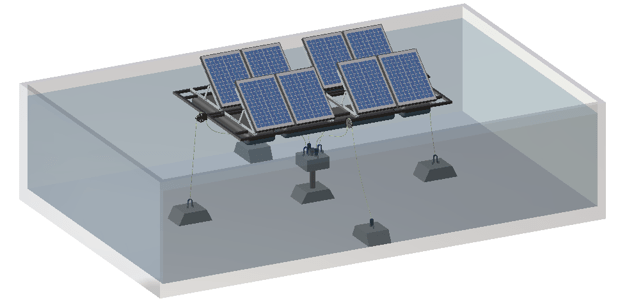
“We validated this concept using the Coupled Eulerian-Lagrangian (CEL) approach implemented in Abaqus/Explicit, a fluid-structure interaction method that enables realistic simulation of fluid forces on moving bodies in a confined basin,” Sahlaoui said. “This level of numerical rigor is rarely applied to FPV mooring design at this stage of concept validation, and it provides a reproducible, quantitative benchmark that future studies can use for direct comparison.”
Following the simulation, the team constructed a laboratory-scale experimental setup. The floating structure consisted of a rectangular aluminum frame assembled with 3D-printed polylactic acid (PLA) connectors and supported by 11 polyethylene terephthalate (PET) floats. Four plastic grooved pulleys with stainless-steel components were mounted symmetrically beneath the platform. The mooring lines and the central adjustable guide bar were also made of stainless steel, while both the 1 kg counterweight and the bottom anchors were cast from concrete. The complete setup was installed in a glass basin measuring 1.0 m × 0.5 m × 0.8 m, with a total volume of 0.4 m³.
“The result that surprised us most was the magnitude of the horizontal displacement reduction achieved by such a geometrically simple mechanism,” Sahlaoui noted. “Compared to a conventional taut mooring system operating under the same surface-wave conditions, our proposed system reduced surge displacement, along the main axis, by 71.7% and sway displacement, along the perpendicular axis, by 65.6%. We had anticipated an improvement, but not of this order.”
A second surprising finding, she added, concerns the efficiency of water-level tracking: The system achieved 75% tracking efficiency over the full basin depth range tested. “This was obtained without any tuning or active adjustment, purely from the geometry of the pulley and the counterweight’s mass ratio,” the scientists highlighted.
“This study represents an early-stage proof of concept,” Sahlaoui concluded. “Several follow-up research directions are already being planned, such as the scaling up to an operational size, testing with real hydrodynamic loading and multi-float configurations, and ultimately a field pilot deployment.”
The system was presented in “Design and analysis of an innovative mooring system for stabilizing floating photovoltaic systems under water level variations,” published in Scientific Reports. Researchers from Morocco’s Mohammed VI Polytechnic University, Green Energy Park Research Platform, Abdelmalek Essaadi University, and Sidi Mohamed Ben Abdellah University have contributed to the study.
The post Passive mooring system enables floating PV to track water-level changes appeared first on pv magazine Global.


