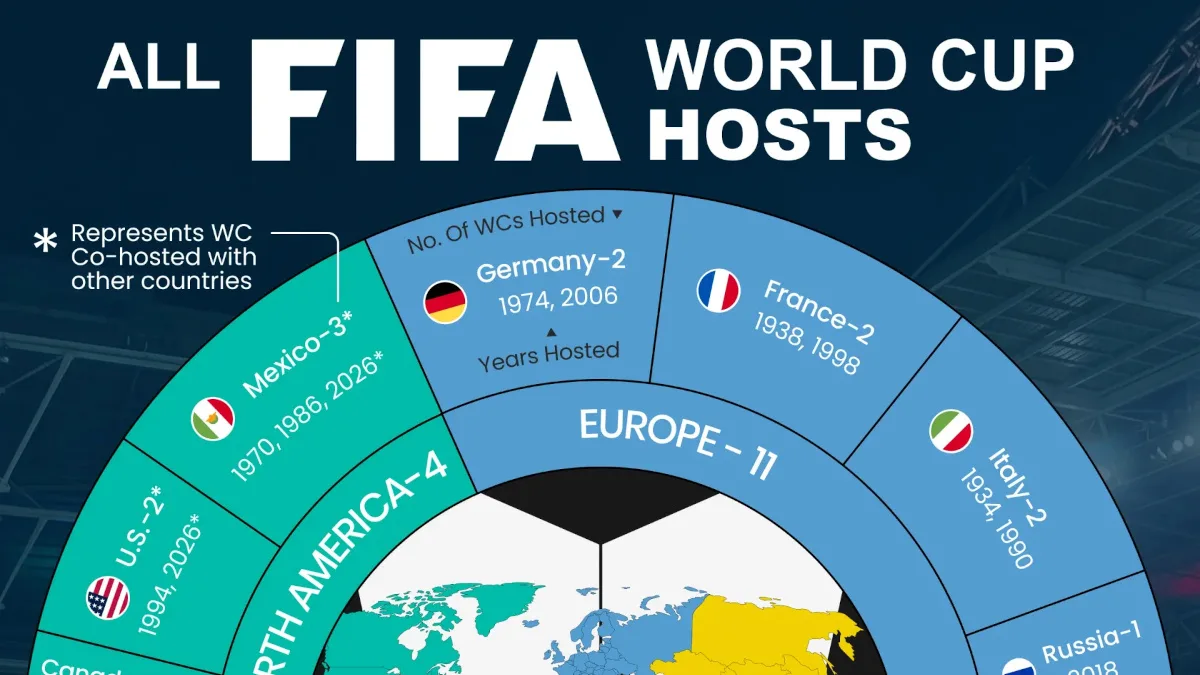
All of the FIFA World Cup Host Countries in History
This was originally posted on our Voronoi app. Download the app for free on iOS or Android and discover incredible data-driven charts from a variety of trusted sources.
Key Takeaways:
- Mexico has become the first country to host three FIFA World Cups.
- European nations have hosted 11 World Cups, more than any other region.
- World Cup hosting is becoming increasingly multinational, with six countries involved in the 2030 tournament.
The FIFA World Cup has been staged in just 19 countries since the tournament began in 1930, despite being watched by billions of fans worldwide every four years.
This graphic by Harris Saleem, using data from Top End Sports, shows every World Cup host nation through 2026 and reveals which countries have hosted football’s biggest event most often.
Mexico leads all nations with three tournaments, while Europe remains the dominant host region with 11 World Cups across nine countries. Looking ahead, FIFA is increasingly embracing multi-country tournaments, a trend that will reach a new scale in 2030.
Which Countries Have Hosted the FIFA World Cup?
While the World Cup is a global event, hosting opportunities have been concentrated among a relatively small group of countries. Since 1930, just 19 nations have staged the tournament, with several countries returning as hosts multiple times.
The table below shows every FIFA World Cup host nation and the years they staged the tournament.
| Country | World Cups Hosted | Hosting Years |
|---|---|---|
 Mexico Mexico |
3 | 1970, 1986, 2026 |
 United States United States |
2 | 1994, 2026 |
 Germany Germany |
2 | 1974, 2006 |
 Italy Italy |
2 | 1934, 1990 |
 Brazil Brazil |
2 | 1950, 2014 |
 France France |
2 | 1938, 1998 |
 Canada Canada |
1 | 2026 |
 Qatar Qatar |
1 | 2022 |
 Russia Russia |
1 | 2018 |
 South Africa South Africa |
1 | 2010 |
 Japan Japan |
1 | 2002 |
 South Korea South Korea |
1 | 2002 |
 Spain Spain |
1 | 1982 |
 Argentina Argentina |
1 | 1978 |
 England England |
1 | 1966 |
 Chile Chile |
1 | 1962 |
 Sweden Sweden |
1 | 1958 |
 Switzerland Switzerland |
1 | 1954 |
 Uruguay Uruguay |
1 | 1930 |
Mexico is now the first nation to host three World Cups, having previously staged the tournament in 1970 and 1986. A second tier of hosts includes Germany, France, Italy, Brazil, and the United States, each with two tournaments.
Europe has been the center of World Cup hosting activity, accounting for 11 tournaments across Germany, France, Italy, Spain, England, Sweden, Switzerland, and Russia. South America has hosted five editions, while Asia and Africa only began hosting in the 21st century.
How FIFA Chooses Host Nations
Hosting the World Cup has become increasingly competitive. FIFA evaluates bids based on factors such as stadium capacity, transportation networks, accommodation availability, security planning, financial guarantees, and sustainability initiatives.
In recent decades, FIFA has also sought to expand the tournament’s geographic reach. South Africa became the first African host in 2010, Russia hosted in 2018, and Qatar became the first Middle Eastern nation to stage the tournament in 2022. These newer hosts demonstrate how the World Cup has evolved into a truly global event rather than one concentrated in Europe and South America.
The shift toward co-hosting has accelerated as tournament requirements grow. The 2026 World Cup, hosted by the United States, Mexico, and Canada, will feature a record 48 teams and more than 100 matches.
The Future of World Cup Hosting
The World Cup’s hosting model is undergoing one of its biggest shifts. As tournament sizes expand and infrastructure requirements grow, FIFA has increasingly favored multi-country bids over single-nation hosts.
FIFA has already confirmed hosts for the next two tournaments beyond 2026. The 2030 World Cup will be jointly hosted by Spain, Portugal, and Morocco, with centenary celebration matches taking place in Uruguay, Argentina, and Paraguay to mark 100 years since the first tournament. FIFA officially approved the six-country hosting arrangement in late 2024.
Four years later, Saudi Arabia will host the 2034 FIFA World Cup, becoming only the second Middle Eastern nation to stage the competition. These selections reflect FIFA’s continued emphasis on regional rotation and expanding football’s global footprint.
Learn More on the Voronoi App 
Want to explore the business behind the games? Check out Breaking Down the $417 Billion Sports Industry on the Voronoi app.