

The insights and technical expertise in this article were provided by our District Manager, Ronnie Hou
- What is PPWR?
- What industries are high-risk under PPWR?
- PPWR Compliance Without Compromise: Engineering High-Performance Mono-Material Packaging
- Conclusion
The era of treating sustainable packaging as a voluntary corporate social responsibility (CSR) checkbox is officially over. With the EU’s PPWR forcing a hard pivot to full recyclability by 2030. This regulatory pressure is not confined to Europe; similar compliance pressures are mounting rapidly across North America and Asia as regional governments aggressively expand their own EPR laws. For global CPG brands, there is simply zero wiggle room left on the schedule.
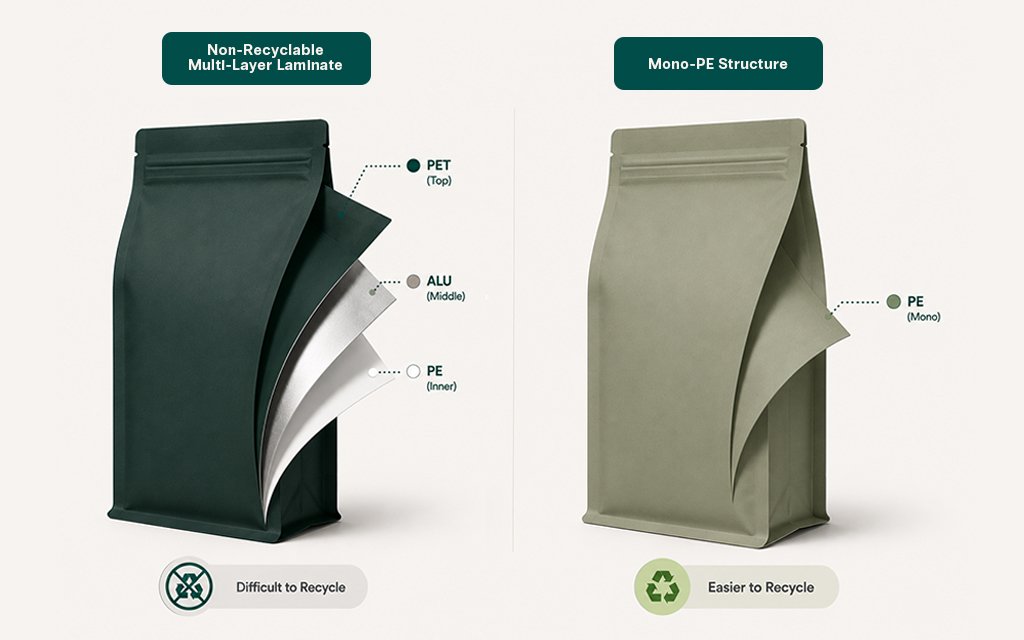
This shift tears up the traditional flexible packaging playbook. The CPG industry default for blocking oxygen, moisture, and UV degradation used to be straightforward. Brands can simply run a multi-material laminate, specifically the traditional PET/ALU/PE matrix. The incoming circular design guidelines strip away that option, making these non-recyclable mixed structures a total non-starter for future market access. The real challenge now is re-engineering the pouch for compliance while keeping the exact barrier performance needed to protect the product over its shelf life.
Achieving this requires moving away from legacy converter mentalities and stepping into advanced material science. By solving the barrier equation for the most chemically sensitive category, coffee, Zenpack provides a scalable blueprint for the entire flexible CPG spectrum. This approach enables brands to meet 2030 circularity targets through mono-material innovation while fully maintaining shelf stability and protecting the bottom line.
What is PPWR?
When the PPWR officially passed in February 2025, the old compliance playbook died. The official grace period vanishes on August 12, 2026. From that day forward, full enforcement takes over. These rules cover the entire lifecycle, checking everything from initial design and manufacturing to final material recovery. The 2030 boundary leaves no room for hesitation. Once that deadline hits, you lose access to the EU market unless your format is truly recyclable and makes commercial sense.
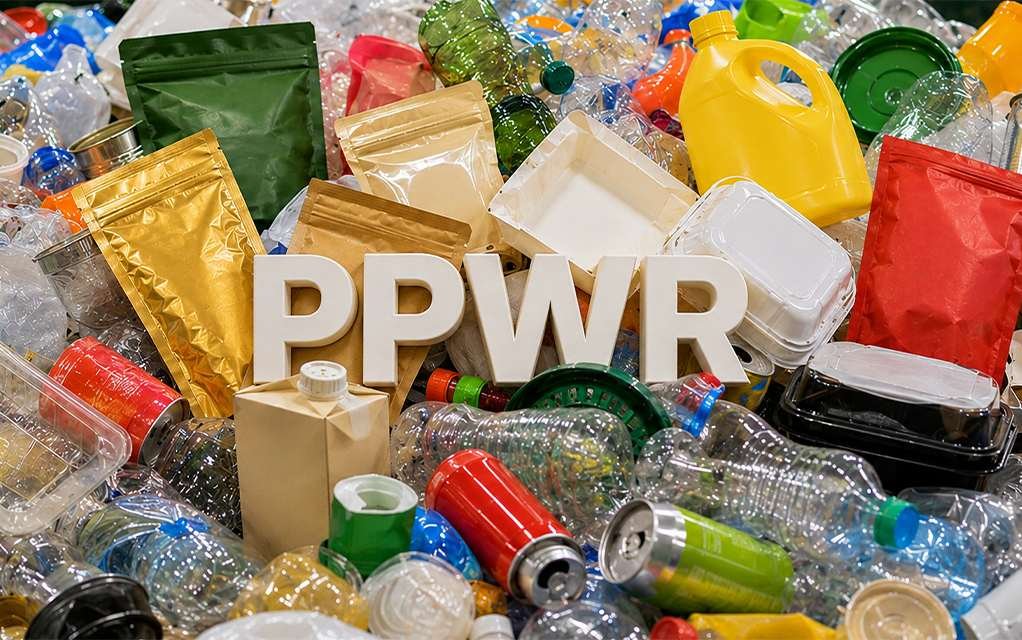
The PPWR skips right past simple post-consumer sorting to target packaging architecture directly. It enforces strict structural bans on specific single-use configurations and establishes an immediate zero-tolerance policy for hazardous chemical contaminants. This includes an aggressive phase-out of PFAS in food-contact packaging, a shift that instantly turns legacy grease- and moisture-proofing methods into major regulatory liabilities. Eco-design is no longer a tool for green marketing narratives; it is the absolute price of admission for market access.
What industries are high-risk under PPWR?
Zenpack uses tailored packaging engineering to neutralize the regulatory exposure of multi-material laminates. Building flexible packaging with a strict focus on a single polymer group simplifies the recycling process.
Specialty Coffee
Coffee packaging highlights this barrier equation perfectly. Traditionally, the industry relied on an aluminum foil layer to mitigate oxidation and the loss of volatile aromatics. While structurally protective, the inclusion of foil drops the pouch to an unrecyclable Grade D or E status under modern PPWR criteria.
Zenpack eliminates this vulnerability by replacing the aluminum with a high-barrier Mono-PE structure. Adding ultra-thin EVOH or SiOx coatings to this single-polymer base solves the barrier issue. The resulting pouch hits standard coffee shelf-life targets and stands out on retail shelves. More importantly, it clears the regulatory hurdle for a fully recyclable mono-material status.
Nutraceuticals & Functional Powders
Moisture instantly ruins functional powders and nutraceuticals. Formulas like collagen, protein, and vitamins absorb humidity like a sponge. If a package lets even a tiny amount of moisture leak inside during shipping, the powder clumps up and spoils immediately. To protect these regulated products, the traditional safeguard was thick foil laminates, but that approach no longer meets the PPWR grading scales.
Balancing barrier needs, logistics, and sustainability goals requires precise material adjustments. Zenpack pairs structural engineering with food-safe liners to cut carbon footprints without sacrificing performance.
Across these sectors, brands are adopting two distinct sustainability approaches: the first path targets straightforward component swaps within the material stack. Companies switch to PCR bottles, specify soy-based inks, and source FSC-certified paper. Others are completely disrupting their core architecture. They are either rolling out industrial compostable refill networks or replacing rigid bottles entirely with 100% flexible high-barrier mono-PE pouches.
Premium Snacks & Dry Foods
Premium snacks and dry foods rely heavily on metallized PET to protect crunch texture and shelf appeal. However, standard PET and PE combinations are immediately rejected by circular sorting infrastructure. Brands need an alternative, but they cannot afford a drop in barrier performance.
Zenpack bypasses this bottleneck with high-clarity Mono-PP structures built with internal metallization. We finish the surface with advanced choices like soy-ink compatible, water-based matte or gloss aqueous coatings. The physical output delivers an understated, premium tactile experience and high-end visual depth. Transitioning from unrecyclable film lamination to these recyclable coating formulations keeps the product safe. Brands lock in product quality and shelf presence. More importantly, the finished package sails straight through automated recycling systems.
PPWR Compliance Without Compromise: Engineering High-Performance Mono-Material Packaging
Transitioning away from legacy multi-layer configurations to meet EU PPWR mandates presents a significant physical challenge.
The Material Science: Eliminating Film Stretch with MDO and BOPE
In the old packaging, high-modulus PET acted as the rigid structural skeleton. It provided the necessary stiffness, upstand capabilities, and heat resistance.
Pure PE films, by contrast, are inherently ductile. Run them on automated Form-Fill-Seal (FFS) production lines, and that natural elasticity triggers severe stretching and deformation. This mechanical weakness spikes material waste and drives manufacturing costs. The final presentation looks distorted and completely misses brand expectations.
Zenpack eliminates this engineering gap using Machine Direction Orientation (MDO) and Biaxially Oriented Polyethylene (BOPE) technologies. Directional stretching during production mechanically forces the polymer’s molecular chains into a highly ordered, parallel alignment.
This structural realignment delivers a massive upgrade to the substrate’s tensile strength and flexural modulus. The resulting package provides the crisp tactile “snap,” rigid structural performance that matches legacy PET, while maintaining 100% mono-material circularity.
The Shelf Presence Challenge: Preventing Bag Sagging in Heavy Formats
High-volume mass production demands a flawless shelf presence. However, heavy payloads—like one-kilogram coffee bags or five-kilogram pet food sacks—will cause a standard mono-material film to sag.
Zenpack sloves this structural vulnerability by customizing resin blends and tweaking exact film thicknesses. We also engineer wide-gusset designs to maximize load-bearing capacities. This specific structure prevents base collapse and forces the pouch to keep its sharp, upright posture.
The Aesthetic Challenge: Eliminating the “Waxy” Look of Sustainable Plastics
Fixing physics is only half of the battle. Addressing the visual shortcomings of sustainable alternatives matters just as much. Standard PE base films naturally come out dull, waxy, or milky, which compromises the appearance and unboxing experience.
Zenpack bypasses this cosmetic flaw. Because we can source a structural base film that is natively clear and glossy, we apply custom matte ink overprinting directly onto the surface. This treatment hides the underlying polymer characteristics, creating an elegant, anti-glare, premium matte finish without relying on unrecyclable mixed-film laminations.
The Recycling Bottleneck: Mastering the “5% Non-Plastic Limit”
Securing a coveted Grade A recyclability rating under the PPWR requires mastering a strict structural limit: non-plastic components, including inks, adhesives, and functional barriers, must not exceed 5% of the total packaging mass.
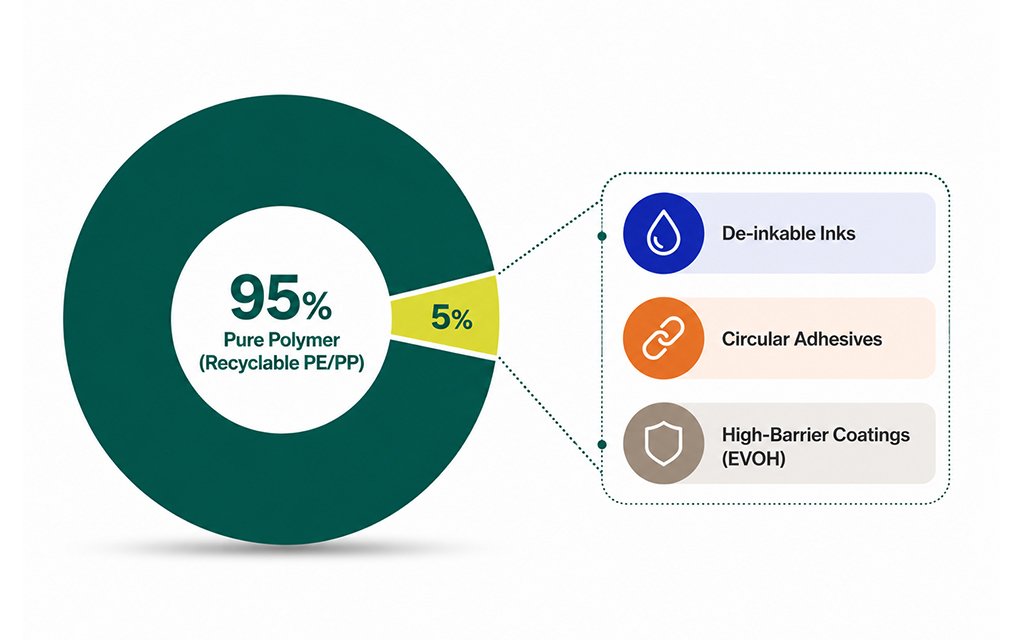
Zenpack manages this through our design strategy, which relies on single-polymer co-extrusion, micro-functional coatings, and chemistry built to cooperate with the recycling loop.
Conventional ink systems ruin recycling purity. Zenpack swaps them out for specialized water-based inks that deliver vivid graphics but maintain flawless de-inkability during processing.
For bonding, we introduce food-grade, solvent-free Circular Adhesives with an aqueous content of 98% or higher. Traditional adhesives turn yellow or emit foul odors during the recycling melt. These specialized formulations, by contrast, match the PE stream perfectly and wash off during the purification phase. This process protects the pure output of manufacturing resource management.
Replacing PFAS in Food Packaging
The EU’s total ban on per- and polyfluorinated substances (PFAS) forced food-contact packaging to find a new technical route. Zenpack achieves total compliance. without sacrificing critical grease resistance, water barriers, or anti-permeation stability.
Instead of relying on legacy fluorinated coatings or heavy UV lacquers, Zenpack utilizes a multi-pronged approach: base-material resin modification, functional co-extrusion, and a top layer of 100% biodegradable and recyclable water-based aqueous coatings.
Conclusion
The 2030 deadline under EU PPWR cuts through the noise. That threshold makes circular economy compliance non-negotiable. High-performance mono-material packaging has transitioned from a progressive branding differentiator into an immediate baseline requirement for global market access.
Navigating this technical transformation forces CPG leaders to rethink their setup. Fragmented sourcing fails here. You need complete, end-to-end packaging engineering to stay on the shelves.
Zenpack as a premier packaging engineering consultant, we tie our global facility network directly into the initial design phase. That early move syncs regulatory compliance with high-volume mass production before a single machine runs. Suddenly, barrier properties, premium aesthetics, and mechanical performance line up perfectly.
Reach out to Zenpack today. Let’s audit your current packaging and co-develop a scalable blueprint around your specific product requirements.
The post The PPWR Shift: Transitioning from Multi-Layer Laminates to Circular Mono-Material Coffee Pouches appeared first on Zenpack Blog.


