

A Complete Guide for Sustainable Facilities
Waste is one of the most overlooked but most powerful levers in sustainability. While organizations invest heavily in energy, carbon, and materials strategies, waste is often treated as an afterthought. That is a mistake.
Within the Triple Bottom Line framework developed by John Elkington, waste management is one of the only systems that directly impacts People, Planet, and Profit at the same time. It is visible to users, measurable in data, and actionable in operations.
This guide explains how waste supports each pillar and how to design a waste strategy that drives real sustainability performance.
What is the Triple Bottom Line
The Triple Bottom Line reframes business success beyond financial profit alone. It focuses on People, Planet, and Profit.
Waste sits at the intersection of all three, making it one of the most effective ways to operationalize sustainability in real and visible ways.
Waste and the Planet Environmental Impact
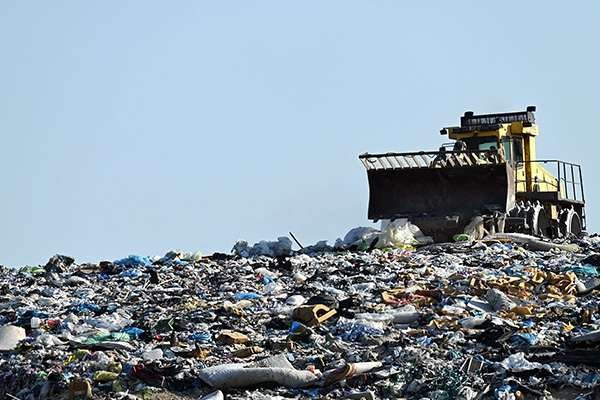
Waste is fundamentally an environmental issue. Every material that enters a landfill represents both lost resources and added environmental harm.
Landfill reduction is a primary goal.
Reducing waste sent to landfill extends landfill lifespan, reduces leachate and groundwater contamination, and minimizes long term environmental liabilities.
Greenhouse gas emissions are closely tied to waste.
Organic waste in landfills produces methane, a greenhouse gas far more potent than carbon dioxide. Food waste is one of the largest contributors to landfill emissions, and composting dramatically reduces this impact.
Resource conservation is another major benefit.
Recycling reduces the need for virgin materials. Aluminum recycling saves significant energy compared to new production, paper recycling reduces deforestation, and plastics recycling reduces fossil fuel demand.
Waste systems also enable a circular economy where materials are reused rather than discarded.
This requires proper separation at the source, clear signage, and alignment with downstream recycling and composting infrastructure.

Waste and People Social Impact
Waste is the most visible sustainability system in any building. It is where people interact with sustainability every day.
Public health and cleanliness are directly influenced by waste systems.
Poor systems lead to:
- Contamination
- Odors
- Pests
- Unsafe conditions
while well managed systems create cleaner and healthier environments.
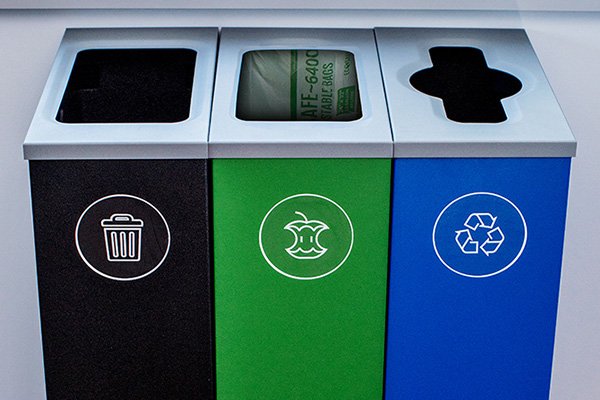
User experience and behavior are shaped by waste system design. Effective systems are intuitive, clearly labeled, and make the sustainable choice the easy choice. Design drives behavior more than policy alone.
Waste systems also play a role in education and culture. Every interaction with a bin is an opportunity to reinforce sustainability values and build engagement among employees, tenants, and visitors.
Worker safety is another critical factor. Custodial teams and waste haulers are directly impacted by how systems are designed. Efficient systems reduce heavy lifting, minimize contamination exposure, and improve workflow from front of house to back of house.
Waste also impacts brand and credibility. It is one of the most visible proofs of sustainability. If systems are confusing, overflowing, or poorly maintained, they undermine broader sustainability claims.
Waste and Profit Economic Impact
Waste is often viewed as a cost center, but it is actually a performance driver.
Cost reduction is one of the most immediate benefits. Reducing landfill waste lowers hauling costs, tipping fees, and the frequency of pickups. Operational efficiency improves when systems are well designed. Streamlined collection processes reduce labor inefficiencies and improve back of house operations.
There are also revenue opportunities. Materials such as cardboard, metals, and electronics can generate rebates when properly separated.
Waste data supports better decision making. Tracking waste enables performance monitoring, benchmarking, and continuous improvement across facilities.
Waste performance also contributes to ESG outcomes. Strong waste metrics support certifications such as LEED and WELL, improve investor confidence, and enhance stakeholder trust.
Why Waste is the Ultimate Triple Bottom Line Lever
Waste is unique because it is visible, measurable, and environmentally impactful at the same time.
It connects behavior, operations, and infrastructure in a way that few other sustainability initiatives do. It is one of the only systems where daily user interaction, operational execution, and measurable outcomes all intersect.
How to Build a Triple Bottom Line Waste Strategy
To fully leverage waste, organizations need to move beyond thinking about bins and instead think in systems.
The first step is to start with a waste audit. This establishes what is being generated, where it is generated, and how it is currently managed.
The next step is to design the full system. This includes front of house elements such as user facing bins, signage, and placement, as well as back of house elements such as collection processes, sorting areas, and hauling infrastructure.
Alignment with haulers and local infrastructure is essential. Materials collected must match what can actually be processed, and contamination must be minimized.
Training and engagement are critical to success. Programs should be launched with education, reinforced through communication, and supported with clear visual cues.
Ongoing tracking and improvement ensure long term success. Monitoring diversion rates, identifying contamination, and optimizing systems over time drives continuous performance gains.
Key Metrics to Track
To support the Triple Bottom Line, organizations should track diversion rate, total waste generated by stream, cost per ton, contamination rate, participation rates, and emissions impact where possible.
Final Takeaway
If sustainability is the goal, waste is the proof.
It is one of the only systems that people see every day, operations manage continuously, and leadership can measure and improve.
A well designed waste program does not just reduce trash. It drives environmental performance, user engagement, and financial results at the same time.


