How Much Paid Leave Do New Parents Get?
Key Takeaways
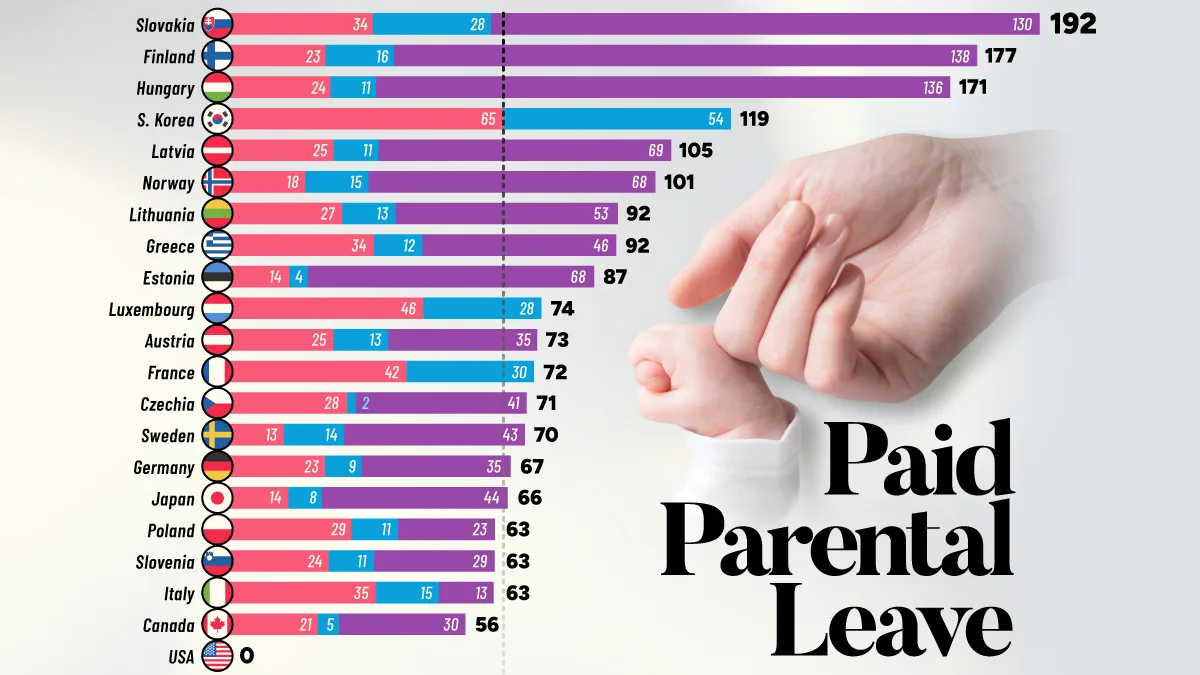
- Slovakia leads the OECD with 192 weeks of combined paid leave entitlements per child across maternity, paternity, and shared leave.
- Several countries provide more than two years of combined paid leave, compared with an OECD average of 65 weeks.
- The U.S. is the only OECD country with no national paid parental leave entitlement.
When a child is born, one question quickly becomes unavoidable for working parents: when do you go back to work?
Across OECD countries, the answer ranges from weeks to years, reflecting vastly different systems of parental support.
Using the latest available OECD data, this visualization compares paid birth-related leave entitlements across 38 countries. Figures are for 2024 and include time reserved for mothers and fathers, as well as leave that can be shared between parents.
The Countries Offering the Most Paid Leave
The OECD average stands at around 15 months of combined paid leave per child, but the total can mask significant differences in how that time is allocated.
Some countries concentrate benefits around mothers, while others reserve substantial time for fathers or give parents greater flexibility to divide leave between them.
| Country | Maternity | Paternity | Shared | Total Weeks Per Child |
|---|---|---|---|---|
 Slovakia Slovakia |
34.0 | 28.0 | 130.0 | 192.0 |
 Finland Finland |
22.8 | 16.2 | 138.2 | 177.2 |
 Hungary Hungary |
24.0 | 10.8 | 136.0 | 170.8 |
 South Korea South Korea |
64.9 | 54.0 | 0.0 | 118.9 |
 Latvia Latvia |
24.7 | 10.7 | 69.3 | 104.7 |
 Norway Norway |
18.0 | 15.0 | 68.0 | 101.0 |
 Lithuania Lithuania |
26.7 | 12.7 | 52.7 | 92.1 |
 Greece Greece |
34.3 | 11.5 | 45.9 | 91.7 |
 Estonia Estonia |
14.3 | 4.3 | 67.9 | 86.5 |
 Luxembourg Luxembourg |
46.0 | 28.0 | 0.0 | 74.0 |
 Austria Austria |
24.7 | 13.0 | 35.3 | 73.0 |
 France France |
42.0 | 30.2 | 0.0 | 72.2 |
 Czechia Czechia |
28.0 | 2.0 | 40.5 | 70.5 |
 Sweden Sweden |
12.9 | 14.3 | 42.9 | 70.1 |
 Germany Germany |
22.7 | 8.7 | 35.3 | 66.7 |
 Japan Japan |
14.0 | 8.0 | 44.0 | 66.0 |
 Poland Poland |
29.0 | 11.0 | 23.0 | 63.0 |
 Slovenia Slovenia |
23.6 | 10.7 | 28.6 | 62.9 |
 Italy Italy |
34.7 | 15.0 | 13.0 | 62.7 |
 Canada Canada |
21.0 | 5.0 | 30.0 | 56.0 |
 Belgium Belgium |
32.3 | 21.3 | 0.0 | 53.6 |
 Portugal Portugal |
23.3 | 22.3 | 6.9 | 52.5 |
 Denmark Denmark |
15.0 | 11.0 | 26.0 | 52.0 |
 Iceland Iceland |
26.0 | 20.0 | 6.0 | 52.0 |
 Ireland Ireland |
33.0 | 9.0 | 0.0 | 42.0 |
 UK UK |
39.0 | 2.0 | 0.0 | 41.0 |
 Netherlands Netherlands |
25.0 | 15.0 | 0.0 | 40.0 |
 Spain Spain |
16.0 | 16.0 | 0.0 | 32.0 |
 Chile Chile |
30.0 | 1.0 | 0.0 | 31.0 |
 New Zealand New Zealand |
26.0 | 0.0 | 0.0 | 26.0 |
 Colombia Colombia |
18.0 | 2.8 | 0.0 | 20.8 |
 Australia Australia |
2.0 | 2.0 | 16.0 | 20.0 |
 Costa Rica Costa Rica |
17.3 | 1.6 | 0.0 | 18.9 |
 Türkiye Türkiye |
16.0 | 1.0 | 0.0 | 17.0 |
 Switzerland Switzerland |
14.0 | 2.0 | 0.0 | 16.0 |
 Israel Israel |
15.0 | 0.0 | 0.0 | 15.0 |
 Mexico Mexico |
12.0 | 1.0 | 0.0 | 13.0 |
 U.S. U.S. |
0.0 | 0.0 | 0.0 | 0.0 |
 OECD Average OECD Average |
25.0 | 13.0 | 27.0 | 65.0 |
Slovakia tops the ranking with 192 combined weeks of paid leave entitlements per child, followed by Finland at 177 weeks and Hungary at 171. These totals combine maternity, paternity, and shared leave, so they do not represent the number of consecutive weeks a single parent can take.
For perspective, Canada provides 56 combined weeks, the UK 39, and Australia 22, compared with Slovakia’s 192.
How Parental Leave Has Evolved
The length of parental leave is only part of the story. Over the past half-century, many countries have also redesigned these policies around how time is divided between parents.
Sweden became the first country to introduce paid parental leave for both mothers and fathers in 1974, while Norway pioneered a non-transferable father quota in 1993.
Since then, father-specific leave has spread widely. South Korea now stands out with 54 weeks reserved for fathers, compared with an OECD average of 13 weeks. These policies can give families more time at home while encouraging fathers to take on more childcare and helping both parents stay connected to their careers.
Family policies are also evolving as fertility rates decline across wealthy economies. Today, 37 of 38 OECD countries have fertility rates below replacement level.
The U.S. Stands as an Outlier
At the opposite end of the ranking, the U.S. is the only OECD country without a national paid maternity leave entitlement and one of three without national paid leave for fathers.
American parents may still receive paid time through state programs or employers. Thirteen states and Washington, D.C., have enacted paid family and medical leave programs.
The stakes extend beyond time at home. First-time mothers who used paid leave were more likely to return to the same employer after childbirth (92.3% vs. 73.3%), highlighting how parental leave can shape career continuity as well as family life.
Learn More on the Voronoi App
To learn more about this topic, check out this graphic on the cost of raising a child in each state.
- Source: https://www.visualcapitalist.com/ranked-which-countries-give-new-parents-the-most-paid-leave/