 See more visuals like this on the Voronoi app.
Mapped: Europe’s GDP Growth Forecasts for 2026
See visuals like this from many other data creators on our Voronoi app. Download it for free on iOS or Android and discover incredible data-driven charts from a variety of trusted sources.
Key Takeaways
- Europe’s largest economies are forecast to grow below 1% in 2026.
- Germany and France are both projected at 0.9%, while Italy lags at 0.8%.
- Eastern and Southeastern Europe lead growth, with several countries above 3–5%.
Europe’s gross domestic product (GDP) is projected to grow by only 2.3% on average in 2026, held back by sluggish growth in major eurozone markets such as France, Germany, and Italy. However, other regions are expected to see faster economic expansion, especially in Southern and Eastern Europe.
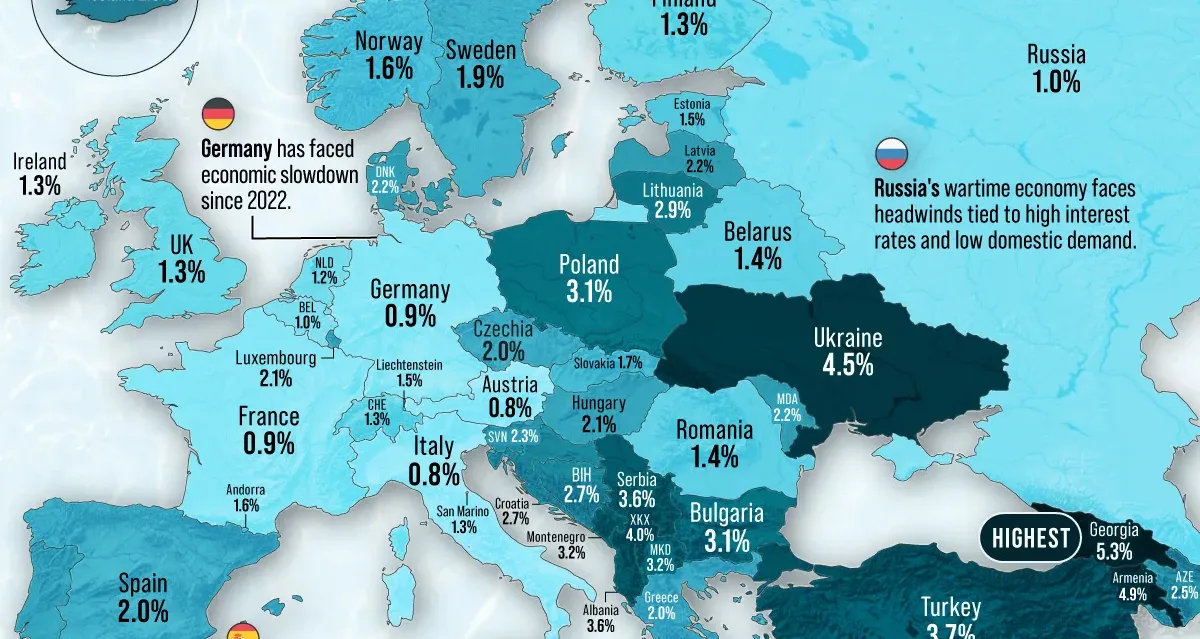
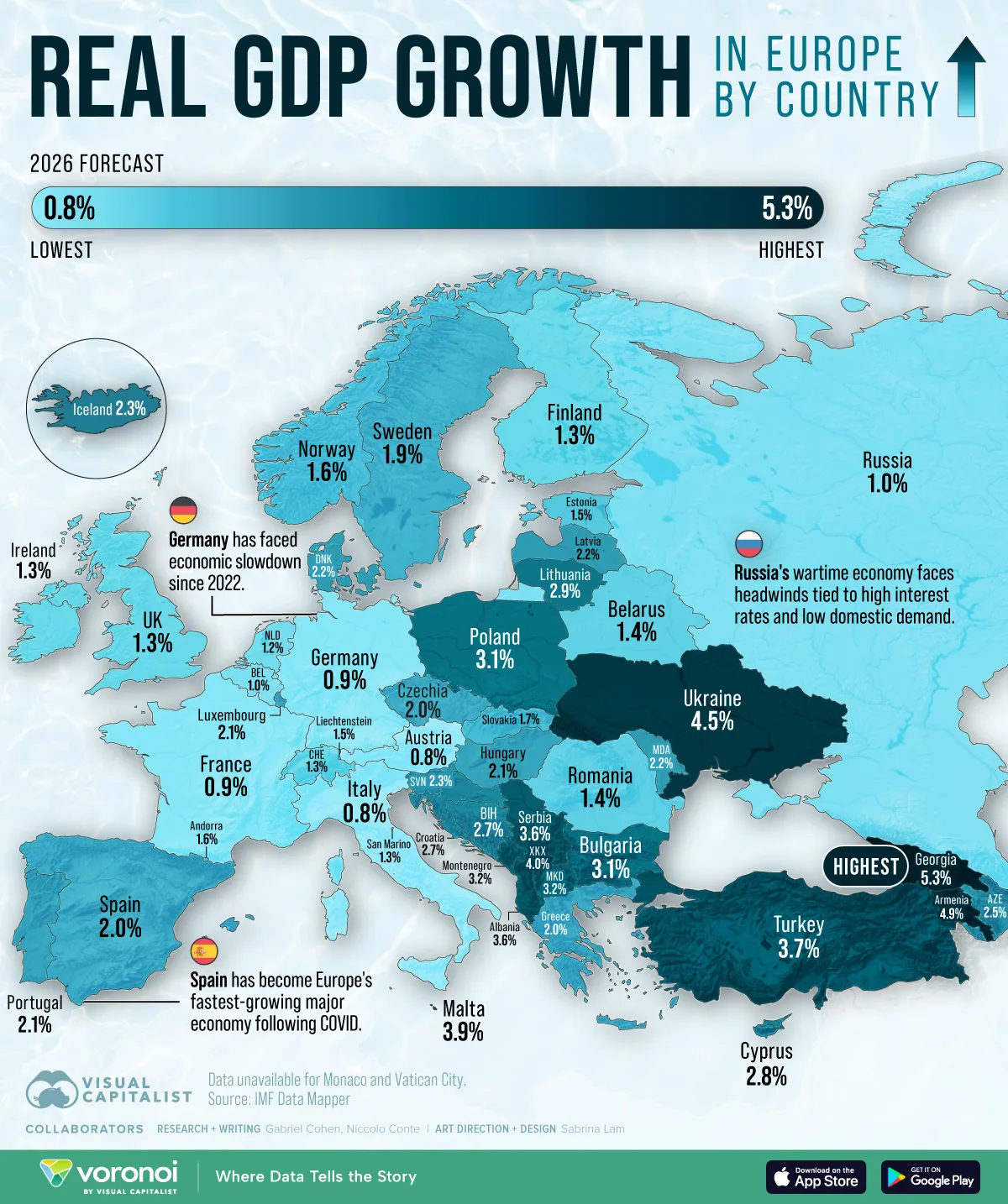
This map showcases forecasted European GDP growth rates for 2026 utilizing data from the International Monetary Fund (IMF).
Across the Old Continent, growth is constrained by high regulation, weak demand, and a difficult global environment, with heavy export-led economies like Germany particularly impacted.
Germany’s Years-Long Hangover
Germany, the third-largest economy worldwide, is facing deep structural problems with its market structure. Following two consecutive years of recession, Europe’s largest economy barely grew at all in 2025, and is expected to see just 0.9% growth in 2026, ahead of only two other European Union (EU) member states.
The data table below provides a 2026 forecast of European GDP growth.
| Country | Real GDP Growth (%) |
|---|---|
 Albania Albania |
3.6 |
 Andorra Andorra |
1.6 |
 Armenia Armenia |
4.9 |
 Austria Austria |
0.8 |
 Azerbaijan Azerbaijan |
2.5 |
 Belarus Belarus |
1.4 |
 Belgium Belgium |
1 |
 Bosnia and Herzegovina Bosnia and Herzegovina |
2.7 |
 Bulgaria Bulgaria |
3.1 |
 Croatia Croatia |
2.7 |
 Cyprus Cyprus |
2.8 |
 Czechia Czechia |
2 |
 Denmark Denmark |
2.2 |
 Estonia Estonia |
1.5 |
 Finland Finland |
1.3 |
 France France |
0.9 |
 Georgia Georgia |
5.3 |
 Germany Germany |
0.9 |
 Greece Greece |
2 |
 Hungary Hungary |
2.1 |
 Iceland Iceland |
2.3 |
 Ireland Ireland |
1.3 |
 Italy Italy |
0.8 |
 Kosovo Kosovo |
4 |
 Latvia Latvia |
2.2 |
 Liechtenstein Liechtenstein |
1.5 |
 Lithuania Lithuania |
2.9 |
 Luxembourg Luxembourg |
2.1 |
 Malta Malta |
3.9 |
 Moldova Moldova |
2.2 |
 Montenegro Montenegro |
3.2 |
 Netherlands Netherlands |
1.2 |
 North Macedonia North Macedonia |
3.2 |
 Norway Norway |
1.6 |
 Poland Poland |
3.1 |
 Portugal Portugal |
2.1 |
 Romania Romania |
1.4 |
 Russia Russia |
1 |
 San Marino San Marino |
1.3 |
 Serbia Serbia |
3.6 |
 Slovakia Slovakia |
1.7 |
 Slovenia Slovenia |
2.3 |
 Spain Spain |
2 |
 Sweden Sweden |
1.9 |
 Switzerland Switzerland |
1.3 |
 Turkey Turkey |
3.7 |
 Ukraine Ukraine |
4.5 |
 United Kingdom United Kingdom |
1.3 |
Between 2005 and 2019, Germany experienced what has been termed the “labor market miracle,” an era of economic expansion powered by high employment growth, low interest rates, and cheap energy. However, this period came to an abrupt end with the COVID-19 pandemic and especially with Russia’s invasion of Ukraine, which sent energy prices skyrocketing and all but halted German growth.
Germany’s post-COVID economic situation is a perfect storm of challenges. Energy prices have remained high owing to Russia’s ongoing war in Ukraine and escalating conflicts in the Middle East. German industry, the pride of the country, is increasingly being squeezed by both U.S. tariffs as well as massive Chinese competition. Major trade deals and deregulation efforts are being hamstrung by political gridlock in both Berlin and Brussels, the latter being the EU’s political capital.
Today, the EU’s modest growth forecast for 2026 can be attributed in no small part to the severe economic woes faced by its main economic engine. So long as Germany is not able to modernize its economy and restore its prior growth levels from previous decades, the EU as a whole will face severe headwinds.
Europe’s Other Major Economies
Beyond Berlin, the news remains grim for the other major economies of Europe.
France is projected to match Germany’s sluggish growth of just 0.9%, while Italy is tied with Austria for the continent’s slowest growth (0.8%). Russia (1%) is still held back by the high interest rates and low domestic demand of its wartime economy, while the United Kingdom (1.3%) fares only slightly better.
Spain has been touted as the eurozone’s newest star, with the Iberian country becoming the fastest-growing Western major economy on the backs of high post-COVID public investment and strong renewable energy resources. While the forecast of 2% for 2026 represents a slowdown from the 2.8-3.5% seen in recent years, Spanish fortunes have flipped as dramatically as their German counterparts’ from the eurozone crisis of the 2010s.
The Rise of Europe’s East and South
Of course, Spain is far from the only country rewriting its reputation in real time. Poland (3.1%) is another EU heavyweight in the making, while the tiny island country of Malta’s impressive 3.9% is likely to be the highest economic expansion in the bloc.
Outside of the EU, countries in Eastern Europe and the Caucasus emerge as major growth hubs, led by Georgia (5.3%), Armenia (4.9%), and war-torn Ukraine (4.5%).
Turkey, the top economy of the Eastern Mediterranean, faces a growth projection of 3.7%, although its results are tampered by an inflation rate hovering around 30% following peaks in 2022 and 2024.
Learn More on the Voronoi App
If you enjoyed today’s post, check out Comparing Electricity Prices for Household Consumers in Europe on Voronoi.