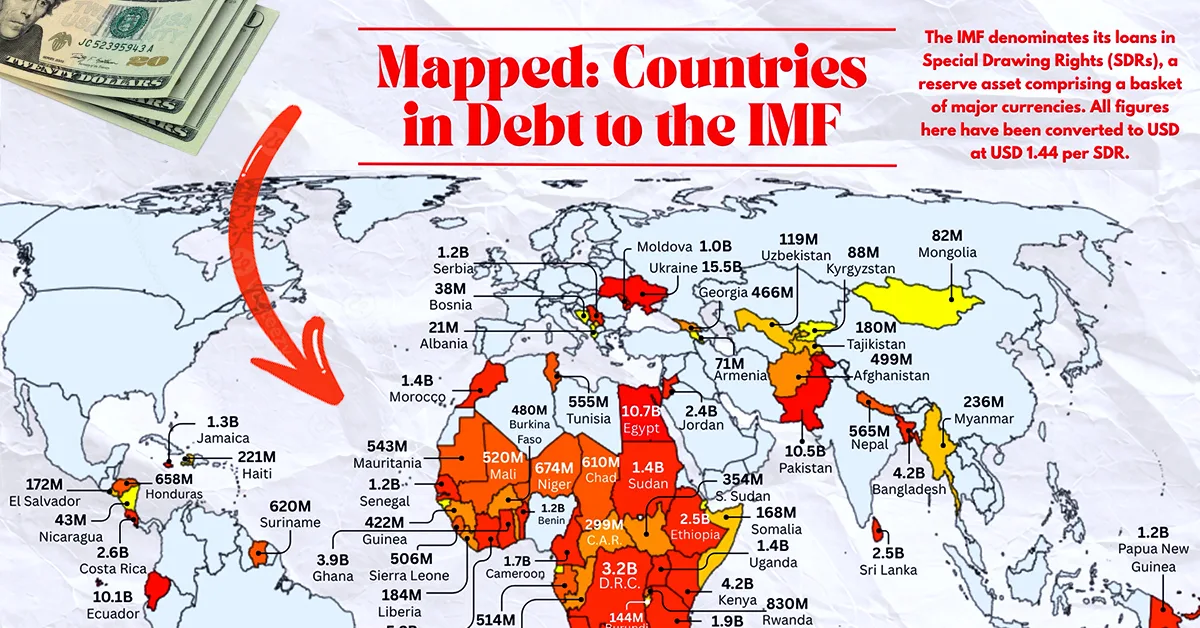
Mapped: The Countries Most in Debt to the IMF
This was originally posted on our Voronoi app. Download the app for free on iOS or Android and discover incredible data-driven charts from a variety of trusted sources.
Key Takeaways
- Argentina owes over $60B to the IMF—far more than any other country.
- More than 80 countries currently owe the IMF, spanning every region.
- African nations make up the largest share of borrowers, though typically with smaller loans.
Dozens of countries are currently relying on the International Monetary Fund as economic pressures strain public finances.
This map, created by Iswardi Ishak using International Monetary Fund (IMF) data, shows outstanding IMF credit by country as of April 2026.
While borrowing is widespread, a handful of countries account for a disproportionate share—led by Argentina, which stands far ahead of the rest.
The Biggest IMF Borrowers
Argentina isn’t just the largest IMF borrower—it’s in a league of its own, owing nearly four times more than the next-largest country.
With over $60 billion in outstanding credit, Argentina’s total reflects a long cycle of inflation crises, currency instability, and repeated IMF programs stretching back decades.
Below, we break down the global distribution of IMF debt and highlight the largest borrowers.
| Rank | Member | IMF Debt (USD, millions) | IMF Debt as share of GDP (%) |
|---|---|---|---|
| 1 |  Argentina Argentina |
60,176 | 8.7 |
| 2 |  Ukraine Ukraine |
15,481 | 6.9 |
| 3 |  Egypt Egypt |
10,669 | 2.5 |
| 4 |  Pakistan Pakistan |
10,500 | 2.6 |
| 5 |  Ecuador Ecuador |
10,082 | 7.3 |
| 6 |  Côte d’Ivoire Côte d’Ivoire |
5,189 | 5.3 |
| 7 |  Kenya Kenya |
4,216 | 2.9 |
| 8 |  Bangladesh Bangladesh |
4,157 | 0.8 |
| 9 |  Ghana Ghana |
3,947 | 3.3 |
| 10 |  Angola Angola |
3,510 | 2.3 |
| 11 |  Congo (DRC) Congo (DRC) |
3,201 | 3.5 |
| 12 |  Costa Rica Costa Rica |
2,555 | 2.3 |
| 13 |  Ethiopia Ethiopia |
2,541 | 2.1 |
| 14 |  Sri Lanka Sri Lanka |
2,537 | 2.6 |
| 15 |  Jordan Jordan |
2,371 | 3.7 |
| 16 |  Tanzania Tanzania |
1,923 | 2.0 |
| 17 |  Zambia Zambia |
1,831 | 4.4 |
| 18 |  Cameroon Cameroon |
1,684 | 2.6 |
| 19 |  Sudan Sudan |
1,428 | 3.2 |
| 20 |  Uganda Uganda |
1,378 | 1.9 |
| 21 |  Morocco Morocco |
1,350 | 0.7 |
| 22 |  Jamaica Jamaica |
1,278 | 5.6 |
| 23 |  Papua New Guinea Papua New Guinea |
1,237 | 3.6 |
| 24 |  Serbia Serbia |
1,226 | 1.1 |
| 25 |  Senegal Senegal |
1,214 | 3.0 |
| 26 |  Benin Benin |
1,163 | 4.2 |
| 27 |  Moldova Moldova |
1,016 | 4.6 |
| 28 |  Madagascar Madagascar |
988 | 4.7 |
| 29 |  Rwanda Rwanda |
830 | 4.8 |
| 30 |  Niger Niger |
674 | 2.7 |
| 31 |  Honduras Honduras |
658 | 1.6 |
| 32 |  Suriname Suriname |
620 | 10.5 |
| 33 |  Chad Chad |
610 | 2.4 |
| 34 |  Barbados Barbados |
574 | 6.8 |
| 35 |  Nepal Nepal |
565 | 1.2 |
| 36 |  Tunisia Tunisia |
555 | 0.9 |
| 37 |  Mauritania Mauritania |
543 | 3.8 |
| 38 |  Mali Mali |
520 | 1.5 |
| 39 |  Gabon Gabon |
514 | 2.2 |
| 40 |  Sierra Leone Sierra Leone |
506 | 6.1 |
| 41 |  Congo, Republic of Congo, Republic of |
499 | 3.2 |
| 42 |  Afghanistan Afghanistan |
499 | 2.5 |
| 43 |  Burkina Faso Burkina Faso |
480 | 1.5 |
| 44 |  Georgia Georgia |
466 | 1.1 |
| 45 |  Togo Togo |
432 | 3.2 |
| 46 |  Guinea Guinea |
422 | 1.4 |
| 47 |  Malawi Malawi |
388 | 2.1 |
| 48 |  South Sudan South Sudan |
354 | 6.2 |
| 49 |  Paraguay Paraguay |
334 | 0.6 |
| 50 |  Central African Republic Central African Republic |
299 | 8.6 |
| 51 |  North Macedonia North Macedonia |
278 | 1.5 |
| 52 |  Liberia Liberia |
264 | 4.7 |
| 53 |  El Salvador El Salvador |
248 | 0.6 |
| 54 |  Myanmar Myanmar |
236 | 0.3 |
| 55 |  Haiti Haiti |
221 | 0.6 |
| 56 |  The Gambia The Gambia |
217 | 7.8 |
| 57 |  Kosovo Kosovo |
205 | 1.5 |
| 58 |  Tajikistan Tajikistan |
180 | 0.9 |
| 59 |  Somalia Somalia |
168 | 1.2 |
| 60 |  Seychelles Seychelles |
149 | 6.6 |
| 61 |  Burundi Burundi |
144 | 1.8 |
| 62 |  Uzbekistan Uzbekistan |
119 | 0.1 |
| 63 |  Cabo Verde Cabo Verde |
118 | 3.4 |
| 64 |  Kyrgyzstan Kyrgyzstan |
88 | 0.4 |
| 65 |  Mongolia Mongolia |
82 | 0.3 |
| 66 |  Guinea-Bissau Guinea-Bissau |
81 | 2.7 |
| 67 |  Armenia Armenia |
71 | 0.2 |
| 68 |  Nicaragua Nicaragua |
62 | 0.3 |
| 69 |  Equatorial Guinea Equatorial Guinea |
45 | 0.3 |
| 70 |  Sao Tome & Principe Sao Tome & Principe |
44 | 4.5 |
| 71 |  Djibouti Djibouti |
41 | 0.9 |
| 72 |  Bosnia and Herzegovina Bosnia and Herzegovina |
38 | 0.1 |
| 73 |  Comoros Comoros |
38 | 2.1 |
| 74 |  St. Lucia St. Lucia |
28 | 1.1 |
| 75 |  St. Vincent and the Grenadines St. Vincent and the Grenadines |
27 | 2.3 |
| 76 |  Maldives Maldives |
24 | 0.3 |
| 77 |  Grenada Grenada |
23 | 1.6 |
| 78 |  Samoa Samoa |
21 | 1.5 |
| 79 |  Albania Albania |
21 | 0.1 |
| 80 |  Tonga Tonga |
20 | 2.8 |
| 81 |  Lesotho Lesotho |
15 | 0.5 |
| 82 |  Dominica Dominica |
13 | 1.7 |
| 83 |  Solomon Islands Solomon Islands |
9 | 0.5 |
The next largest borrowers include Ukraine, Egypt, and Pakistan. Meanwhile, dozens of countries owe under $1 billion, particularly across Africa.
Suriname stands out on a relative basis rather than in absolute terms. The South American nation has the highest IMF debt as a share of GDP, reflecting a severe economic crisis in the early 2020s. After years of fiscal mismanagement, declining oil revenues, and mounting external debt, Suriname defaulted on its sovereign obligations in 2020.
This triggered an IMF-supported restructuring program aimed at stabilizing public finances and curbing inflation. The adjustment process has involved significant austerity measures and currency depreciation.
Why Countries Turn to the IMF
Countries typically borrow from the IMF during periods of economic distress. These situations often fall into a few common categories:
- Balance of payments crises: When nations cannot pay for imports or service external debt.
- Currency instability: Sharp devaluations or loss of foreign reserves.
- Fiscal imbalances: Large government deficits and rising public debt.
For example, Argentina has repeatedly sought IMF assistance amid inflation and currency crises, while nations like Sri Lanka and Pakistan have turned to the IMF during severe external debt pressures.
How IMF Debt Works
Unlike traditional loans, IMF financing is denominated in Special Drawing Rights (SDRs), an international reserve asset created by the IMF. SDRs are based on a basket of major currencies:
- U.S. dollar
- Euro
- Chinese yuan
- Japanese yen
- British pound
Countries receive SDR allocations or loans, which can then be exchanged for hard currency. For this dataset, IMF figures were converted into U.S. dollars (roughly $1.44 per SDR).
Africa’s Prominent Role Among Borrowers
Africa stands out not for the size of its IMF loans, but for how widespread they are. The continent has the highest number of borrowing countries, reflecting persistent structural challenges that make external financing a recurring necessity.
This reflects structural challenges such as:
- Commodity dependence
- Limited fiscal capacity
- Exposure to external shocks
Many African nations borrow relatively smaller amounts, but their reliance on IMF support is widespread.
Criticism and Controversy
Despite its role as a financial backstop, the IMF has faced criticism over its policy conditions. Loan programs often require economic reforms, such as austerity measures, that can be politically and socially challenging.
Critics argue these conditions can slow growth or worsen inequality, while supporters say they are necessary for long-term stability.
Learn More on the Voronoi App 
Explore related insights on global debt dynamics in this visualization: Africa’s Chinese Debt.