
As electricity demand in the United States continues to grow — from data centers, electric vehicles, and other large loads — utilities are struggling to keep up. Instead of building more traditional power plants, utilities can meet that demand in a cleaner and cheaper way by also turning to virtual power plants (VPPs).
VPPs are aggregations of distributed energy resources such as batteries, electric vehicles, smart thermostats, and other connected devices that can provide utility-scale and utility-grade services. Designing VPP Programs to meet utilities’ needs, however, requires planning. Just as traditional grid resources are weighed in utilities’ plans, VPPs should also be considered, modeled, and included in the utility planning process.
Today, existing and proposed VPPs are approaching and exceeding the scale of traditional power plants. In 2024, the average combustion gas turbine in the United States was 180 megawatts (MW). Meanwhile, several VPP programs across the country have met or exceeded this capacity:
- In Massachusetts, National Grid launched ConnectedSolutions in 2016, which has grown to 227 MW and includes residential thermostats, residential batteries, and commercial and industrial demand response. Beyond Massachusetts, ConnectedSolutions’ region-wide, open-access VPP shaved 375 MW of demand from the New England grid during a multi-day heat wave in June 2024.
- In California, the Emergency Load Reduction Program (ELRP) and Demand Side Grid Support (DSGS) programs were launched in 2021 and 2022 respectively, to shore up near-term reliability quickly in response to rolling blackouts. The ELRP reached nearly 800 MW as of 2023 and DSGS has reached 1,145 MW as of October 2025 with a majority of the program’s capacity — 768 MW — stemming from the market-aware storage pilot program.
-
In Texas, NRG and Renew Home announced a partnership to develop a 1 gigawatt (GW) VPP by 2035 driven by smart thermostat usage; as of 2025 NRG has reached 150 MW. Meanwhile, CPS Energy started its VPP pilot over 10 years ago, which has grown to over 250 MW in size as of 2024 with 175,000 customers.
Recent policy and momentum in other states will drive further development of VPPs at this scale. In the past year, the Virginia legislature directed Dominion Energy to develop a VPP pilot program for 450 MW, New Jersey’s governor issued an executive order for the New Jersey Board of Public Utilities to develop a VPP program within six months, and the Colorado legislature directed Xcel Energy to create its first virtual power plant program, which has developed into a 125 MW proposal that was recently approved by state regulators.
Meanwhile, utilities have also directly taken actions to scale VPPs. For example, Xcel Energy in Minnesota plans to procure up to 200 MW of distributed storage, and Georgia Power recently agreed to procure up to 100 MW of new distributed solar and storage.
At these scales, VPPs can provide significant support to utilities in matching supply with demand and maintaining the reliability of the grid. Fortunately, many existing VPPs have already proven their value in both standard and emergency conditions.
During Winter Storm Elliot in 2022, providers across the region provided support by leveraging customer-sited distributed energy resources. CPower, for example, reported providing 50 GWh of energy. And during the 2025 summer heat dome that swept across the eastern United States, numerous VPP aggregators helped manage customer demand across the region to maintain a reliable grid.
For example, on June 24th — one of the region’s highest demand days — Sunrun leveraged more than 340 MW of customer-sited batteries to support the evening net peak, and EnergyHub shed 900 MW of peak load and shifted 3.5 GWh of energy to non-peak periods. And over the course of the, Uplight managed 350 MW of flexible load, all of which supported grid operators in keeping the lights on amid record heat.
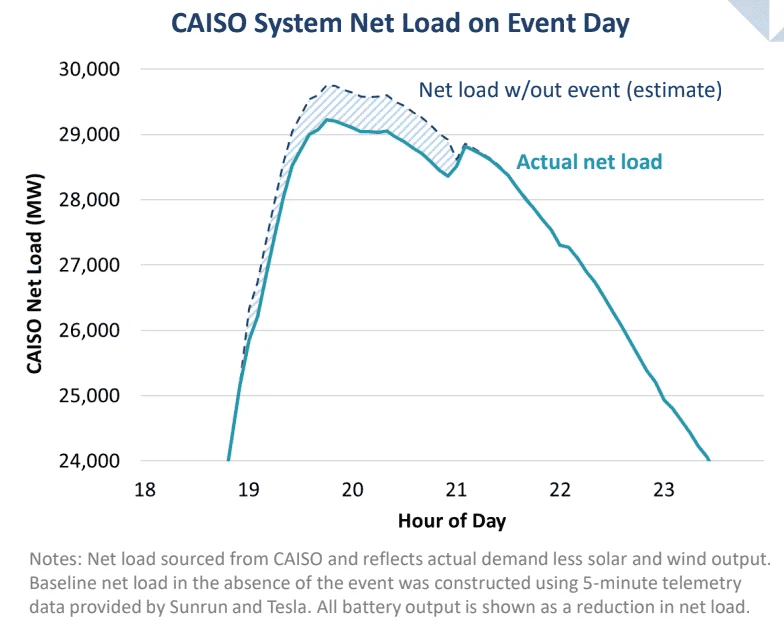
Additionally, a test event on July 29 of California Independent System Operator’s (CAISO’s) Demand Side Grid Support program provided more than 500 MW of demand relief during the afternoon in which net load — demand minus renewables — is highest. The chart below shows the impact of the CAISO VPP test. By simultaneously discharging behind-the-meter energy storage from across the state, VPPs flattened net peak demand between 7:30 and 9:30 p.m.
Exhibit 1
CAISO event day system net load, with and without VPP dispatch
Similar applications of VPPs are starting to emerge on the distribution system, enabling cost savings and making these resources even more attractive to customers and utilities. For example, as part of its 2024 Grid Modernization plan, National Grid found that at least two of its feeder expansion projects could feasibly and cost-effectively be deferred for five years each by leveraging virtual power plant programs, creating near-term savings for customers while benefitting the grid. And Pacific Gas & Electric recently incorporated two battery projects onto its grid that are able to support local distribution overloads, avoid feeder and transformer upgrades, and can participate in the wholesale energy market and support the larger electrical grid.
Despite the growth in VPPs, utility plans aren’t keeping up
To ensure power delivered to customers is both affordable and reliable, many utilities develop regular long-term plans for their electricity generation and distribution systems —called integrated resource plans (IRPs) and distribution system plans (DSPs), respectively. Utilities that develop these plans do so to ensure that they can deliver power to customers under a range of future scenarios at lowest cost to customers. In these plans, the costs and benefits of various investment options are weighed against each other in order to select the least-cost options to meet all of the utilities’ energy needs while maintaining a reliable grid.
VPPs have increasingly been appearing in state-level regulatory filings, including IRPs, DSPs, and other regulatory dockets (Exhibit 2), reflecting an uptick in utility adoption and increasing interest in these technologies from utilities, regulators, and additional stakeholders. As of 2023, there were already more than 500 VPP programs in operation, serving 30 to 60 GW of peak demand.
Exhibit 2
window.addEventListener(“message”, function (a) { if (void 0 !== a.data[“datawrapper-height”]) { var e = document.querySelectorAll(“iframe”); for (var t in a.data[“datawrapper-height”]) for (var r, i = 0; r = e[i]; i++)if (r.contentWindow === a.source) { var d = a.data[“datawrapper-height”][t] + “px”; r.style.height = d } } });
However, despite the increasing prevalence of VPPs in utility plans and regulatory filings, these mentions do not indicate that utilities are fully accounting for the value that VPPs are providing to their systems (Exhibit 3).
Exhibit 3
window.addEventListener(“message”, function (a) { if (void 0 !== a.data[“datawrapper-height”]) { var e = document.querySelectorAll(“iframe”); for (var t in a.data[“datawrapper-height”]) for (var r, i = 0; r = e[i]; i++)if (r.contentWindow === a.source) { var d = a.data[“datawrapper-height”][t] + “px”; r.style.height = d } } });
RMI reviewed a nationally representative sample of IRPs and DSPs and found that utilities do not account for VPPs in the same way in their respective plans, if they account for them at all (Exhibit 4).
Exhibit 4
window.addEventListener(“message”, function (a) { if (void 0 !== a.data[“datawrapper-height”]) { var e = document.querySelectorAll(“iframe”); for (var t in a.data[“datawrapper-height”]) for (var r, i = 0; r = e[i]; i++)if (r.contentWindow === a.source) { var d = a.data[“datawrapper-height”][t] + “px”; r.style.height = d } } });
We found that there are significant benefits that VPPs can provide to utilities and customers, but two shortfalls in planning often prevent the expansion of VPPs in resource plans.
First, VPPs are often not evaluated as a selectable resource for expansion, unlike other utility generating options. Traditional assets used in bulk system and distribution system modeling include associated capital and operating costs, reliability contributions, assumed operating profiles, and other relevant inputs, including operating limitations, reasonable build rates and times, location-specific cost-benefit analyses when appropriate, and others.
By including detailed representations of traditional resource options, models can select the resources best suited and lowest cost to meet future energy and infrastructure needs. However, VPPs often do not get the same modeling treatment, and instead are given fixed rates of expansion that do not account for the economic expansion of VPPs on the grid.
Additionally, VPPs can have restrictive parameters based on current VPP programs or existing grid needs that don’t evolve over time or reflect actual grid performance. This can prevent VPPs from being viewed as long-term perennial assets that can support grid needs into the future. As such, the ability of VPPs to expand and offset new generation in models is limited compared to their real-world potential.
A second shortfall we see in planning is the exclusion of the many benefits and value streams that VPPs provide. VPPs provide benefits to both the bulk power system and distribution system and can include benefits beyond reducing demand during peak periods.
However, many of the benefits that VPPs provide are lacking in cost-benefit analyses and in operating parameters used in modeling, which can under-estimate their economic value and usefulness, especially when comparing them to other generating assets. For example, when VPPs aren’t being modeled as options to support grid stability or mitigate distribution system upgrades, utilities may be led to build redundant generating assets or substations to meet these needs at customers’ expense. Without capturing the full value-stream of VPPs, their ability to economically offset new generation and investment options is stymied and can lead to inefficient grid expansion.
Despite inconsistencies, many utilities are working to address the VPP modeling gap.
To ensure that utility plans enable VPPs to deliver on their potential and reduce costs, they must be meaningfully included in utility plans, with detailed capacity values, reliability attributes, cost assumptions, and benefit streams. In other words, they need to be evaluated on an even playing field against conventional resources.
In distribution plans, VPPs should be considered to avoid or defer distribution system upgrades or otherwise reduce system costs by providing locational services. While utility plans as a whole may not be modeling VPPs in a consistent way that shows their full effect on the grid, we have seen some best practices emerge in utility plans that address typical VPP modeling shortfalls that are worth highlighting.
Best practices: Portland General Electric
Portland General Electric (PGE) does robust modeling of the components that comprise a VPP — distributed energy resources, flexible load, and batteries — to inform both its distribution planning and integrated resource planning. In integrated resource planning, PGE takes a novel approach to integrating its VPP components to ensure that the VPPs that are cost-effective today are properly accounted for, and VPPs that may be more cost-effective in the future — especially compared to other supply-side options — have the chance to be selected to serve future energy and reliability needs.
Through robust technical and locationally granular modeling in the distribution plan, the utility finds the VPP assets that provide benefits that exceed costs today and leverages them to modify and offset its future demand. Afterwards, the utility treats the remaining VPP assets — those that can realistically be deployed but may provide more value in the future — as options that can be selected to meet future demand alongside other supply-side assets.
Importantly, the utility develops an Effective Load Carrying Capacity (ELCC) — a metric used to value a resource’s contribution to the grid during periods of grid stress — for distributed resources, along with operating characteristics and costs of the VPP resources.
By approaching its modeling this way, PGE can identify the opportunities to expand VPP resources that currently provide more benefits to customers than costs, while continuing to evaluate whether additional expansion of or modification to VPP programs could provide customer benefits in the future
Best practices: Green Mountain Power
Green Mountain Power (GMP) in Vermont has also been a leader in quantifying emerging value streams on both the bulk power and distribution systems, which has led to expanding VPP programs.
In its planning, GMP accounted for numerous value streams of VPPs. As a result. it proposed expanding its distributed solar and flexible load programs — including on EV charging and commercial and industrial load management — to capture new regional benefits and defer spending on new transmission and generating capacity.
The benefits that GMP highlights for VPPs, which factor into its expansion plan, include lowering capacity and transmission peaks, which reduce RTO demand charges and transmission expansion costs; providing frequency regulation to the region; resilience benefits during extreme weather events; deferred distribution system upgrades; reduced load; and improved stability on local distribution systems.
Planners and decision makers can support VPP growth through modeling improvements
As virtual power plants continue to become grid assets that rival the scale and characteristics of traditional power plants and grid infrastructure, utilities need to weigh them on equal footing with their conventional counterparts. To do this, utilities and regulators can consider the following modeling improvements:
-
Develop resource attributes of VPPs so that they can be evaluated like traditional investment options. The characteristics of virtual power plants and the costs and benefits of VPP programs must be part of the utility planning process so that utilities are able to evaluate VPPs against other traditional investment options. Regulators and utilities can work to ensure that key characteristics of VPPs — namely reliability contributions, costs and benefits, and operational profiles — are properly incorporated into planning.
-
Allow opportunities for growth of VPPs in models. Once VPPs are able to be compared to traditional investment options, utility models need to be allowed to select VPPs as a feasible future resource option when they are cost-effective rather than solely treating them as a pre-determined resource or adjustment to load forecast. As early as 2007, the Public Utilities Commission of Oregon required electric and gas utilities in their resource planning to “evaluate demand response resources, including voluntary rate programs, on par with other options for meeting energy, capacity, and transmission needs (for electric utilities) or gas supply and transportation needs (for natural gas utilities).
-
Evaluate VPP benefits on both distribution and bulk power systems. VPPs have the benefit of being able to provide benefits across the grid, while traditional investment options often benefit either the bulk power system or the distribution system. Utilities need to account for the integrated costs and benefits of VPPs in planning through integrated system planning that looks at both the larger bulk power system and the distribution system together. In the absence of integrated system planning, proxy values or estimates can be incorporated into existing plans to ensure that full benefit streams are being accounted for.
Utility plans today are underestimating the potential of VPPs as a cost-effective grid resource, creating a risk that utilities will overbuild their grid to meet needs that VPPs are already filling. Until VPPs are properly modeled in utility plans, they may not reach their full potential across the country.
The post Grid-Scale Virtual Power Plants are Here. Have Utilities Noticed? appeared first on RMI.


