

After a winter with little snowpack, high winds and temperatures have led to conflagrations in Utah and Colorado that have burned hundreds of thousands of acres. Governor Spencer Cox of Utah describes the current burning as the “most destructive fire in the state’s history;” Colorado governor Jared Polis has declared the wildfires a disaster, mobilizing the National Guard.
Beginning in the mid-1980s, the Western US has been stunned almost annually by destructive and often deadly wildland fires. It has become increasingly clear that we are in a new era of destructive megafires, due a combination of climate change, vegetation changes from widespread fire suppression, and development at the wildland-urban interface. In this post, I’ll touch briefly on the history of wildland fire and human response in the West, on some climate metrics that are related to the trends in wildland megafires, and identify possible mitigation and adaptation measures to respond to the fire-climate crises.
The first era of megafires
As the timber industry pushed west and north in the late 19th and early 20th centuries, large and destructive forest fires followed, since logging and land clearing for agriculture left large accumulation of debris. Some of the notorious and destructive fires included:
- The 2,400 square-mile Peshtigo fire in Wisconsin, October 1871, which killed over 2,000 people;
- The 3-million acre Big Blowup in Washington, Idaho and Montana, 1910, which killed 85 people. The story of that fire is told in Timothy Eagan’s book, The Big Burn. It marked a turning point for staff of the young US Forest Service, who went from pariahs who were trying to control illegal logging and grazing against strong resistance, to local heroes in the fight to stop the fire; and
- The Tillamook Burn, Oregon, was a series of four fires that burned between 1933 and 1958, consuming 350,000 acres of mostly old-growth Douglas-fir.
Fire prevention and suppression techniques put in place
For generations, Indigenous peoples used fire management techniques such as controlled burns, harnessing the power of fire to shape the landscape for their survival. European colonizers banned and criminalized many of these practices when they arrived in the Americas.
During the 1930s and after World War II, under the New Deal, the US Forest Service and Bureau of Land Management, relying on Civilian Conservation Corps workers, built a network of fire lookouts in the West. Fire stations were built and staffed at the district level. An aggressive educational campaign was launched, using slogans like Smokey the Bear’s famous “Only you can prevent forest fires.” Smokejumpers were trained to parachute into otherwise inaccessible terrain to fight forest fires that mostly originated from lightning strikes.
The anti-fire campaign was successful for a time, but was marred by an incident in 1949, when 13 smokejumpers died fighting the Mann Gulch fire in west Montana. That tragic accident, memorialized in Norman Maclean’s book Young Men and Fire, provided the impetus for the US Forest Service to establish a program of research on fire behavior, with Fire Science Laboratories now at Missoula, MT, Riverside, CA, and Seattle, WA, as well as projects at research stations throughout the US. Research was directed, for example, on understanding how local topography and microclimates could cause sudden and dangerous shifts in fire behavior.
Unfortunately, this March, the US Forest Service announced that it will close the majority of its research stations in 31 states, and consolidate its research division in a centralized office in Fort Collins, Colorado. When the Bureau of Land Management imposed a similar relocation plan during the first Trump administration, more than 87 percent of the Bureau of Land Management employees in the main Washington, DC, office resigned.
This relocation and downsizing of the Forest Service research program will have a devastating effect on ongoing and well-established research programs that are addressing the impacts of climate change on wildfires and forest health. It is hard to see this move by the Trump administration as anything but an ideological attack on science; it will likely take years for the research program to recover.
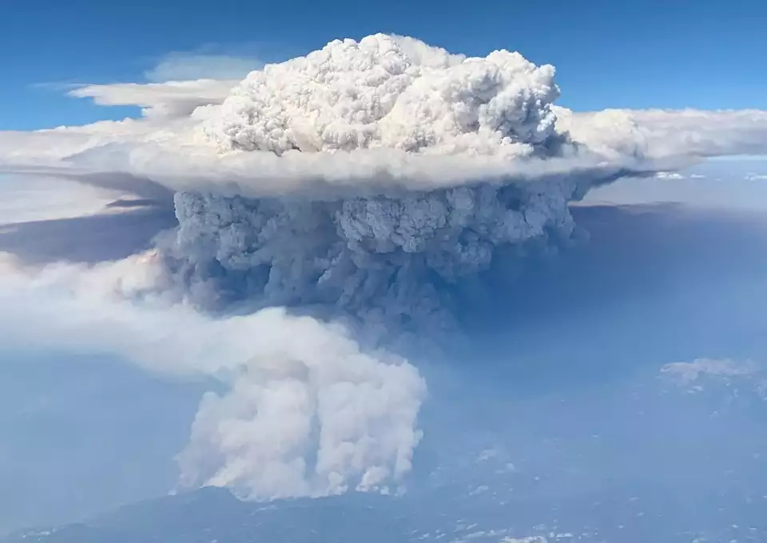
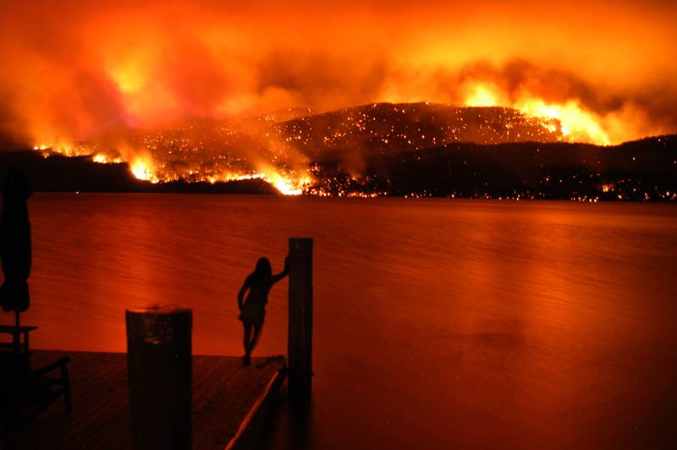
Megafires in the era of climate change
Records since the mid-1980s show marked increases in both the number of large wildland fires (“large” defined as >400 hectares) and total area that they burned. The increases are sharpest in the northern Rocky Mountains, and are attributable to the earlier onset of spring and increasing summer moisture deficit (or vapor pressure deficit). Historic moisture deficit data are based on climate records, and future projections of vapor pressure deficit are derived from general circulation models. The evidence is very strong that increasing summer temperatures and atmospheric water deficit are the primary cause of the upward trend in megafires.
In addition to moisture (or vapor pressure deficit), climatic variables that have been related to changes in longer fire seasons and greater overall burned areas include:
- The percent of annual water-year precipitation falling as snow
- The maximum annual snowpack, in inches of stored water
- The snowpack water storage on April 1, the date of an important snow survey
- The onset date of spring snowmelt
- The center timing of snowmelt—that is, the date by which half the annual water-year snowmelt has passed a stream gage
- The Palmer Drought Severity Index
- The Forest Drought Severity Index
Mitigation and adaptation
For people who live in a wildlife-urban interface area—that is, is an area where homes and businesses are located that are adjacent to undeveloped land, forests and grasslands—adaptation to extreme forest fire might mean keeping a “go bag” close at hand in the short term. For decision-makers thinking about the longer term, modifying design standards will help make buildings more fire resistant.
Mitigation might mean reducing forest fuel loads with prescribed burning, or cutting and removing vegetation. This approach often focuses on “ladder fuels,” small trees and shrubs that can conduct flame from the ground into the higher tree canopy. Fuel load reduction—or eliminating the vegetation most likely to burn—can help firefighters to protect certain assets, but it can be expensive. Average costs for prescribed burning in California range from to $140 to $170 per acre, and for cutting and removing vegetation, from $6,500 to $8,500 per acre.
To date, more than 100,000 acres in California’s Lake Tahoe region have been treated for fuel load reduction. Of course, these treatments will have to be repeated as vegetation re-grows.
Unfortunately, climate change is closing the window on opportunities for safely using prescribed fire—controlled burns—as a vegetation management strategy. This point was driven home in 2022 when a prescribed fire in New Mexico escaped control to become the 345,000-acre Hermit’s Peak Fire.
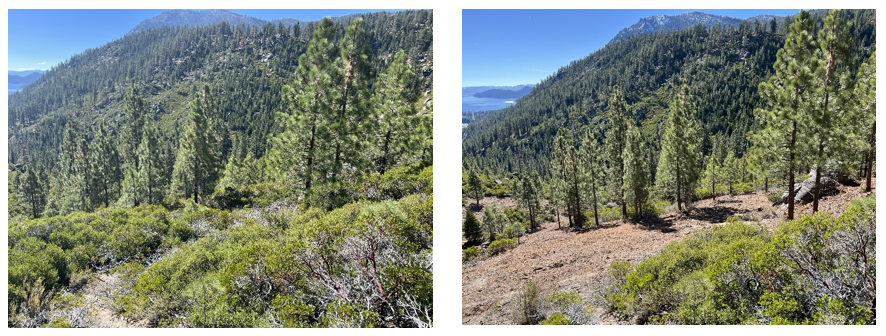
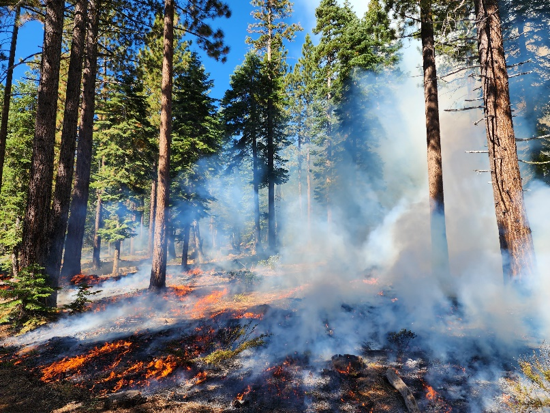
Recent and accurate information on forest conditions is essential for planning and implementing fuel load reduction and prescribed burning. From the 1970s until last year, the US Forest Service’s Aerial Detection Survey mapped areas of forest mortality in California associated with insects, disease, drought and wildfire using low-elevation flights with trained observers. Last year, the Trump administration ended funding for the survey, and the US Forest Service was forced to lay off key staff and terminate the program.
Widening cooperation to address the megafire crisis
Ecologists have long known that many Indigenous Tribes/nations have been using fire for millennia, managing vegetation to enhance forage for deer, keeping forests relatively open to facilitate hunting, and to promote the growth of plants useful for food, dye, medicine, ceremonies and weaving. Finally, staff at public agencies have begun to realize the value of this Indigenous knowledge and to seek opportunities for collaboration.
Although the forest management vocabularies of Tribes and agency staff are quite different, and distrust on the Tribal side is deep (with good reason), both sides are discovering the benefits of working together. The experience of the Yurok and Karuk tribes in working with the US Forest Service using prescribed fire as a vegetation management tool is a good example.
Of course, the best ways to address wildfires are to stop burning fossil fuels, hold fossil fuel companies accountable for the damages their products have caused, restore funding and create new investments into wildfire research and prevention, and allow the US to proceed on a trajectory toward clean, renewable energy and sustainable land management. With the Trump administration working against these goals, we’re in for a long summer of dangerous wildfires. You can help by asking your member of Congress to prevent the restructuring of the US Forest Service, to keep intact this agency’s crucial insights on wildfire prevention. And follow the advice of your local agencies and officials if you live in a wildfire-prone area.


