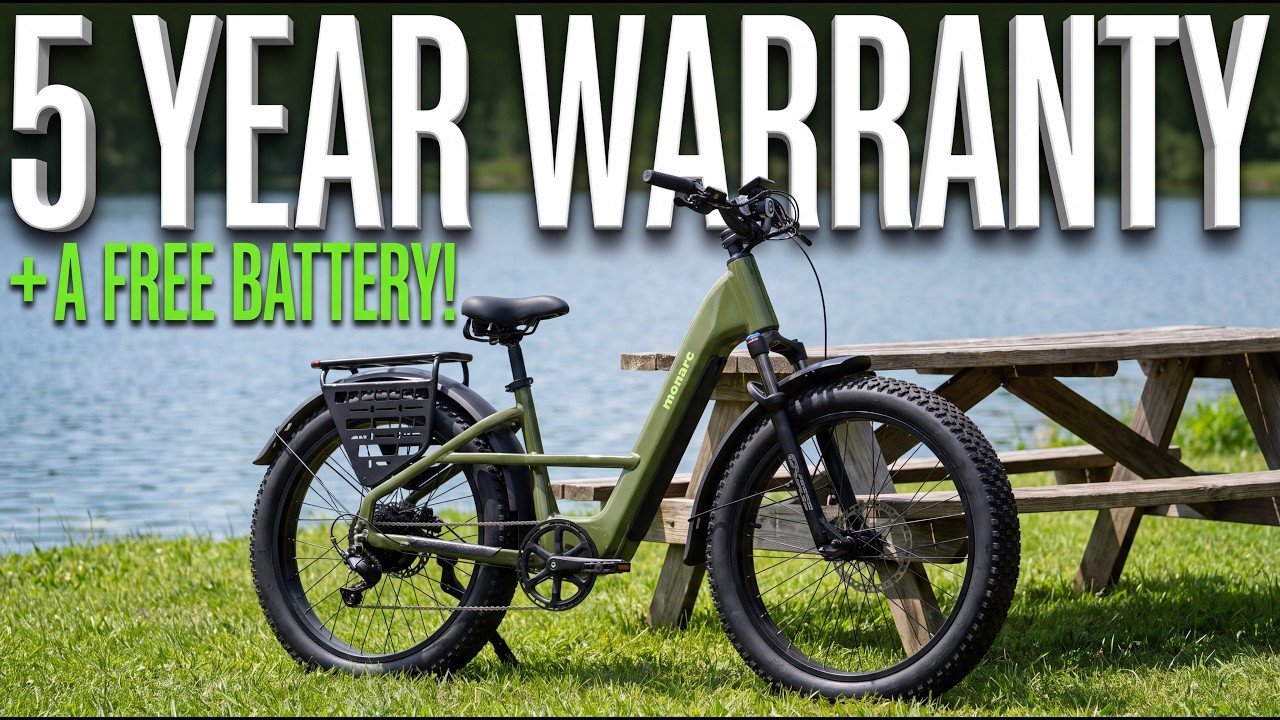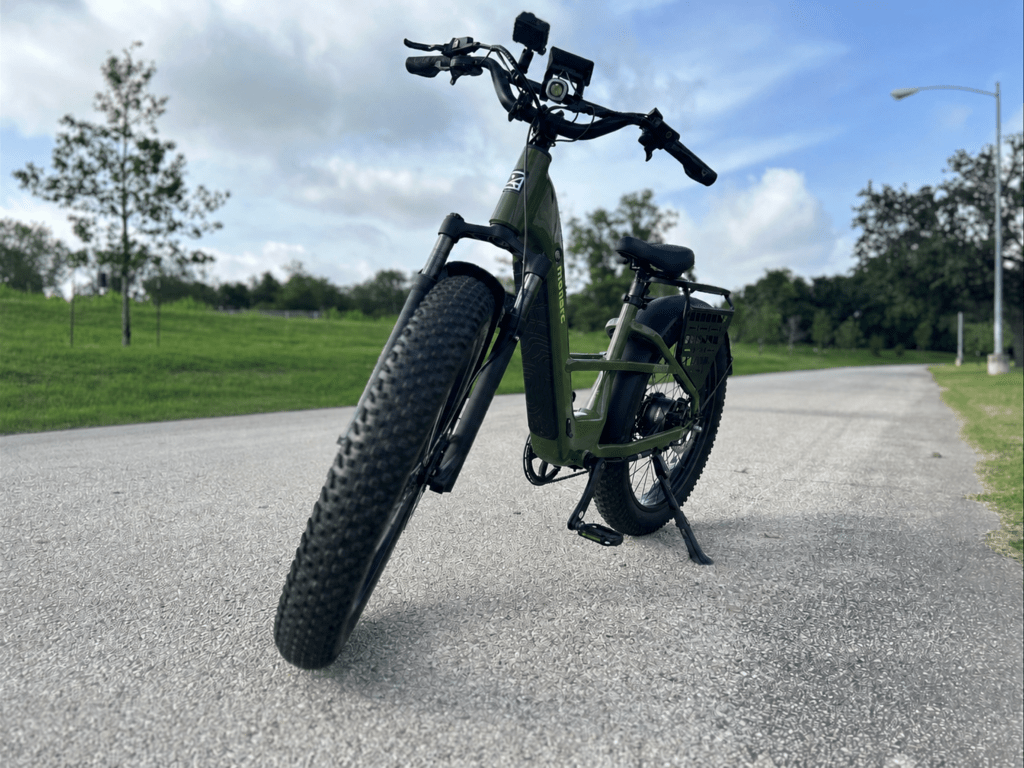
The Monarc Marker is not another inexpensive fat-tire eBike with a giant motor number and entry-level parts bolted around it.
For $1,999, it comes with a 750W Bafang motor capable of 1,638W peak power, Shimano Cues shifting, four-piston hydraulic brakes, an unusually advanced touchscreen and two full-size 720Wh batteries.
That gives you 1,440Wh of total swappable battery capacity before buying a single upgrade.
Add 26 x 4-inch Kenda tires, an adjustable 80mm suspension fork, a 330-pound rider limit and a five-year warranty on most covered components, and the Monarc Marker has one of the most aggressive spec sheets in the fat-tire eBike category.
But specifications do not always translate into a good bike.
We put the Marker through our hill climb, acceleration, braking and real-world range testing to find out whether it actually delivers, or whether this is just another eBike that looks better on paper than it feels on the road. Every number here comes from our standard test protocol.
The result is one of the most comfortable, reassuring and complete fat-tire eBikes we have ridden near the $2,000 mark. We first covered the bike when it was announced in our Monarc Marker launch story.
Review unit disclosure: Monarc provided the Marker used for this review. Monarc did not control our testing, conclusions, or final opinion.
Full video review:
Monarc Marker Review: The Bottom Line
The Monarc Marker is best for someone who wants a powerful, comfortable and genuinely long-range fat-tire eBike without immediately needing to upgrade the battery, brakes or drivetrain.
Its biggest advantage is not any one specification. It is the number of weaknesses Monarc managed to eliminate.
There is enough motor power for difficult hills. The four-piston brakes are appropriate for the bike’s weight and speed. The Shimano Cues drivetrain shifts more cleanly than the entry-level systems found on many competing bikes. The touchscreen is bright and unusually customizable. The second battery dramatically reduces range anxiety.
Most importantly, the Marker feels controlled.
The power arrives quickly without lurching forward, the torque sensor makes pedal assist feel natural and the wide tires create a planted ride that newer riders should find reassuring. There is also enough adjustability for experienced riders to make the bike considerably more aggressive.
The biggest drawback is weight. At 88 pounds on our scale with one battery installed, this is not a bike you will casually carry upstairs or lift onto a lightweight rack. The 26-inch fat tires also make it less agile than a conventional commuter.
But those compromises are expected from a large, adventure-oriented fat-tire eBike.
At $1,999, the Marker sets a very high standard for components, comfort and total battery capacity.
Monarc Marker Specs
| Specification | Monarc Marker |
|---|---|
| Current price | $1,999 |
| eBike class | Class 1, 2 or 3 |
| Default configuration | Class 2 |
| Maximum speed | 28 mph in Class 3 |
| Motor | Bafang B750 rear hub |
| Nominal power | 750W |
| Peak power | 1,638W |
| Controller | 30A |
| Torque | 85 Nm |
| Batteries | Two removable 48V 15Ah batteries |
| Capacity per battery | 720Wh |
| Total swappable capacity | 1,440Wh |
| Battery cells | LG |
| Claimed range | Up to 60 miles per battery |
| Charger | 48V 5A fast charger |
| Charge time | Approximately 3 hours per battery |
| Pedal sensor | Switchable torque or cadence |
| Display | 3.5-inch color touchscreen |
| Drivetrain | Shimano Cues 9-speed |
| Brakes | Talon P4 four-piston hydraulic |
| Brake rotors | 203mm front, 180mm rear |
| Suspension | 80mm Gneiss reverse-arch fork |
| Tires | 26 x 4-inch Kenda all-terrain |
| Claimed weight | 87 pounds |
| Tested weight | 88 pounds |
| Maximum rider weight | 330 pounds |
| Gross payload capacity | 420 pounds |
| Rear rack capacity | 66 pounds |
| Frame options | High-step and step-thru |
| Rider height range | 5’4″ to 6’5″ high-step; 5’2″ to 6’3″ step-thru |
| Bike certification | UL 2849 and ISO 4210 |
| Battery certification | UL 2271 |
| Water resistance | IPX6 bike, IPX7 battery |
Monarc currently lists the Marker at $1,999 with two batteries, a fast charger, fenders, a rear rack and free shipping. The bike ships as Class 2 but can be configured as Class 1 or Class 3, with a maximum assisted speed of 28 mph.
What Makes the Monarc Marker Different?
There are plenty of powerful fat-tire eBikes around $2,000. There are considerably fewer that combine that power with premium brakes, a proper eBike drivetrain, advanced software and two name-brand batteries.
Each Marker battery is a removable 48V 15Ah pack containing 720Wh of capacity. The batteries do not run simultaneously. You ride using one battery and swap in the second when needed.
That is arguably better for many owners than having one giant permanently installed battery. You can leave the spare battery charging at home, carry it for a long trip or alternate between the two packs to reduce the number of cycles placed on each one.
Monarc claims up to 60 miles per battery, or as much as 120 miles when both are used. Real-world range will depend heavily on speed, assist level, rider weight, temperature, hills, wind and tire pressure.
The included 5A charger is another meaningful advantage. Monarc says it can recharge one battery in approximately three hours, significantly faster than the 2A chargers included with many affordable eBikes.
Hill-Climbing Performance
We started with one of our hardest tests.
The Marker uses a Bafang B750 rear hub motor connected to a 30A controller. It is rated at 750W nominal, 1,638W peak and 85 Nm of torque.
Those figures matter on a heavy fat-tire bike. The Marker itself weighs close to 90 pounds, and the large knobby tires create more rolling resistance than conventional commuter tires.
Despite that, the Marker climbed our test hill confidently and maintained strong momentum.
It felt more forceful than a typical entry-level 750W commuter, particularly once the controller began delivering higher output. The motor did not feel like it was slowly running out of breath as the grade increased.
We also checked the motor and battery immediately after the climb. Neither showed concerning heat buildup during this test. The battery remained cool to the touch, and the motor temperature did not give us any reason for concern.
The real proof came at the end of our range test. With only 9% battery remaining, the Marker was still able to climb one of our steepest hills without a noticeable collapse in performance.
That low-battery result matters. Some eBikes feel excellent at a full charge but reduce power dramatically as voltage drops. The Marker retained useful climbing strength until the battery was nearly depleted.
Acceleration and Top Speed
The Monarc Marker ships as a Class 2 eBike, limiting motor assistance to 20 mph. Riders can enter the display settings and configure it for Class 1, Class 2 or Class 3 operation.
In Class 3 mode, the Marker can provide pedal assistance up to 28 mph.
During our acceleration test, the Marker reached 28 mph in approximately 11 seconds in its highest assist setting.
That was significantly faster than its initial run in a lower mode, which took approximately 20 seconds to briefly reach 28 mph. This demonstrates how much the Marker’s selectable power modes affect performance.
The lowest Cruise setting was intentionally gentle, with the display showing approximately 130W during parts of the test. That mode is useful when navigating busy paths, riding around pedestrians or trying to maximize range.
Explore delivered a much stronger response, generally showing around 750 to 800W during acceleration. The highest setting unlocked the bike’s full character and produced the roughly 11-second run to 28 mph.
This is a useful tuning strategy. The Marker can feel calm and approachable when desired without permanently sacrificing its ability to accelerate or climb.
Smooth Power Without Excessive Throttle Lag
Raw acceleration is only part of what makes an eBike feel powerful.
The Marker’s power delivery is one of its strongest qualities because it responds quickly without feeling abrupt.
Some high-output hub-motor bikes hesitate after you press the throttle and then deliver power all at once. Others engage immediately but surge hard enough to make low-speed riding uncomfortable.
The Marker falls between those extremes.
Throttle response begins quickly, but the power eases in progressively enough that the bike does not feel like it is being pulled out from under you. That makes it easier to start on gravel, navigate a tight corner or regain momentum on an incline.
The brake motor cutoffs were also immediate in our test. When a brake lever was pulled, the display’s wattage reading dropped from roughly 1,000W to zero almost instantly.
That immediate cutoff is particularly important on a bike this powerful and heavy.
Torque Sensor and Cadence Sensor Options
The Marker defaults to a torque sensor.
A torque sensor measures how much pressure you apply to the pedals and adjusts the motor output accordingly. Push lightly and the bike gives you gentle support. Pedal harder and it adds considerably more power.
The result feels like your legs suddenly became stronger rather than the motor simply switching on.
This is usually our preferred system for riders who still want their eBike to feel like a bicycle. It is smoother through corners, easier to control on loose terrain and more responsive when climbing.
The Marker also allows you to switch to cadence sensing through the display settings. In cadence mode, the motor mainly responds to whether the pedals are turning, rather than how hard you are pushing.
Cadence sensing can be useful for riders who want to contribute as little physical effort as possible while still using pedal assist. Torque sensing is the better choice for natural control and exercise.
Offering both gives the Marker unusual flexibility. Many bikes force the buyer to choose one system or the other before purchasing.
Braking Performance
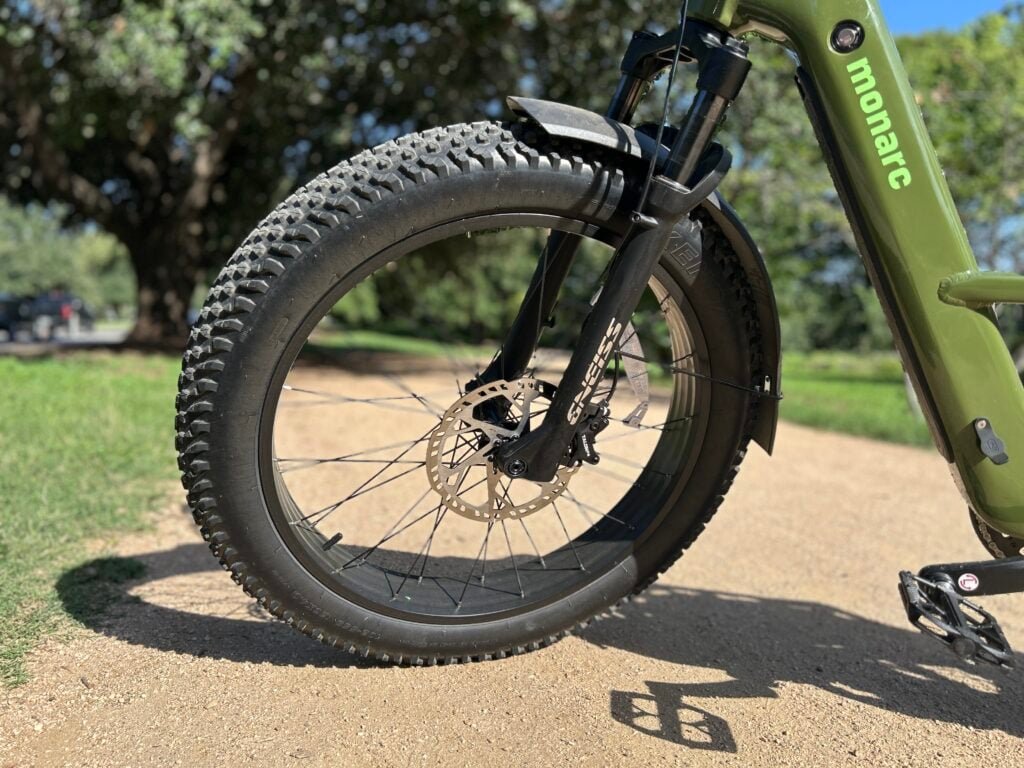
A heavy eBike capable of 28 mph needs serious brakes.
Monarc equipped the Marker with Star Union Talon P4 four-piston hydraulic disc brakes. These clamp a 203mm rotor at the front and a 180mm rotor at the rear.
Our braking benchmark starts at 20 mph, with 20 feet representing a typical stopping distance for the eBikes we test.
The Marker stopped in approximately the high-teens during our test runs, beating the 20-foot benchmark. Braking felt controlled, predictable and strong enough for the bike’s weight.
The rear tire moved slightly during the hardest stops, but the bike remained manageable. That is not unusual when rapidly stopping a fat-tire eBike from 20 mph.
We also tested braking on gravel. Even on the loose surface, the Marker remained composed and gave us enough lever control to manage traction.
The brakes use substantial pads, which should help with durability, although pad life will still depend on rider weight, terrain, weather and how aggressively the bike is ridden.
Monarc made the right decision here. Two-piston brakes would have looked out of place on an 88-pound bike capable of carrying a 330-pound rider. The four-piston system provides the power and modulation this platform needs.
Ride Quality and Comfort
The Marker is one of the most comfortable hardtail fat-tire eBikes we have tested.
Its comfort comes from the combination of two systems rather than an elaborate full-suspension frame.
At the front is an 80mm Gneiss reverse-arch suspension fork with adjustable preload and lockout. The reverse-arch design is intended to provide a lighter, stiffer lower structure than a conventional fork design.
Underneath the bike are enormous 26 x 4-inch Kenda all-terrain tires.
Those tires act as a second layer of suspension. They absorb cracks, gravel chatter and smaller impacts before those forces reach the fork or rider.
Tire pressure gives you another form of adjustment. Higher pressure reduces rolling resistance and can improve efficiency on pavement. Lower pressure increases the size of the tire’s contact patch, improving traction, comfort and stability on loose ground.
We tested the Marker at approximately 27 PSI. At that pressure, it felt extremely stable without becoming excessively vague.
The wide tires inevitably slow the steering compared with a commuter running 2-inch or 2.5-inch tires. But the Marker did not feel like it wanted to tip over while carving. Once moving, it tracked predictably and felt planted.
This is the kind of bike that can reduce anxiety for less experienced riders. The brakes are strong, the tires provide a large contact patch and the power does not arrive unpredictably.
Fat Tires: Advantage or Disadvantage?
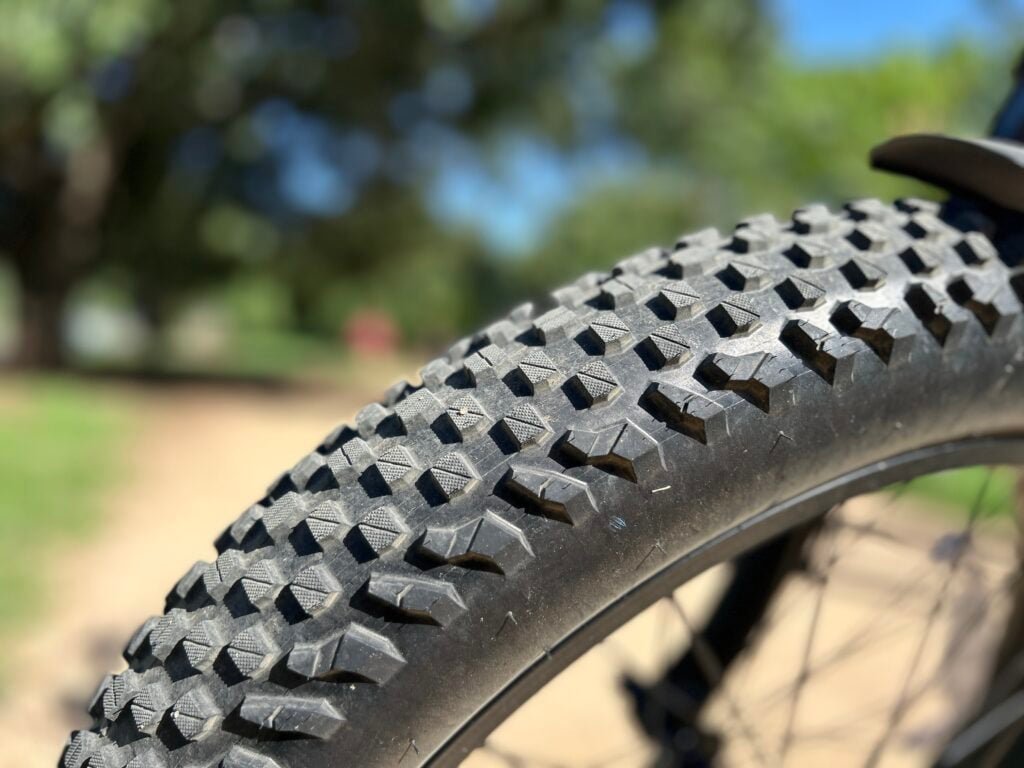
The Marker’s tires are the main reason to choose it over the closely related Monarc Tracer.
The 26 x 4-inch Kenda tires provide more flotation and traction on gravel, packed dirt, grass, sand and poorly maintained pavement. They also add meaningful comfort when riding over expansion joints, potholes and rough trails.
Monarc also ships the tires with sealant already installed, which should stop most small punctures from ending a ride.
The tradeoff is efficiency and agility.
Fat tires require more effort to turn, create more wind and rolling resistance and make the bike heavier. The Marker will generally use more energy than a conventional commuter equipped with the same motor and battery.
The tires also make the bike less precise during quick steering changes. This is not a lightweight trail mountain bike, even though it can comfortably handle light off-road riding.
Choose the Marker when comfort, loose-surface traction and stability matter more than low weight and sharp handling.
Shimano Cues 9-Speed Drivetrain
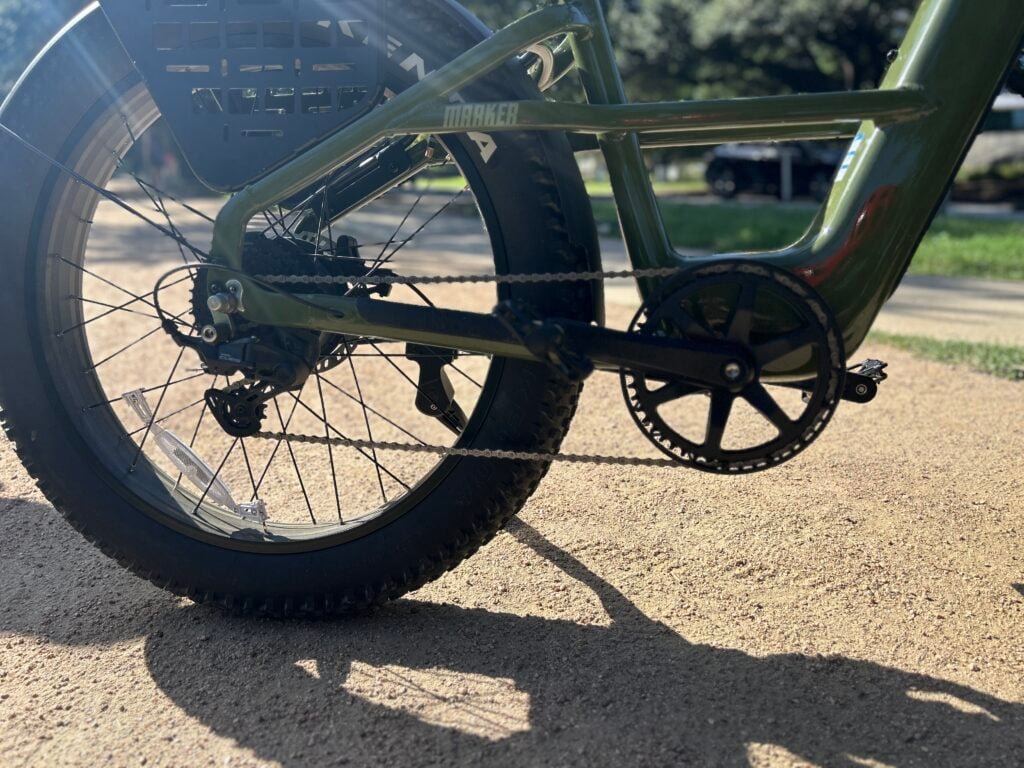
The drivetrain is another place where the Marker separates itself from many sub-$2,000 fat-tire eBikes.
Monarc uses a Shimano Cues 9-speed shifter, derailleur and 11-36T cassette.
Shimano developed the Cues platform with durability and high-torque applications in mind. It is a more appropriate choice for an eBike than the entry-level seven-speed systems still found on many similarly priced models.
Our test bike shifted cleanly in both directions. The nine-speed range also gave us enough gear selection to maintain a comfortable cadence at higher speeds without sacrificing the easier gears needed for hills.
Drivetrains are not as visually exciting as motors or touchscreens, but they have a major effect on long-term ownership. Poor shifting becomes irritating on every ride. A stronger, better-matched drivetrain should also tolerate the demands of a heavy, high-powered bike more effectively.
Touchscreen Display and Ride Customization
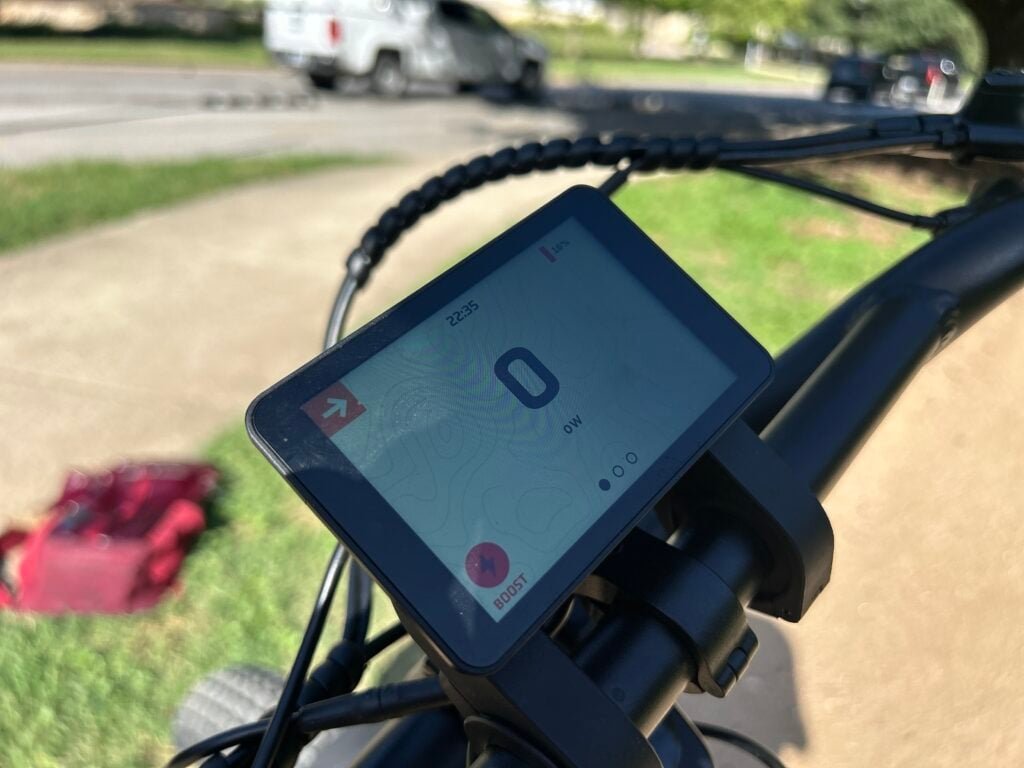
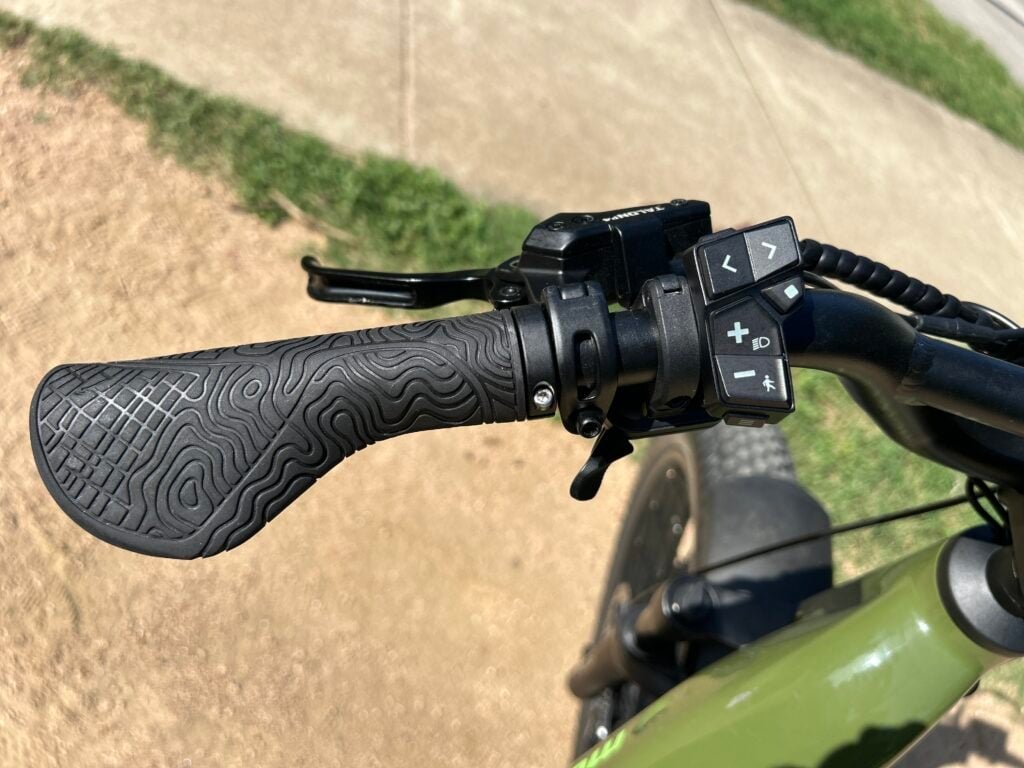
The Marker’s 3.5-inch touchscreen is one of its most distinctive features.
It can be operated through touch or the physical handlebar controls, which is useful when wearing gloves or riding over rough terrain.
The screen remained visible while wearing polarized sunglasses during our test, and brightness can be increased through the settings.
The display provides access to:
- Class 1, 2 and 3 configurations
- Five assistance modes
- Torque or cadence sensing
- Motor-response customization
- Charge-limit settings
- Display themes
- USB device charging
- Smart accessory connections
The five riding modes are named Cruise, Breeze, Explore, Sport and Boost.
Cruise provides mild support for relaxed riding and maximum control. Explore delivers noticeably more assistance without immediately applying full power. Sport and Boost are the settings for reaching higher speeds and attacking difficult climbs.
The charger also supports a preset maximum charge percentage. A rider who does not need maximum range every day can set a lower limit to reduce the amount of time the battery spends fully charged.
Monarc lists app connectivity, display locking, over-the-air updates and additional smart-device integration as part of the platform. At the time of this review, parts of the app ecosystem were still scheduled for later in 2026, so we would treat them as upcoming features rather than reasons to buy the bike today.
Battery and Real-World Range
The Marker’s battery setup is the biggest reason to consider it.
You receive two 48V 15Ah batteries containing LG cells. Each provides 720Wh, creating 1,440Wh of total available energy when both packs are used.
Only one battery is installed and connected at a time. When the first is depleted, you remove it and install the charged spare.
We completed our high-assist range testing with light pedaling over two days. The test was conducted primarily in the highest assist setting, which represents a demanding scenario rather than the low-speed conditions manufacturers typically use for maximum range claims.
The Marker delivered less range than the narrower-tired Monarc Tracer but exceeded the Lectric XPress 2 in our testing. That result makes sense. The Marker and Tracer share similar motor and battery fundamentals, but the Marker’s 4-inch tires and higher weight require more energy.
More importantly, the Marker retained strong performance as the battery approached empty. At 9%, it was still capable of climbing a steep hill without struggling.
For most owners, the second battery is more important than chasing the highest possible laboratory range from one pack. Even if your real-world result falls well below the claimed 60 miles per battery, carrying a fully charged 720Wh spare creates an enormous practical riding radius.
The 5A charger also means you can refill one pack in approximately three hours instead of leaving it connected for most of the day.
Cargo, Lighting and Everyday Practicality
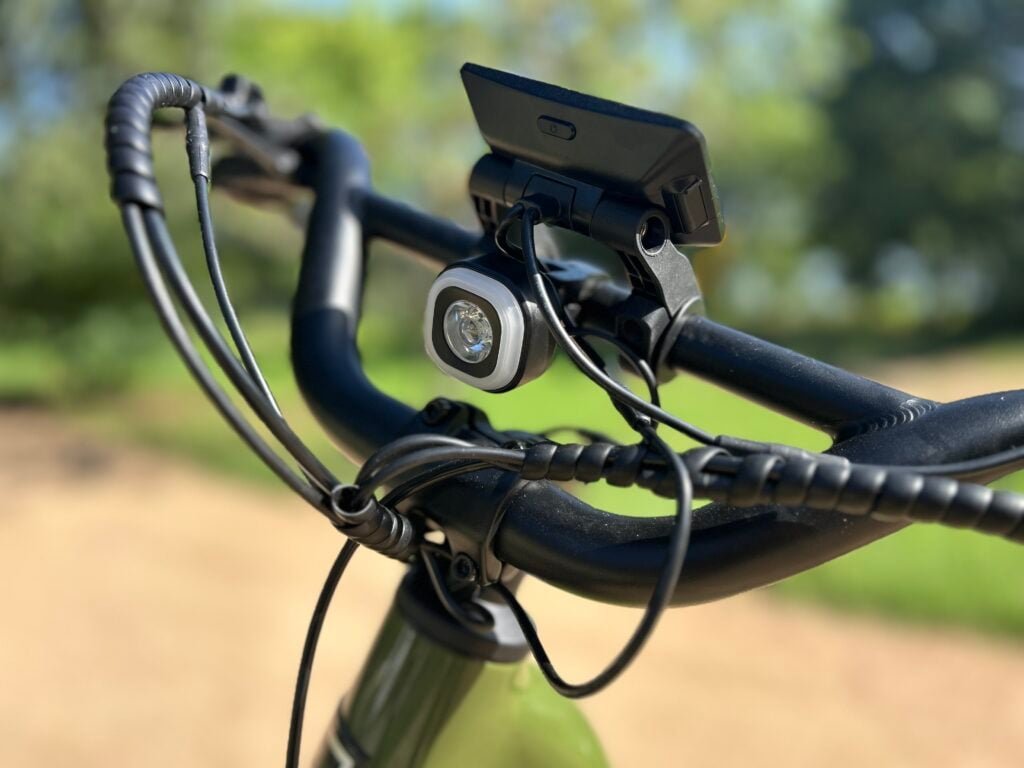
The Marker arrives better equipped than many bikes that initially appear less expensive.
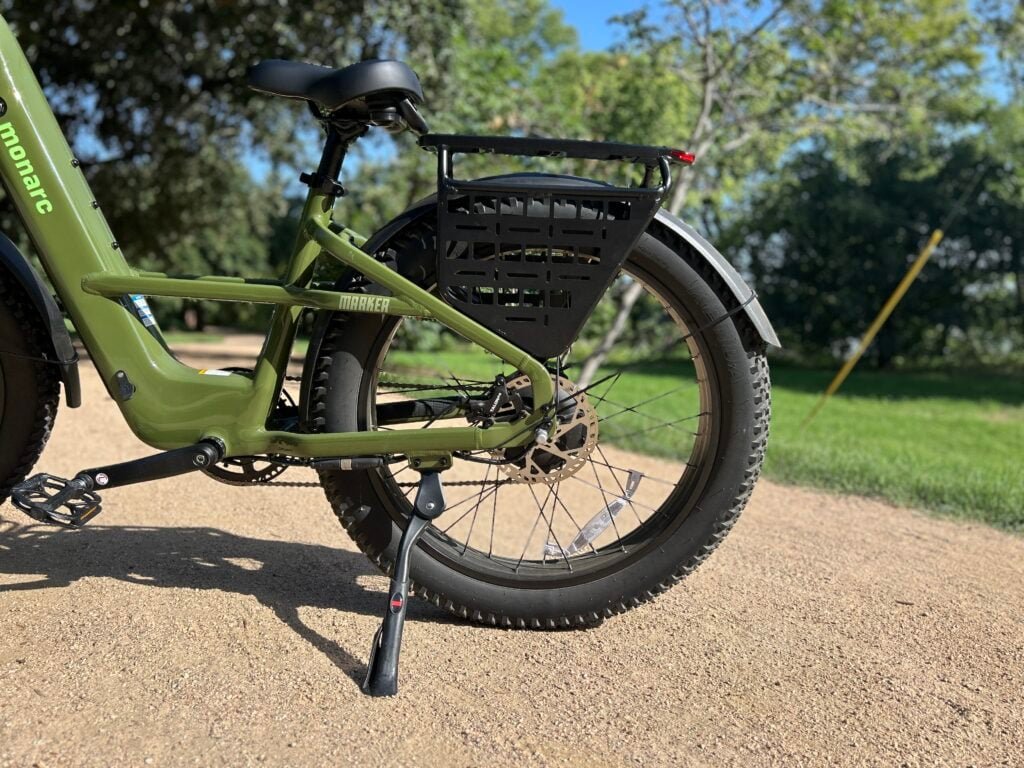
The included rear rack supports up to 66 pounds and is MIK-compatible, making it easier to attach compatible baskets, bags and other accessories. It also includes a modular attachment panel that can be used with panniers, straps and MOLLE-style accessories.
Full fenders are included, as are a 494-lumen headlight and rear lighting integrated into the rack.
The rear system functions as a taillight, brake light and turn signal. Mounting it high on the rack helps keep it visible when riding in traffic.
Monarc rates the complete bike at IPX6 and the batteries at IPX7. That provides more weather protection than we usually see explicitly listed in this price category, although no eBike should be submerged or stored outside indefinitely.
The bike is also certified to UL 2849, while the batteries are certified to UL 2271. Those certifications are becoming increasingly important for riders who store or charge an eBike inside a house, apartment or workplace.
Weight, Payload and Rider Fit
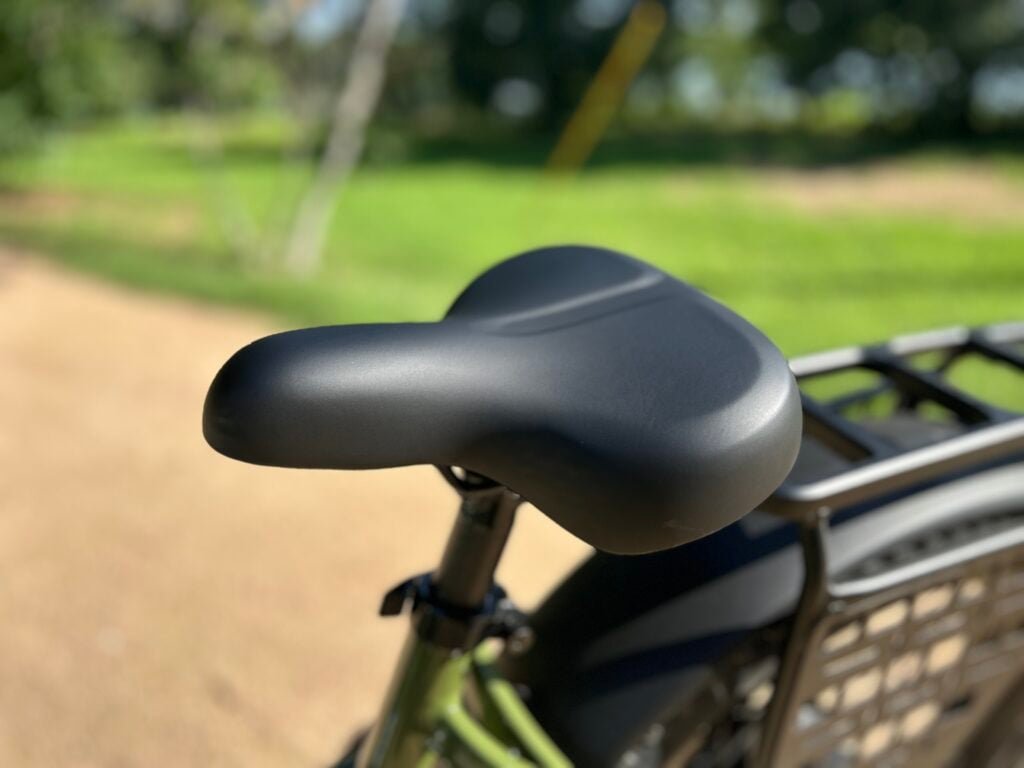
Monarc rates the Marker at 87 pounds with a battery installed. Our scale measured it at 88 pounds.
You notice that weight most when:
- Lifting the bike
- Loading it onto a vehicle rack
- Maneuvering it in a garage
- Braking from higher speeds
- Pedaling without motor assistance
Once the motor is active, the weight becomes much less obvious. The bike accelerates quickly enough that it does not feel sluggish during normal riding.
The maximum rider weight is 330 pounds, while total gross payload capacity is rated at 420 pounds. The rear rack can support up to 66 pounds.
The Marker is offered in high-step and step-thru configurations. Monarc lists the high-step for riders approximately 5 feet 4 inches to 6 feet 5 inches tall. The step-thru is listed for riders from 5 feet 2 inches to 6 feet 3 inches.
Shorter riders should still pay attention to the bike’s overall size. Even the step-thru remains a large eBike with full-size 26-inch fat tires. Riders near the bottom of the recommended range may want to test the fit before ordering when possible.
Monarc Marker Warranty Explained
Monarc advertises a five-year warranty, which is unusually long for a direct-to-consumer eBike.
However, it is important to read the written terms rather than assuming every part receives identical coverage.
Monarc’s current limited warranty states that covered bike components are protected for five years from the original delivery date. The original batteries are listed separately with a one-year warranty period. Wear items such as tires, tubes, chains, brake pads, rotors and grips are excluded.
The five-year covered-parts period remains a meaningful advantage, particularly for items such as the motor, controller, display, brakes, drivetrain and electrical system.
Any promotional extension to battery coverage should be confirmed at checkout and saved in writing because promotions and warranty language can change.
Monarc operates under Lectric eBikes LLC, which gives this new brand more infrastructure behind it than the typical startup entering the eBike market.
Monarc Marker vs Monarc Tracer
The Tracer is the most logical alternative because the two bikes share many of the same electronics and components.
Both use a powerful Bafang rear hub system, a 30A controller, removable 720Wh batteries, Shimano Cues shifting and a similar touchscreen platform.
The primary difference is the platform.
The Marker is the larger, heavier fat-tire model. It is better suited to gravel, rough pavement, loose terrain and riders who prioritize comfort and stability.
The Tracer is the more efficient city and commuter option. Its narrower tires and lower weight make it easier to steer, transport and pedal. It should also extract more range from the same battery capacity. We also put it head to head with a rival in our Velotric Discover 3 vs Monarc Tracer comparison.
Buy the Marker when you specifically want fat tires and mixed-terrain capability.
Buy the Tracer when most of your riding will happen on pavement and you would rather save money and weight.
Monarc Marker vs Lectric XPress 2
The Lectric XPress 2 occupies a lower price category and is likely the more sensible choice for riders who primarily want an affordable commuter.
The XPress 2 is lighter, less expensive and easier to manage. It still offers a polished riding experience without forcing the owner to handle an 88-pound fat-tire bike.
Moving up to the Marker gets you significantly more peak power, a second full-size battery, larger tires, four-piston brakes, a more premium drivetrain and greater mixed-terrain ability.
You may not notice the power difference while casually cruising on flat pavement. It becomes much more obvious when accelerating from a stop, carrying additional weight or climbing a difficult hill.
The XPress 2 is the value commuter.
The Marker is the more capable, higher-spec, do-almost-anything option.
Monarc Marker Pros and Cons
What we liked
- Two complete 720Wh batteries included, 1,440Wh total
- Strong but controllable Bafang motor and 30A controller
- Four-piston hydraulic brakes with 203mm front rotor
- Shimano Cues 9-speed eBike drivetrain
- Excellent comfort from the 80mm fork and 4-inch tires
- Highly customizable touchscreen and five ride modes
- Switchable torque or cadence sensing
- Fast 5A charger refills a pack in about three hours
- Useful standard kit: fenders, 66 lb rack, lights, turn signals
- Tire sealant preinstalled from the factory
- UL 2849 bike and UL 2271 battery certification
- Held climbing power down to 9% battery
What we would change
- Very heavy at 88 pounds on our scale
- Fat tires reduce efficiency, range and steering agility
- Only one battery is used at a time, so swaps are manual
- Parts of the app ecosystem were not available at launch
- Battery warranty is one year, not the headline five
Who Should Buy the Monarc Marker?
The Marker is an excellent match for:
- Riders who regularly encounter rough pavement, gravel or packed dirt
- Heavier riders who need a strong frame and capable braking system
- Long-distance commuters who want a charged spare battery
- Recreational riders who prioritize stability and comfort
- Anyone who wants premium components without moving above $2,000
- Riders who want torque sensing but appreciate the option of cadence assist
- Owners who plan to carry cargo or use the bike as a partial car replacement
Who Should Skip It?
Consider another bike when:
- You need to carry your eBike upstairs
- Your vehicle rack cannot safely support an 88-pound bike
- You ride almost exclusively on smooth pavement
- You prefer quick, bicycle-like steering
- You want a lightweight fitness-oriented eBike
- You do not need two batteries or extended range
- You are near the bottom of the stated rider-height range and want a very compact frame
If it does fit your riding, the Marker sits comfortably alongside our picks for the best electric bikes of the year.
Is the Monarc Marker Worth $1,999?
Yes.
The Monarc Marker is one of the most complete fat-tire eBikes available around $2,000.
It is not the lightest, most agile or most efficient bike in the category. The narrower Monarc Tracer is a better choice for many pavement-focused commuters, while the Lectric XPress 2 offers excellent value at a substantially lower price.
But neither offers the Marker’s particular combination of all-terrain comfort, high-output power, four-piston brakes, Shimano Cues shifting and two included 720Wh batteries.
The Marker feels like it was designed around reducing ownership anxiety.
You have a spare battery when the first runs out. You have a fast charger when both need to be replenished. You have strong brakes for controlling the bike’s weight. You have large tires for traction and comfort. You have a long warranty on covered bike components.
That makes the Marker particularly compelling for someone who wants one eBike to handle commuting, errands, recreation and light trail exploration.
At $1,999, it does not just compete with other fat-tire eBikes. It forces them to explain why they include less.
Monarc Marker Frequently Asked Questions
How much does the Monarc Marker cost?
Does the Monarc Marker include two batteries?
What is the Monarc Marker’s top speed?
How fast does the Monarc Marker accelerate?
What is the Monarc Marker’s real-world range?
Can the Monarc Marker climb steep hills?
Does the Monarc Marker have a torque sensor?
Is the Monarc Marker good for off-road riding?
How much does the Monarc Marker weigh?
What is the Monarc Marker’s weight capacity?
How long does the Monarc Marker take to charge?
What does the five-year warranty cover?
Ride Safe
Wear a properly fitted helmet, follow local eBike laws and inspect your bike before every ride. Class 3 speeds should only be used where legal and appropriate for the conditions. Performance testing shown here was conducted by experienced adult riders in controlled conditions. Do not attempt to recreate it.
Affiliate Disclosure
RiderGuide may earn a commission when you purchase through links in this article, at no additional cost to you. This supports our independent testing and content.
{“@context”:”https://schema.org”,”@graph”:[{“@type”:”Product”,”@id”:”https://riderguide.com/reviews/monarc-marker/#product”,”name”:”Monarc Marker”,”brand”:{“@type”:”Brand”,”name”:”Monarc”,”sameAs”:”https://monarcbikes.com”},”category”:”Electric Bicycle”,”description”:”The Monarc Marker is a $1,999 fat-tire electric bike with a 750W Bafang rear hub motor rated to 1,638W peak, two removable 720Wh LG-cell batteries, Talon P4 four-piston hydraulic brakes, a Shimano Cues 9-speed drivetrain and 26 x 4-inch Kenda all-terrain tires.”,”image”:”https://materialsindustry.com/wp-content/uploads/2026/08/monarc-marker-review-is-this-the-best-2000-fat-tire-ebike.png”,”sku”:”MONARC-MARKER-2026″,”offers”:{“@type”:”Offer”,”url”:”https://riderguide.com/rgo/MonarcMarker/43807/1/”,”price”:”1999.00″,”priceCurrency”:”USD”,”itemCondition”:”https://schema.org/NewCondition”,”priceValidUntil”:”2027-08-04″,”availability”:”https://schema.org/InStock”,”seller”:{“@type”:”Organization”,”name”:”Monarc”}},”additionalProperty”:[{“@type”:”PropertyValue”,”name”:”Verified weight”,”value”:”88 lb”},{“@type”:”PropertyValue”,”name”:”Top speed (Class 3)”,”value”:”28 mph”},{“@type”:”PropertyValue”,”name”:”0-28 mph acceleration”,”value”:”Approximately 11 seconds”},{“@type”:”PropertyValue”,”name”:”Braking distance (20 mph)”,”value”:”High teens in feet, under our 20-foot benchmark”},{“@type”:”PropertyValue”,”name”:”Total battery capacity”,”value”:”1,440Wh across two 720Wh packs”},{“@type”:”PropertyValue”,”name”:”Peak motor power”,”value”:”1,638W”},{“@type”:”PropertyValue”,”name”:”Maximum rider weight”,”value”:”330 lb”}],”aggregateRating”:{“@type”:”AggregateRating”,”ratingValue”:”99″,”bestRating”:”100″,”worstRating”:”1″,”reviewCount”:”1″,”ratingCount”:”1″}},{“@type”:”Review”,”@id”:”https://riderguide.com/reviews/monarc-marker/#review”,”itemReviewed”:{“@id”:”https://riderguide.com/reviews/monarc-marker/#product”},”name”:”Monarc Marker Review: Best $2K Fat-Tire eBike?”,”reviewBody”:”The Monarc Marker is a $1,999 fat-tire electric bike whose advantage is not one headline specification but the number of weaknesses it removes. It ships with two removable 720Wh LG-cell batteries for 1,440Wh of swappable capacity, a 750W Bafang rear hub motor rated to 1,638W peak through a 30A controller, Talon P4 four-piston hydraulic brakes on 203mm front and 180mm rear rotors, a Shimano Cues 9-speed drivetrain, an 80mm Gneiss suspension fork and 26 x 4-inch Kenda all-terrain tires. In our testing it reached 28 mph in roughly 11 seconds in Class 3 at the highest assist level, stopped from 20 mph in the high teens in feet, and still climbed a steep hill with only 9 percent battery remaining. Power delivery is quick without lurching, and the switchable torque sensor makes pedal assist feel natural. The main drawbacks are an 88-pound tested weight, the efficiency penalty of 4-inch tires, and a written battery warranty of one year against the headline five-year figure for other covered components.”,”datePublished”:”2026-08-04″,”author”:{“@type”:”Person”,”name”:”Matt Kaye”,”url”:”https://riderguide.com/author/matt-kaye/”,”jobTitle”:”Lead Tester”,”worksFor”:{“@type”:”Organization”,”name”:”RiderGuide”,”url”:”https://riderguide.com”}},”publisher”:{“@type”:”Organization”,”name”:”RiderGuide”,”url”:”https://riderguide.com”},”positiveNotes”:{“@type”:”ItemList”,”itemListElement”:[{“@type”:”ListItem”,”position”:1,”name”:”Two complete 720Wh batteries included, 1,440Wh of swappable capacity”},{“@type”:”ListItem”,”position”:2,”name”:”Strong but controllable Bafang motor with a 30A controller”},{“@type”:”ListItem”,”position”:3,”name”:”Talon P4 four-piston hydraulic brakes beat our 20-foot benchmark”},{“@type”:”ListItem”,”position”:4,”name”:”Shimano Cues 9-speed drivetrain instead of an entry-level 7-speed”},{“@type”:”ListItem”,”position”:5,”name”:”80mm fork and 26 x 4-inch Kenda tires make it exceptionally comfortable”}]},”negativeNotes”:{“@type”:”ItemList”,”itemListElement”:[{“@type”:”ListItem”,”position”:1,”name”:”Very heavy at 88 pounds on our scale”},{“@type”:”ListItem”,”position”:2,”name”:”Fat tires cost range, efficiency and steering agility”},{“@type”:”ListItem”,”position”:3,”name”:”Written battery warranty is one year, not the headline five”}]},”reviewRating”:{“@type”:”Rating”,”ratingValue”:”99″,”bestRating”:”100″,”worstRating”:”1″}},{“@type”:”VideoObject”,”@id”:”https://riderguide.com/reviews/monarc-marker/#video-review”,”name”:”Monarc Marker Review – Setting a New Standard For $2K Fat Tire eBikes”,”description”:”RiderGuide’s full video review of the Monarc Marker fat-tire eBike, covering hill climbing, acceleration, braking, range and component quality.”,”thumbnailUrl”:”https://materialsindustry.com/wp-content/uploads/2026/08/monarc-marker-review-is-this-the-best-2000-fat-tire-ebike-8.jpg”,”uploadDate”:”2026-08-02T13:15:15-07:00″,”contentUrl”:”https://www.youtube.com/watch?v=iRdcMjqHUTs”,”embedUrl”:”https://www.youtube.com/embed/iRdcMjqHUTs”,”duration”:”PT13M24S”,”publisher”:{“@type”:”Organization”,”name”:”RiderGuide”,”logo”:{“@type”:”ImageObject”,”url”:”https://riderguide.com/wp-content/uploads/2024/04/RG-Logo.png”}}},{“@type”:”FAQPage”,”@id”:”https://riderguide.com/reviews/monarc-marker/#faq”,”mainEntity”:[{“@type”:”Question”,”name”:”How much does the Monarc Marker cost?”,”acceptedAnswer”:{“@type”:”Answer”,”text”:”The Monarc Marker currently costs $1,999. Pricing and included promotional accessories can change, so check the current offer before ordering.”}},{“@type”:”Question”,”name”:”Does the Monarc Marker include two batteries?”,”acceptedAnswer”:{“@type”:”Answer”,”text”:”Yes. It includes two removable 48V 15Ah batteries containing 720Wh each. Only one battery powers the bike at a time, giving you 1,440Wh of total swappable capacity.”}},{“@type”:”Question”,”name”:”What is the Monarc Marker’s top speed?”,”acceptedAnswer”:{“@type”:”Answer”,”text”:”The Marker can reach 28 mph when configured as a Class 3 eBike. It ships in Class 2 configuration, which limits motor assistance to 20 mph.”}},{“@type”:”Question”,”name”:”How fast does the Monarc Marker accelerate?”,”acceptedAnswer”:{“@type”:”Answer”,”text”:”In our highest-assist test, the Marker accelerated from zero to 28 mph in approximately 11 seconds.”}},{“@type”:”Question”,”name”:”What is the Monarc Marker’s real-world range?”,”acceptedAnswer”:{“@type”:”Answer”,”text”:”Range varies considerably with assist level, speed, terrain, wind, rider weight and tire pressure. Monarc claims up to 60 miles per 720Wh battery and up to 120 miles when both batteries are used. Our demanding high-assist test produced less range than the narrower Monarc Tracer but more than the Lectric XPress 2.”}},{“@type”:”Question”,”name”:”Can the Monarc Marker climb steep hills?”,”acceptedAnswer”:{“@type”:”Answer”,”text”:”Yes. Its 750W Bafang motor, 1,638W peak output and 85 Nm rating delivered strong performance on our hill test. It also climbed a steep hill with only 9% battery remaining.”}},{“@type”:”Question”,”name”:”Does the Monarc Marker have a torque sensor?”,”acceptedAnswer”:{“@type”:”Answer”,”text”:”Yes. It defaults to torque sensing but can be switched to cadence sensing through the touchscreen settings.”}},{“@type”:”Question”,”name”:”Is the Monarc Marker good for off-road riding?”,”acceptedAnswer”:{“@type”:”Answer”,”text”:”It is well suited to gravel roads, packed dirt, grass and light trails. The Marker is not a full-suspension mountain bike intended for large jumps or highly technical downhill riding.”}},{“@type”:”Question”,”name”:”What does the five-year warranty cover?”,”acceptedAnswer”:{“@type”:”Answer”,”text”:”Monarc’s written warranty currently provides five years of coverage for listed bike components, including the frame, motor, controller, display and drivetrain. The original batteries are listed with a one-year warranty, while wear components are excluded. Buyers should review the current policy before purchasing.”}}]}]}
<p>The post Monarc Marker Review: Is This the Best $2,000 Fat-Tire eBike? first appeared on Rider Guide.</p>