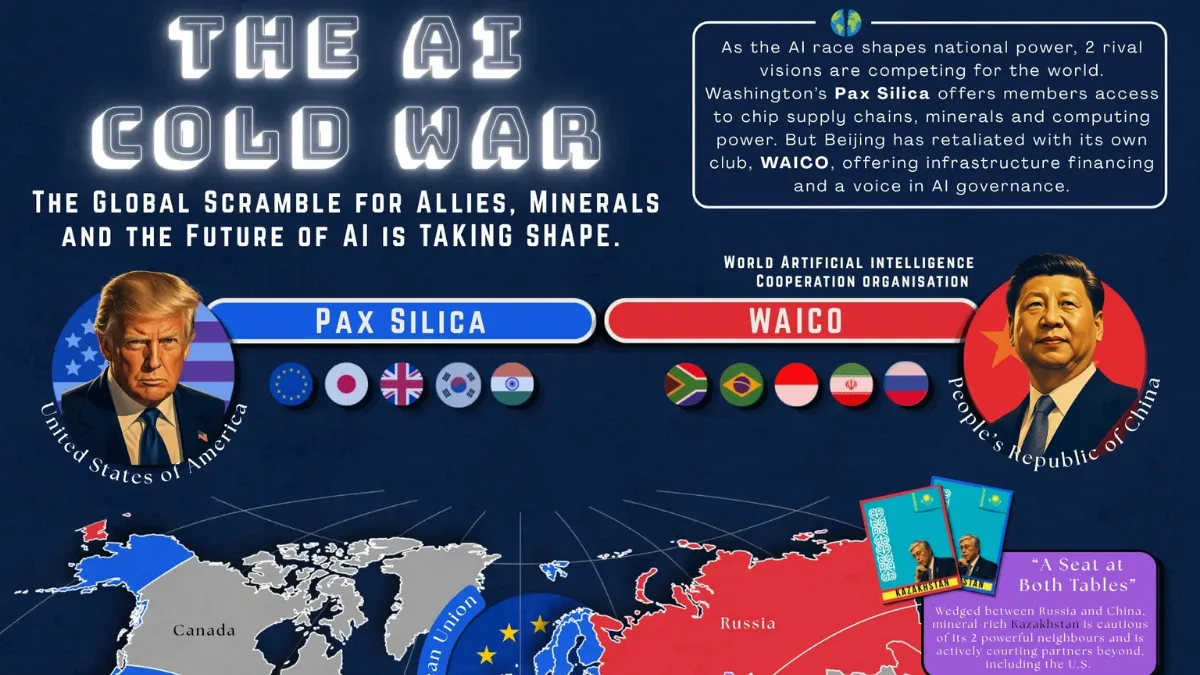
The AI Cold War: Which Countries Are on Each Side?
- The U.S. and China are building competing international networks around AI infrastructure, supply chains, and governance.
- Kazakhstan is the only country belonging to both blocs, showing that the emerging AI divide is not strictly binary.
- W.A.I.C.O.’s 29 founding members include 12 African countries, while Pax Silica is concentrated among advanced economies in Europe and the Indo-Pacific.
Artificial intelligence is becoming a major arena for geopolitical competition between the U.S. and China, spanning advanced chips and data centers to technical standards and AI governance.
This visualization, created by Iswardi Ishak, maps two emerging camps: the U.S.-led Pax Silica initiative and China’s World Artificial Intelligence Cooperation Organization (W.A.I.C.O.). The visualization is based on data from the U.S. Department of State and Xinhua Net.
Two Competing Visions for the AI Era
Pax Silica is a U.S.-led initiative focused on securing the physical foundations of AI, including semiconductors, computing infrastructure, advanced manufacturing, and critical minerals. Its membership brings together many economies that occupy important positions in the global chip supply chain.
By contrast, W.A.I.C.O. is an intergovernmental organization headquartered in Shanghai. In July 2026, 29 countries signed its founding agreement, with a stated goal of promoting international cooperation and global governance around safe and equitable AI.
The table below shows the countries participating in the two groups:
| Country | Group |
|---|---|
 Kazakhstan Kazakhstan |
Both |
 Argentina Argentina |
Pax Silica |
 Australia Australia |
Pax Silica |
 Chile Chile |
Pax Silica |
 Costa Rica Costa Rica |
Pax Silica |
 El Salvador El Salvador |
Pax Silica |
 Finland Finland |
Pax Silica |
 Germany Germany |
Pax Silica |
 Greece Greece |
Pax Silica |
 India India |
Pax Silica |
 Israel Israel |
Pax Silica |
 Italy Italy |
Pax Silica |
 Japan Japan |
Pax Silica |
 Netherlands Netherlands |
Pax Silica |
 Norway Norway |
Pax Silica |
 Panama Panama |
Pax Silica |
 Philippines Philippines |
Pax Silica |
 Qatar Qatar |
Pax Silica |
 Singapore Singapore |
Pax Silica |
 South Korea South Korea |
Pax Silica |
 Sweden Sweden |
Pax Silica |
 United Arab Emirates United Arab Emirates |
Pax Silica |
 United Kingdom United Kingdom |
Pax Silica |
 United States of America United States of America |
Pax Silica |
 Austria Austria |
Pax Silica (via EU) |
 Belgium Belgium |
Pax Silica (via EU) |
 Bulgaria Bulgaria |
Pax Silica (via EU) |
 Croatia Croatia |
Pax Silica (via EU) |
 Cyprus Cyprus |
Pax Silica (via EU) |
 Czech Republic Czech Republic |
Pax Silica (via EU) |
 Denmark Denmark |
Pax Silica (via EU) |
 Estonia Estonia |
Pax Silica (observer status only) |
 France France |
Pax Silica (via EU) |
 Hungary Hungary |
Pax Silica (via EU) |
 Ireland Ireland |
Pax Silica (via EU) |
 Latvia Latvia |
Pax Silica (via EU) |
 Lithuania Lithuania |
Pax Silica (via EU) |
| Netherlands |
Pax Silica (via EU) |
 Poland Poland |
Pax Silica (via EU) |
 Portugal Portugal |
Pax Silica (via EU) |
 Romania Romania |
Pax Silica (via EU) |
 Slovakia Slovakia |
Pax Silica (via EU) |
 Spain Spain |
Pax Silica (via EU) |
 Taiwan Taiwan |
Pax Silica (non-signatory participant) |
 Algeria Algeria |
WAICO |
 Belarus Belarus |
WAICO |
 Brazil Brazil |
WAICO |
 Cambodia Cambodia |
WAICO |
 Cameroon Cameroon |
WAICO |
 China China |
WAICO |
 Congo Congo |
WAICO |
 Cuba Cuba |
WAICO |
 Ethiopia Ethiopia |
WAICO |
 Indonesia Indonesia |
WAICO |
 Iran Iran |
WAICO |
 Kenya Kenya |
WAICO |
 Kyrgyzstan Kyrgyzstan |
WAICO |
 Laos Laos |
WAICO |
 Lesotho Lesotho |
WAICO |
 Malaysia Malaysia |
WAICO |
 Mozambique Mozambique |
WAICO |
 Myanmar Myanmar |
WAICO |
 Nicaragua Nicaragua |
WAICO |
 Oman Oman |
WAICO |
 Pakistan Pakistan |
WAICO |
 Russia Russia |
WAICO |
 Senegal Senegal |
WAICO |
 Serbia Serbia |
WAICO |
 South Africa South Africa |
WAICO |
 Tajikistan Tajikistan |
WAICO |
 Uzbekistan Uzbekistan |
WAICO |
 Venezuela Venezuela |
WAICO |
 Zambia Zambia |
WAICO |
The memberships reveal two different geographic strengths. Pax Silica includes the U.S. and major European and Indo-Pacific technology economies, while W.A.I.C.O. extends more deeply into the Global South, including Brazil, Indonesia, South Africa, Pakistan, and numerous African states.
Why Countries Are Choosing Different Sides
The two blocs are not exact equivalents. Pax Silica is principally a supply-chain partnership, while W.A.I.C.O. is a treaty-founded international organization centered on AI cooperation and governance. That difference also helps explain why membership can overlap.
For Washington, access to cutting-edge chips and trusted supply chains is a major source of leverage. The U.S. ecosystem includes semiconductor strengths across countries such as Japan, South Korea, and the Netherlands, while America’s broader economic relationship with Beijing remains deeply interconnected through U.S.-China trade.
China, meanwhile, can offer developing economies infrastructure, training, and access to increasingly competitive open-weight AI models. This may be particularly attractive to countries that feel underrepresented in Western-led technology institutions or want to avoid dependence on a single supplier.
The World’s AI Swing States
The map also highlights Canada, Mexico, Saudi Arabia, Türkiye, and Vietnam among the major economies still in play. Their choices matter because AI infrastructure is becoming increasingly difficult to separate from foreign policy.
This does not necessarily mean every country must permanently choose Washington or Beijing. Singapore and other globally connected economies have incentives to preserve access to multiple technology ecosystems, particularly as AI adoption varies widely around the world.
The stakes are enormous. One analysis estimates roughly $800 billion in Asia-Pacific data center investment through 2030, meaning today’s decisions about chips, clouds, energy systems, and technical standards could lock in relationships for decades.
What the AI Cold War Could Mean for the Future
Rather than two isolated digital worlds emerging overnight, the bigger risk is gradual fragmentation. Countries could face different rules governing access to cloud infrastructure, technical standards, and AI models depending on their partnerships.
Yet the map also shows why the Cold War analogy has limits. These blocs are neither mutually exclusive nor military alliances, and many strategically important economies remain outside either camp.
The contest may ultimately be less about which country builds the best AI model and more about which ecosystem becomes indispensable. Washington is betting on control of crucial supply-chain chokepoints and trusted infrastructure, while Beijing is building a broader coalition around access, development, and a larger role for emerging economies in AI governance.
Learn More on the Voronoi App
To see how individual models compare within this rapidly evolving landscape, check out Ranked: The Smartest AI Models in 2026 on the Voronoi app.