

Fraunhofer Institute for Solar Energy Systems ISE has unveiled a price simulator that measures the impact of battery storage on electricity prices.
Freely accessible via Fraunhofer’s Energy-Charts.info platform, the tool uses actual buy and sell bids from Germany’s daily electricity exchange auction.
These day-ahead prices are used to calculate a simulated price with a hypothetical battery fleet. Users can select a battery capacity of 0 GW to 20 GW and a storage duration of two to six hours.
Differing market scenarios are also available, including whether power plants with block bids lasting several hours react to changing prices, and whether neighboring countries are taken into account via electricity market coupling.
The simulator also shows charging and discharging power, the state of charge of storage systems, electricity consumption and the potential feed-in from solar and wind power.
The results are available at quarter-hour intervals and can be downloaded as data. Fraunhofer adds the simulator is updated daily.
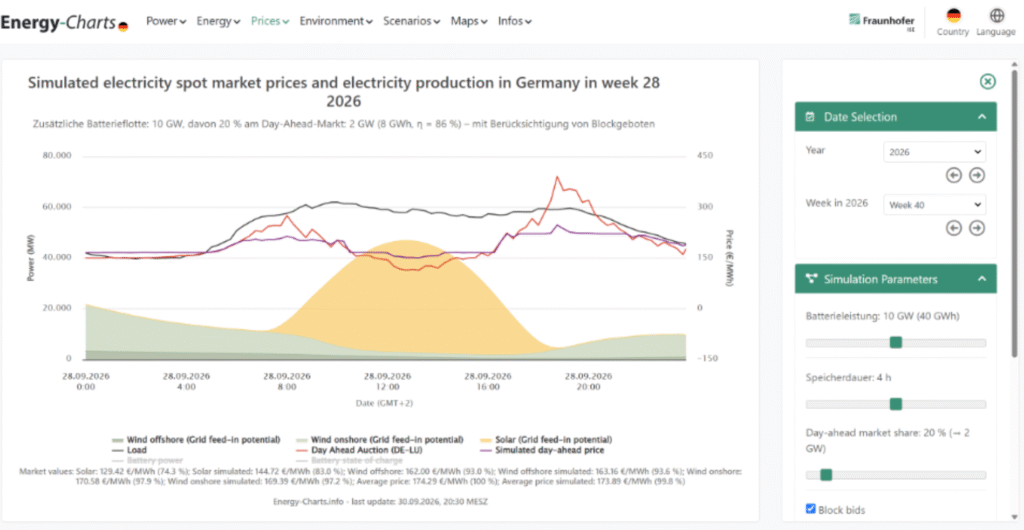
Fraunhofer has used its simulator to share analysis of 2025 data alongside an additional 20 GW of batteries with a two-hour storage duration, in a scenario with block bids but without cross-border electricity trading.
The researchers say this 20 GW fleet would have lead to the average price difference across all days between the most expensive and the cheapest quarter-hour of a day fall from €130/MWh to €53/MWh, a decrease of 60%.
Meanwhile, the number of hours with prices above €200/MWh would have fallen from 169 to 20, while the number of negative price hours would have dropped from 575 to 271. The market value of solar power rises by 35% under this scenario, from €45.08/MWh to €61.02/MWh.
Fraunhofer’s analysis adds that on the most expensive day last year (Jan. 20, 2025), 20 GW of batteries would have lowered the evening price peak from €583/MWh to €221/MWh. On the day with the lowest price (May 11, 2025), the 20 GW fleet would have absorbed midday electricity and raised the price from €-250/MWh to €-20/MWh.
“Storage systems smooth out prices, but they don’t generate electricity,” emphasised Leonhard Gandhi, project manager for the Energy Charts at Fraunhofer ISE. “The simulator illustrates both of these points very clearly and thus also shows that we need to consider storage and reliable power generation together.”
The post Fraunhofer ISE releases electricity price simulator appeared first on pv magazine Global.


