A new DNA test could help catch more of the U.S. spent fowl making it into Canada without the same restrictions as broiler chicken.
Chicken Farmers of Canada (CFC) alleges some importers are exploiting the exemption by misclassifying broiler chicken as spent fowl to circumvent import controls.
WHY IT MATTERS: The two types of poultry meat can be difficult to distinguish through visual inspection, so identifying mislabelled shipments presents a significant enforcement challenge.
“Spent fowl” refers to egg-laying hens, shipped at the end of their egg-producing cycle, whose meat goes mainly to further-processed goods such as nuggets, soups or pet food, unlike the younger broilers raised for slaughter as whole roasting birds or for fresh chicken cuts.
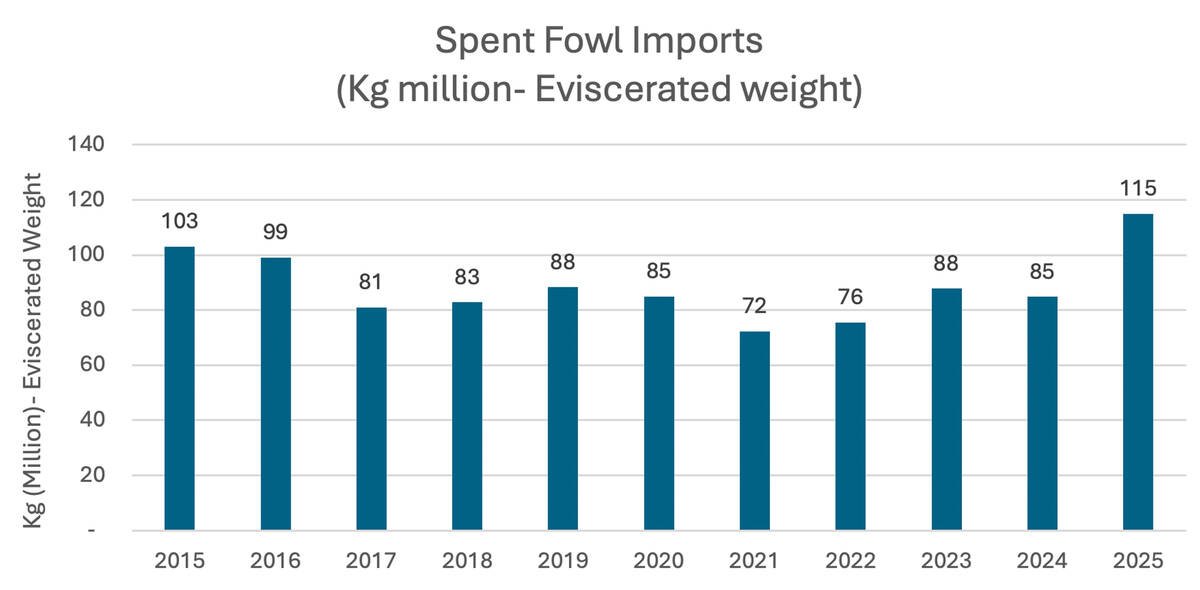
CFC told Farmtario it has identified a significant increase in poultry imports declared as spent fowl. The organization cites 2025 figures showing imports reached 115 million kilograms, representing a 35 per cent increase over 2024.
Industry impact
CFC communications officer Cristiane Doherty said some importers are falsely declaring chicken meat as spent fowl to avoid Canada’s import rules. She added that, since 2025, the Canada Border Services Agency (CBSA) has identified multiple cases of fraudulent imports totalling $196 million in assessed duties.
“Any lost opportunity to produce more chicken for Canadians has an impact on the farm, and on the economy,” she said, adding that, based on 2025 data, illegal imports represent an annual loss of 3,600 jobs, $394 million in economic activity and $129 million in taxes.
Illegal imports
The U.S. processes spent fowl for its domestic market and exports to other countries. However, Agriculture and Agri-Food Canada (AAFC) import data show that, in 2025, Canada’s spent fowl imports, when converted to whole-bird equivalent, would have accounted for 93 per cent of total U.S. production.
Given that the U.S. also supplies its domestic market and other export destinations, CFC argues this discrepancy points to potential mislabelling of broiler chicken as spent fowl.
“Illegal imports also represent a risk in food traceability in the case of a recall,” she added.
Test implementation
In March 2025, the federal government committed to working with industry and enforcement agencies to develop an action plan to address spent fowl misrepresentation.
Since that announcement, Doherty said CFC has continued to work with AAFC, CBSA and the Canadian Food Inspection Agency (CFIA) on implementing a DNA test that can distinguish broiler chicken from spent fowl.
“We are hopeful that the government will implement this test as a means of import verification,” she said.
Trent partnership
CFC has supported DNA testing developed in collaboration with Trent University to distinguish broiler chicken from spent fowl.
Doherty noted that meat products are not typically inspected at the border but at the receiving plant or cold-storage facility.
“We would expect samples to be collected when meat is inspected for food safety,” she said.
She said efforts to ensure imported poultry is properly classified continue to be a priority, adding that DNA technology is a key step towards greater accuracy.
“The implementation of the DNA test will allow Canada’s authorities to properly classify import shipments and eliminate the abuses that have been so detrimental to the Canadian chicken sector and to the Canadian economy,” she said.