Our XXL Lysimeter Experiment, ” Article 4 of 6
Total alkalinity is the number we care about, and it is expensive and slow: pump the leachate, take it to the lab, titrate. Our greenhouse work already showed that electrical conductivity (EC) of the leachate tracks alkalinity closely enough to stand in for many of those titrations (see the MRV Proxies for EW series and the TA/EC report). This article pushes that idea one step further and asks the question a field operator would actually ask: can a sensor buried in the soil — logging continuously, never pumped, never sent to a lab — stand in for the leachate you would otherwise have to collect?
The answer is a qualified yes, and the qualifications are where the value is.
The sensor
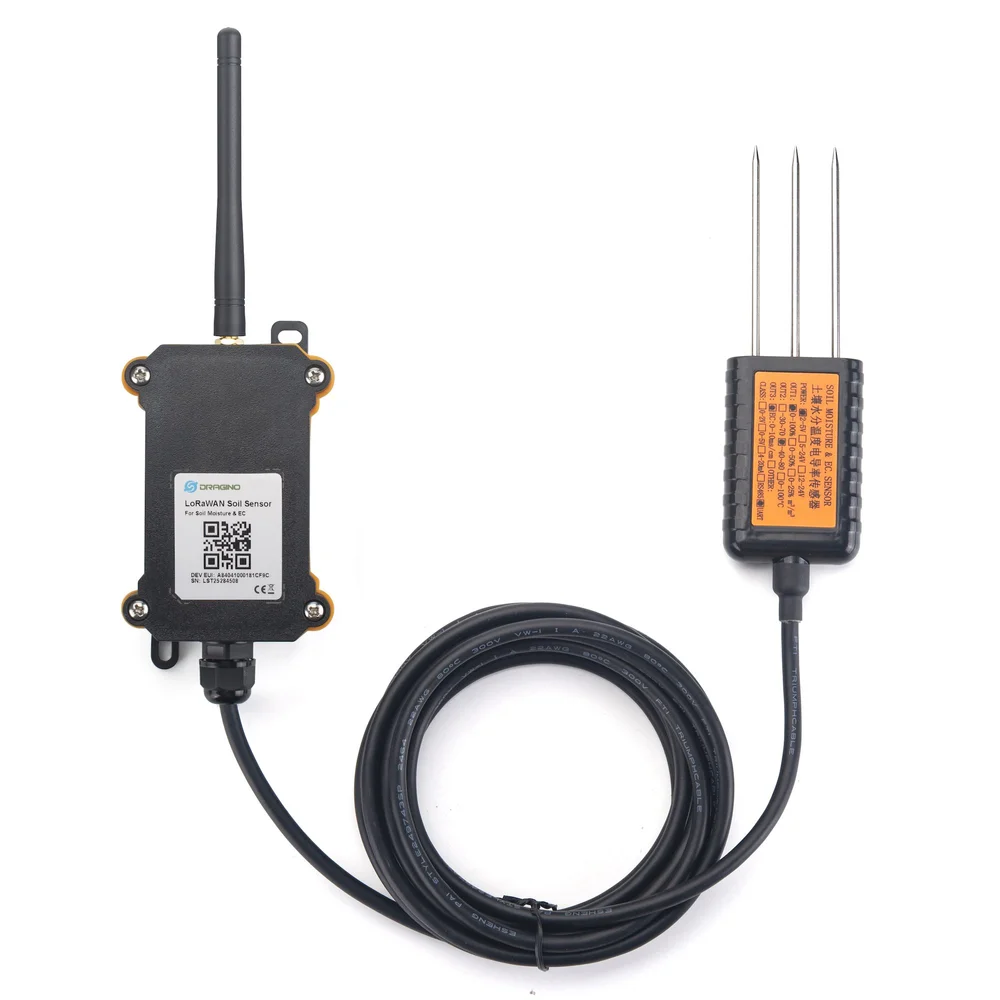
We used the LSE01 — LoRaWAN Soil Moisture & EC Sensor from Dragino (and its sister product, the Dragino LSPH01 soil-pH sensor), a simple, low-cost sensor that transmits the data via the LoRaWAN protocol. The sensors sent one data point every 60 minutes. In total we deployed 120 probes — an EC/moisture probe and a pH probe at each of three positions (30 cm, 60 cm and in the drainage tank) for every one of the 20 pots (2 × 3 × 20 = 120). Each EC/moisture probe reports soil moisture, bulk electrical conductivity and temperature from the same three prongs; the EC reading is the one we test against the leachate.
The proxy chain, one link at a time
The open question: does a sensor in the soil see the same thing as the leachate?
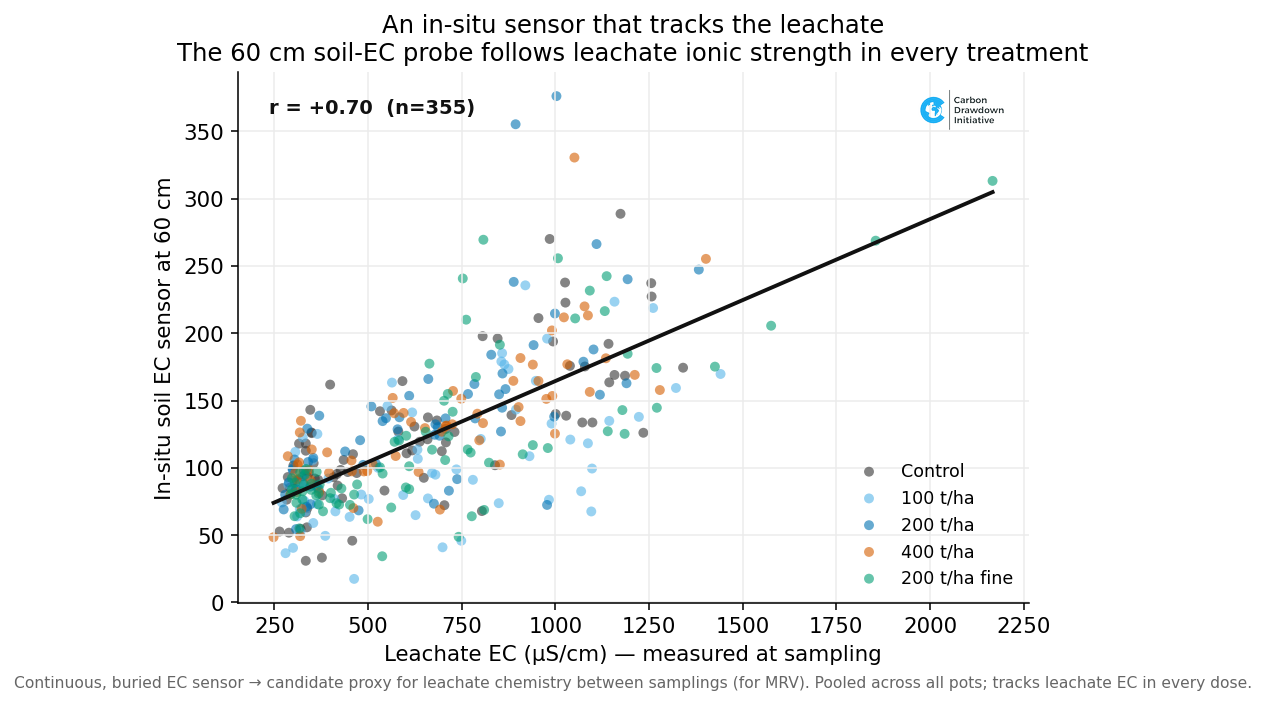
For the 60 cm probe, it largely does. Pooled across all pots, the buried 60 cm EC tracks leachate lab-EC at r = 0.70 (n = 355), and it tracks the ions that carry the alkalinity charge just as well — Ca and Mg at r ≈ 0.70. Total alkalinity itself follows more loosely, at r ≈ 0.45: EC measures the total ionic strength of the water, of which bicarbonate is only one part, so the tightest match is EC-to-EC. But since leachate EC is itself a strong stand-in for TA (r ≈ 0.95 in our greenhouse data), the buried probe reaches alkalinity through that chain — soil-EC → leachate-EC → TA.
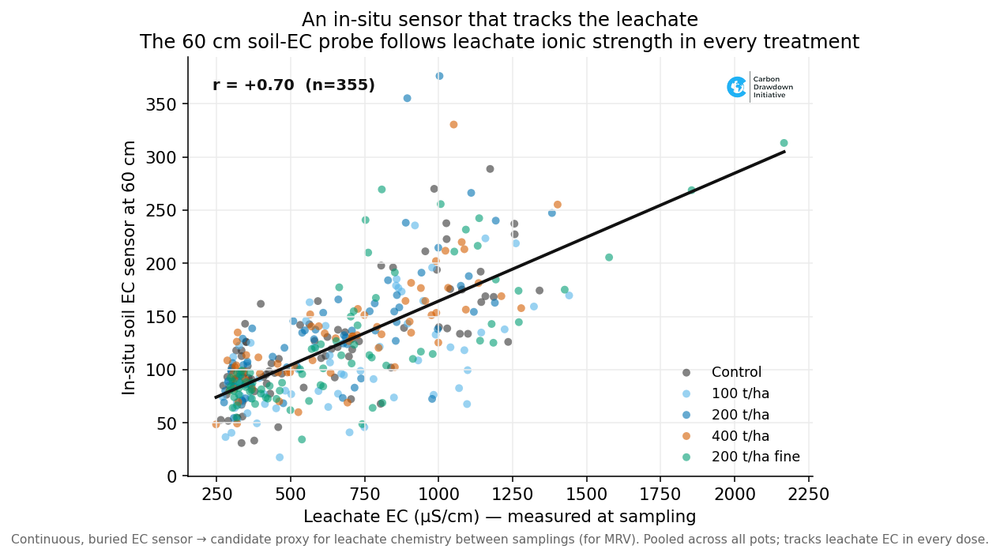
Figure 1: In-situ 60 cm soil-EC vs leachate EC, all treatments pooled (r = 0.70, n = 355). The buried probe follows leachate ionic strength across every dose.
Crucially, this is not carried by one treatment. Broken out per dose, the 60 cm probe tracks leachate EC in every one — control r ≈ 0.75, 100 t/ha 0.60, 200 t/ha 0.69, 400 t/ha 0.77, FINE 0.77. A proxy that only worked in the high-dose pots would be useless for MRV; this one works across the board.
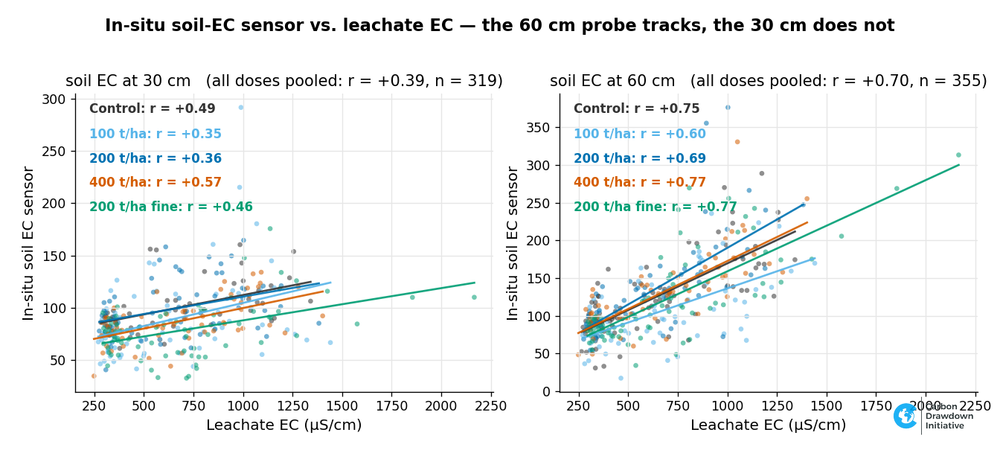
Figure 2: Soil-EC vs leachate EC with all doses overlaid — 30 cm (left) and 60 cm (right); coloured line + r per dose. The 60 cm probe tracks leachate EC in every dose (pooled r = +0.70, n = 355); the 30 cm probe is consistently loose (pooled r = +0.39, n = 319).
Depth matters — the 30 cm probe does not work
Figure 2 also shows the failure. The 30 cm probe is much weaker: r = 0.39 pooled. The shallow soil dries out, warms and cools, and channels water unevenly; 60 cm sits closer to the draining pore water that actually becomes leachate. If you bury one EC sensor for MRV, depth is not a detail — it is the difference between a usable proxy and a poor one.
One caveat we deliberately do not act on: because the probe reads EC and moisture from the same prongs — and the LSE01 already temperature- and conductivity-compensates its EC — soil moisture is not an independent variable for us to filter or correct against. It would not matter anyway: whenever we pumped leachate the soil was wet, with only 3 of 355 paired readings below 10 % VWC. So we apply no dryness filter and no moisture correction — the raw buried EC is what we compare.
What this means for MRV
The picture is genuinely useful: a continuously logged 60 cm soil-EC probe tracks the ionic strength of the leachate — and hence its alkalinity — across every treatment at this site, at r ≈ 0.70. It cannot replace titration outright: it is a proxy, and (as our greenhouse work insists) a site-calibrated one, not a global formula. And it is a bulk-soil reading: what the probe registers depends not only on the pore-water chemistry but on how much water the soil is holding around the prongs, so soil moisture manipulates the value directly. Because soil texture and water-holding capacity — and the climate that drives them — differ from site to site, the soil-EC ↔ leachate relationship can shift drastically elsewhere; treat the calibration as site- and climate-specific and re-anchor it wherever you deploy, rather than assuming ours transfers. It also tracks all the dissolved load, not just the weathering-derived part — so it measures leachate chemistry, not weathering per se. But it can fill the long gaps between grab samples with continuous in-situ data, at a fraction of the cost — the continuous, buried extension of the EC-as-TA argument we made in the greenhouse.
The defensible recipe is a hybrid, the same shape as our greenhouse conclusion: bury a 60 cm EC probe for continuous data; take periodic leachate titrations to anchor and recalibrate the EC ↔ TA relationship for that site; and treat a sudden EC jump as a prompt to investigate, not as instant CDR.
Next: we chase a tempting third signal — a weathering fingerprint in the soil CO₂ itself.
The XXL Lysimeter dataset (2022-2026) series
-
Intro article — why a 1,400-day, daily-instrumented experiment is worth the wait.
-
Dose–response — the initial flush (the Birch effect, not weathering), the long convergence, the n = 4 power problem, and the FINE-is-a-different-rock confound.
-
The soil breathes — how temperature and soil CO₂ drive a seasonal weathering engine visible in the buried sensors.
-
A buried EC sensor as a continuous MRV proxy — the 60 cm probe tracks leachate chemistry remarkably well (and the 30 cm one does not); the long-term, in-situ extension of our EC-as-alkalinity-proxy work.
-
What the soil tells us when it breathes — reading four years of buried CO₂ sensors: the soil as a living system of warmth, water and microbes — and why even a sensor in every pot is the weathering engine, not a carbon meter.
-
Four years of buried sensors — rainfall, ambient CO₂, and the reality that most field sensors die within two to three years.
Data, code & figures: doi.org/10.5281/zenodo.21216439 (CC-BY-4.0) · github.com/dirkpaessler/carbdown_xxl_lysimeter_2022_2026