

MMCM and carbon credit standard developer CerCarbono have announced the issuance of the world’s first carbon credits for end-of-life vehicle recycling at COP31. The milestone creates a new way to reward emissions reductions from recovering and recycling materials from old vehicles.
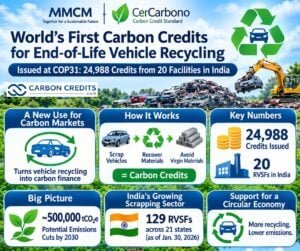
The first issuance covers 24,988 carbon credits from 20 Registered Vehicle Scrapping Facilities (RVSFs) in India. The program aims to turn vehicle recycling into a new source of carbon finance while supporting India’s shift toward a more circular economy.
The carbon credits follow a dedicated methodology developed by MMCM and CerCarbono. It measures the emissions avoided when recovered materials, such as steel, aluminum, plastics and glass, replace materials made from virgin resources.
India is expanding its vehicle scrapping system. It is also introducing rules that make manufacturers more responsible for what happens to vehicles at the end of their life.
MMCM estimates that its wider program could deliver around 500,000 tonnes of CO2 equivalent (CO2e) in emissions reductions by 2030. However, that figure is a future estimate. The 24,988 credits represent the program’s first issuance, not its full potential.
First Carbon Credits Issued for End-of-Life Vehicle Recycling
The initial issuance covers 20 registered vehicle scrapping facilities in India. These facilities recover and process materials from vehicles that have reached the end of their useful lives.
The program is linked to MMCM’s wider network of more than 40 authorized vehicle scrapping facilities. Its partners and associated facilities include operations connected with Mahindra CERO, TVS and Tata Re.Wi.Re.
The first issuance marks a new use of carbon markets in the automotive sector. Carbon credits have traditionally supported projects such as renewable energy, forest protection and methane reduction. This program applies carbon accounting to the recovery and recycling of materials from old vehicles.
Each issued credit represents one tonne of verified carbon dioxide equivalent emissions reduced or avoided. The reductions come from using recovered materials instead of producing the same materials from virgin resources.
The announcement also gives vehicle recycling companies a possible new source of revenue. Carbon finance could help support better recycling systems, improve material recovery and make formal scrapping facilities more attractive to investors.
How the Vehicle Recycling Carbon Credit Methodology Works
The credits use CerCarbono’s methodology, CM-WM-ELV-01: Recovery and Recycling of Materials from End-of-Life Vehicles. The standard was developed with MMCM and published in July 2025.
The methodology measures emissions avoided when materials recovered from old vehicles replace materials produced from virgin resources. It covers the recovery and recycling of metals, plastics, and glass.
The calculation compares emissions under two scenarios. The first is the baseline. This shows emissions that would happen if similar materials came from virgin resources. The second is the project scenario: the emissions from collecting, dismantling, sorting, and processing materials recovered from end-of-life vehicles.
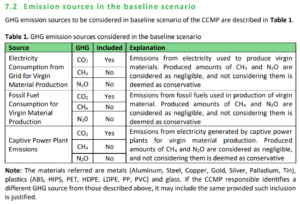
The difference between these two figures determines the emissions reductions that may qualify for credits. The methodology includes extra emissions outside the main project activities, which are called leakage.
Importantly, the system does not automatically award credits for every vehicle that enters a scrapping facility. Projects need to prove that their recycling efforts offer extra environmental benefits. This should go beyond what would occur without the carbon-credit program.
Existing facilities must also demonstrate increased recycling compared with their historical activity. This helps prevent projects from receiving credits for recycling that was already taking place.
Vehicles that can still be legally repaired, reused, or returned to service are excluded. This rule helps ensure that the program focuses on vehicles that have genuinely reached the end of their useful lives.
These requirements are important for credit quality. They show that the claimed emissions cuts come from extra material recovery, not just counting processed vehicles.
India’s Vehicle Scrapping Industry Is Growing
India’s vehicle scrapping system provides a strong market for the new carbon credit program. The country’s vehicle fleet includes older vehicles that can create higher pollution and maintenance costs.
Formal scrapping facilities can take these vehicles out of use. They also recover valuable materials for reuse in manufacturing.
According to India’s Ministry of Road Transport and Highways, 129 Registered Vehicle Scrapping Facilities were operating across 21 states and union territories as of January 30, 2026. These facilities had scrapped a total of 430,306 vehicles by that date.
India has introduced policies to boost formal vehicle recycling. These policies make producers more responsible for the waste their products create.
The Environment Protection (End-of-Life Vehicles) Rules, 2025 introduced extended producer responsibility requirements for vehicle manufacturers. These rules set annual scrapping targets beginning in fiscal year 2025–26. The targets apply to vehicles placed on the market 15 years earlier for transport vehicles and 20 years earlier for non-transport vehicles.
This policy could boost demand for authorized scrapping facilities. It may also enhance material recovery from old vehicles.
Carbon credits may provide an additional financial incentive. Eligible facilities can earn credits for verified emissions reductions. This allows them to make money in addition to the value of recovered steel, aluminum, and other materials.
MMCM Targets 500,000 Tonnes of Emissions Cuts by 2030
MMCM expects the program to grow as more facilities join its network. The company estimates that the wider initiative could deliver around 500,000 tonnes of CO2e in emissions reductions by 2030.
This is a projection for the expanded program, not a volume of credits already issued. Reaching it depends on how many facilities join, how much material they recover, and if they meet the methodology’s requirements.
The company has also pointed to the potential for carbon finance to support India’s vehicle recycling sector. In 2025, MMCM’s CEO told Argus that the model could unlock about 10 billion rupees, or roughly US$116 million, in carbon funding over the next ten years.
That amount is a potential funding estimate, not money already raised or guaranteed revenue. Actual funding will depend on future credit generation, demand from buyers, and the prices those buyers are willing to pay.
Still, the model could create a stronger business case for formal vehicle recycling. It can also link car makers, recycling plants, and carbon market players. They can use a shared system to measure emissions cuts.
Carbon Finance Could Boost India’s Circular Automotive Economy
The new issuance highlights how carbon markets could help reduce emissions beyond the energy and power sectors.
- Vehicle production requires large amounts of materials and energy.
- Making metals and other components from virgin resources can generate significant emissions.
- Recycling materials from old vehicles can cut down on new production. It also helps keep valuable resources in use.
This is the main climate benefit behind the new methodology. It rewards verified reductions from material recovery rather than treating vehicle scrapping as an environmental benefit on its own.
However, the program’s impact will depend on strong monitoring and reliable data. Projects must show how much material they recover, how it is processed, and whether it actually replaces virgin materials. They must also account for emissions from collection, transport, and recycling.
Additionality will remain important as India’s vehicle scrapping industry grows. If recycling becomes standard practice because of government rules or market demand, projects will need to show that the activities receiving credits go beyond what would have happened anyway.
The first 24,988 credits provide an initial test of this approach. The next challenge will be expanding the program while maintaining clear records, credible calculations and independent verification.
For India, the initiative could bring carbon finance into a growing recycling market. For the wider automotive industry, it offers another way to connect emissions reductions with resource efficiency. Its long-term value will depend on whether the first issuance can lead to larger, measurable and verifiable results across the vehicle supply chain.
The post First Vehicle Recycling Carbon Credits Issued by MMCM and CerCarbono at COP31 appeared first on Carbon Credits.


