Ontario’s growing nuclear power program could deliver a major economic boost to Canada, creating millions of job-years and strengthening the country’s manufacturing sector. However, Canada must act quickly to ensure domestic manufacturers benefit from the massive investment rather than lose opportunities to international suppliers.
A November 2026 report from Canadian Manufacturers & Exporters (CME), titled Turning Ontario’s Nuclear Advantage into an Industrial Advantage, estimates that four major nuclear projects could contribute approximately CAD 881.5 billion to Canada’s GDP and generate 3.45 million cumulative job-years over their lifecycles.
Ontario could capture most of these benefits, with an estimated CAD 806.1 billion in GDP contributions and 2.94 million job-years. The findings highlight how nuclear investment could support more than electricity generation. It could also expand manufacturing capacity, create skilled jobs, strengthen domestic supply chains, and open new export opportunities.
The report was commissioned by Ontario’s Nuclear Advantage, a coalition of industry, labour, and supply-chain organizations. CME conducted the economic analysis and developed recommendations for turning the province’s nuclear expansion into a long-term industrial advantage.

Four Nuclear Projects Could Deliver Billions in Economic Benefits
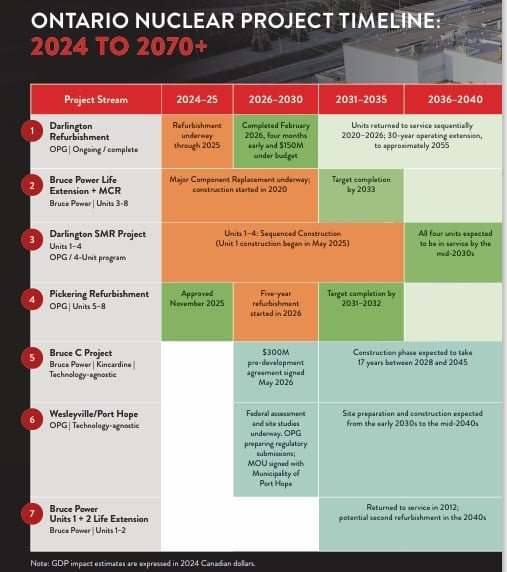
The report examines four major projects: the Darlington Small Modular Reactor (SMR) project, Pickering Nuclear Generating Station refurbishment, the proposed Bruce C project, and the potential Wesleyville nuclear development.
Together, these projects represent a multi-decade investment opportunity extending into the 2040s and beyond.
Here is a closer look at their estimated economic contributions.
1. Darlington SMR Project
Ontario Power Generation (OPG) is developing four BWRX-300 small modular reactors at its Darlington site. Each unit will have a capacity of 300 MW, bringing the total planned capacity to 1,200 MW.
Construction of the first reactor began in May 2025. All four units are expected to enter service by the mid-2030s, with an estimated operating lifespan of 60 years.
According to CME, the project could contribute CAD 38.5 billion to Canada’s GDP and support approximately 245,200 job-years. Ontario could account for CAD 35.1 billion of the economic contribution.
The project also gives Canadian manufacturers an opportunity to develop experience in SMR technology and build a supply chain that could support future international deployments.
2. Pickering Nuclear Refurbishment
OPG’s refurbishment of units 5 to 8 at the Pickering Nuclear Generating Station is another major investment. The five-year refurbishment program began in 2026 and is expected to finish by 2031–2032.
The project will extend the operating life of the 2,100 MW facility by approximately 30 years.
CME estimates that the refurbishment could add CAD 41.6 billion to Canada’s GDP and generate 261,000 job-years. Ontario could receive CAD 38.2 billion in GDP benefits and 235,400 job-years.
3. Bruce C Nuclear Project
Bruce Power’s proposed Bruce C development represents a much larger expansion opportunity. The company signed a CAD 300 million pre-development agreement in May 2026 to advance planning for the project.
The proposed development could add up to 4,800 MW of nuclear capacity. Construction is expected to run from 2028 to 2045, subject to regulatory approvals and final investment decisions.
The project could contribute CAD 259.6 billion to Canada’s GDP and generate 832,500 job-years. Ontario’s estimated share stands at CAD 237.5 billion and 714,000 job-years.
4. Wesleyville Nuclear Project
OPG’s proposed Wesleyville development near Port Hope could become the largest of the four projects by economic contribution.
The technology-agnostic project could deliver up to 10,000 MW of nuclear capacity. Site preparation and construction could begin in the early 2030s, with units potentially entering service in the early to mid-2040s.
CME estimates that Wesleyville could contribute CAD 541.8 billion to Canada’s GDP and generate approximately 2.1 million job-years. Ontario could capture CAD 495.2 billion and 1.78 million job-years.
The project remains subject to further planning, regulatory reviews, and government decisions.
Canada’s Existing Nuclear Industry Provides a Strong Foundation
Ontario is not starting from scratch. The province already has an established nuclear industry, experienced manufacturers, and a domestic supply chain that has developed over several decades.
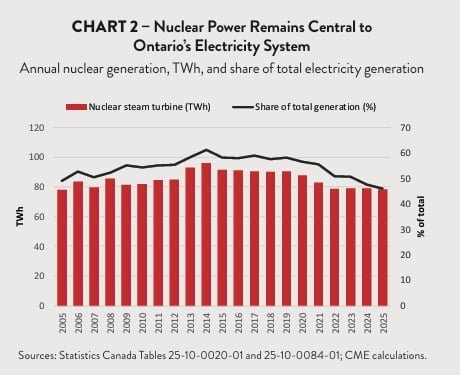
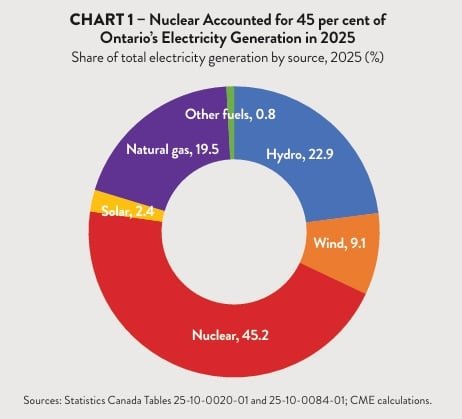
Nuclear power accounted for 45.2% of Ontario’s electricity generation in 2025, producing 78.3 terawatt-hours (TWh). The sector contributes approximately CAD 22 billion annually to Canada’s economy and supports 89,000 jobs nationwide.
Canada also has more than 250 companies supporting its nuclear supply chain. These businesses provide engineering, construction, precision manufacturing, electrical equipment, safety systems, digital technologies, and specialized services.
The benefits already extend across multiple communities. OPG’s Pickering refurbishment supply chain includes more than 200 suppliers across 50 Ontario communities. Its Darlington SMR supply chain includes more than 80 suppliers across 41 communities.
CME also highlights the role of companies such as BWXT Canada. In 2025, BWXT secured contracts worth more than CAD 1 billion to support Pickering’s life-extension program and the first Darlington SMR. The contracts include manufacturing 48 steam generators for Pickering and the reactor pressure vessel for Darlington.
These examples show how nuclear investment can support manufacturing businesses well beyond the power plant itself.
Rising Electricity Demand Strengthens the Nuclear Opportunity
Ontario’s nuclear expansion comes as electricity demand continues to increase.
The Independent Electricity System Operator (IESO) projects that provincial electricity demand could rise by as much as 90% by 2050 under its high-demand scenario. Population growth, industrial development, and the electrification of manufacturing are expected to drive much of this increase.
Reliable electricity will become increasingly important for energy-intensive industries such as steel, cement, chemicals, automotive manufacturing, mining, and advanced materials.
Nuclear power can provide dependable, low-emissions electricity around the clock, complementing renewable energy sources such as wind and solar.
The report also highlights opportunities beyond nuclear equipment. Ontario manufacturers could expand production of transformers, switchgear, electrical components, control systems, and other grid technologies needed for the wider electricity buildout.
Global Nuclear Growth Could Create Export Opportunities
The economic opportunity extends beyond Canada’s borders.
- The International Energy Agency estimates that annual global nuclear investment could increase from approximately US$88 billion today to US$162 billion by 2030 under its Announced Pledges Scenario.
Canada also has ambitions to become an important nuclear technology and supply-chain exporter. Its Nuclear Energy Strategy aims to secure CANDU technology in at least four new international markets by 2040 and significant Canadian supply-chain participation in at least five international large-reactor and SMR projects.
- CME estimates that achieving these export objectives could generate an additional CAD 48 billion to CAD 97 billion in Canadian GDP and support between 333,000 and 665,000 cumulative job-years.
Potential exports include nuclear-grade components, engineering services, refurbishment expertise, fuel-cycle capabilities, inspection technologies, robotics, and SMR-related equipment.
Government and Industry Must Act Now
Despite the scale of the opportunity, CME warns that Canada needs stronger coordination to ensure domestic manufacturers capture the benefits.
The report outlines four priorities: advancing major nuclear projects and key investment decisions, expanding domestic manufacturing capacity, developing a skilled nuclear workforce, and strengthening export financing and procurement support.
Long-term project schedules and predictable procurement contracts would help manufacturers invest in new facilities, advanced equipment, and specialized technologies. Training programs and apprenticeships must also keep pace with demand for engineers, technicians, construction workers, and skilled tradespeople.
Ontario’s nuclear buildout could become a major driver of Canada’s industrial growth. However, the economic benefits will depend on how effectively governments, utilities, manufacturers, and workers coordinate their efforts.
For Canada, the opportunity is not simply to build more nuclear reactors. It is to develop the manufacturing capabilities, skilled workforce, and export capacity needed to compete in the global nuclear market for decades.
The post Ontario’s Nuclear Buildout Could Generate $881.5 Billion for Canada’s Economy appeared first on Carbon Credits.