

A coordinated network of organizations and companies linked to the oil and gas industry is targeting various levels of Canadian education, introducing pro-oil narratives into provincial curricula and spreading climate disinformation. Internal documents found by Greenpeace Canada describe its strategies and ongoing operations to influence K-12 classrooms, university campuses, prospective teachers, and recent graduates.
Greenpeace Canada’s investigation previously identified and documented Energy in Action (EIA), a network of charities, non-profits, front groups, and corporations actively targeting various Canadian communities. The network’s platform included materials uploaded by members describing their activities and operations. Some of these materials were presentations to an unknown group of funders named Canadian Energy Prosperity (CEP).
Several EIA member organizations were focused on influencing students and educators across all school levels with at least three members primarily focused on this sector. Organizations with an educational focus include Energy Creates, Ag for Life, and Switch Energy Alliance. Other members with educational initiatives included the Fraser Institute, Geologic, Young Canadians for Resources, and the Canadian Energy Executive Association.
Presentations by these groups, found on EIA’s website in pages dedicated for CEP funder sessions held at the Calgary Petroleum Club in July 2025 and January 2026, detail how member organizations intend to influence classroom discussions and shape how teachers and students think about energy issues in Canada.
Influencing K-12 science lesson plans
Greenpeace Canada’s investigation into EIA documented a campaign by Switch Energy Alliance, a non-profit that provides energy educational resources through its “free, video-based online learning platform.” A previous investigation by Heated revealed Switch Energy Alliance’s financial ties to the oil and gas sector.
The organization presented an “Executive Impact” report to CEP funders on July 2, 2025, highlighting results of its Switch Classroom campaign—an initiative that targets elementary, middle, and high school students and educators. The report boasted about the campaign’s reach across Canadian classrooms and curricula, estimating that its program has reached over one hundred thousand students and identified hundreds of teachers specifically in Alberta, Saskatchewan, and B.C. The report also discussed a specific targeting strategy that reached teachers as they prepared science lesson plans on energy.
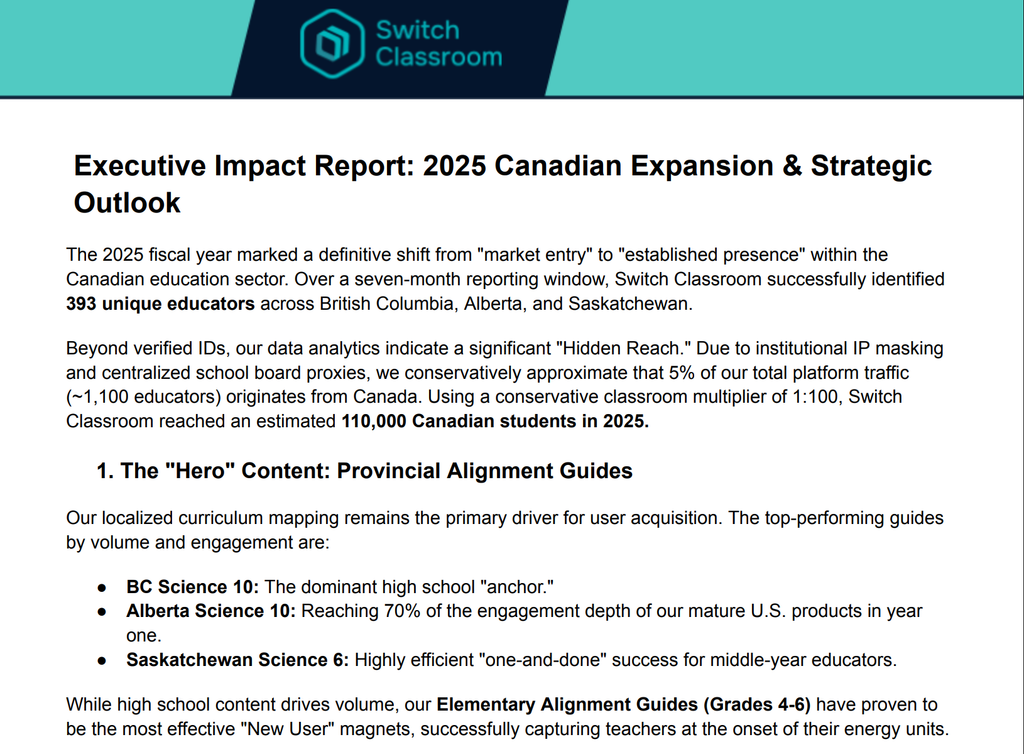
Screenshot of a page from an “Executive Impact Report” for 2025 by Switch Classroom showing key metrics and strategies. Source: EIA (archived)
Beyond classrooms, the program expanded its reach through institutional partnerships with school boards and universities. This included an academic relationship with the UBC Faculty of Education aimed at reaching future teachers before they enter the workforce.
The organization also said it intends to expand the program to Ontario and translate one of its modules to reach the French-speaking market. Its expansion in Canada included conferences and running targeted ad campaigns in K-12 educators’ magazines.
Climate denial in high schools
The Fraser Institute, a registered charity that describes itself as an independent, non-partisan Canadian public policy think tank, also targeted the educational sector. Fraser Institute President Niels Veldhuis opened the CEP’s funders event on January 19, 2026, during time allocated for “Advocacy Showcase.”
The think tank presented a deck titled, “Bringing Environmental and Energy Facts to the Canadian Public and Canadian Classrooms: Featuring Bjorn Lomborg.” This presentation discussed an educational initiative by the Fraser Institute introducing pro-oil perspectives on environmental and energy topics to Canadian public and high school classrooms, with a focus on teachers.
The opening slides featured Danish political scientist Bjorn Lomborg, who has been accused of spreading climate denialism and misinformation. In the presentation, the Fraser Institute outlined plans to introduce Lomborg to Canadian classrooms, highlighting several of his misleading essays on energy issues.
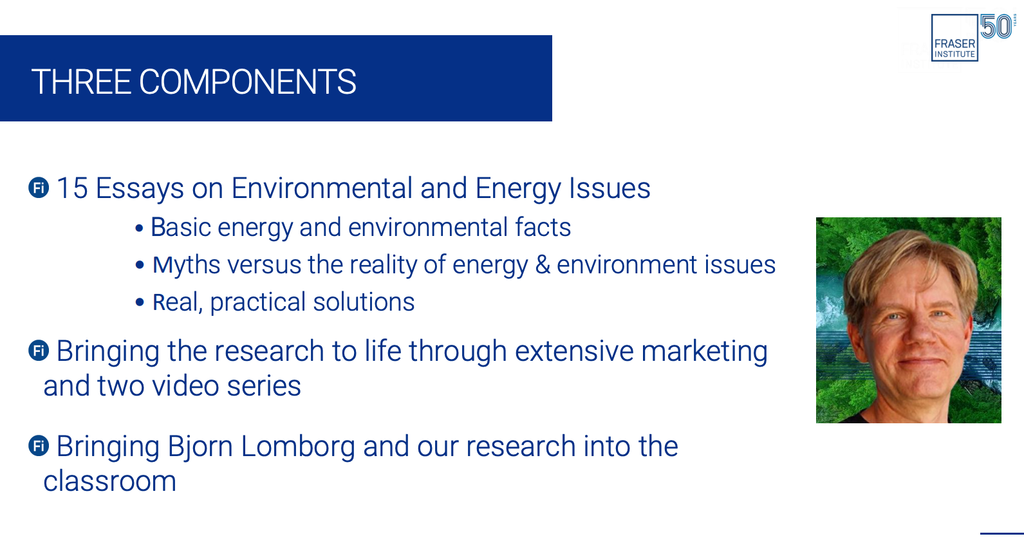
Screenshot from the Fraser Institute’s presentation to funders in January 2026 featuring climate denier Bjorn Lomborg. Source: EIA (archived)
This presentation also discussed its future plans from January 2027 to June 2027 to influence “Lesson Plans, In-Class Exercises and Curriculum.” Moreover, the presentation spoke about workshops targeting teachers “on the Reality of the Environment and Energy” in Fall 2027 to instruct them on how to use the Fraser Institute’s curricula. They also included three teacher organizations as part of efforts for “developing a network,” showing engagement with teachers in Ontario, B.C., and Alberta.
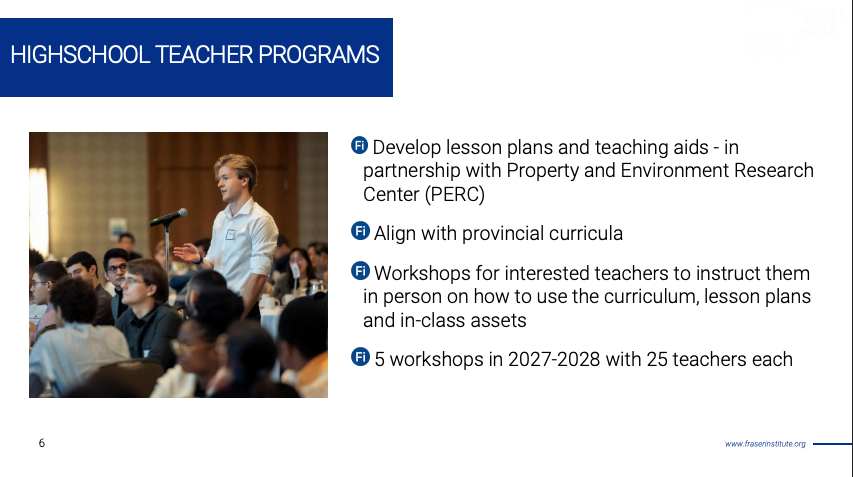
Screenshot from the Fraser Institute’s presentation to funders in January 2026 describing its targeting of high school teacher programs. Source: EIA (archived)
Post-secondary scholarships and media
Though not directly in the classroom, the educational project Energy Creates targets students aged fifteen to twenty-five by offering generous post-secondary scholarships of up to $100,000. To enter the contest, students must watch Global Warning—a climate change film directed by the organization’s founder, Matthew Embry—and pass a related quiz. Once passed, participants submit artistic work focused on the Canadian energy sector.
In video presentations made to CEP funders in 2025 and 2026, the organization detailed how it combines these financial incentives with media production to engage youth, generating millions of views and impressions. One of the presentations also showed that Energy Creates operates as a media arm for the broader EIA network, using its production teams to cover “major energy events.” For example, the video showed footage from the “Get It Done B.C.” event hosted by EIA member Resource Works with sponsors including the Canadian Association of Petroleum Producers (CAPP).
Screenshot from a video presentation by Energy Creates for CEP funders in 2025 found on video hosting website Vimeo. Source: Vimeo (archived)
The organization also stated in a video presentation that it focuses on “building a shareable open media archive that CEP partners can use freely.” It summarized its strategy to funders through four connected parts: “the scholarships that attract students, the films that create national moments, the social channels that keep the conversation alive, and the CEP event coverage that captures the voices that shape Canada’s energy future.”
University social media campaigns
Higher education was also a target for the network. EIA’s “non-partisan, not-for-profit group” Young Canadians for Resources (YCR), an initiative by oil-linked front group Canada Action, presented a deck titled “Why energy matters and how we will promote it to young Canadians.” The deck featured five university students across Canada outlining a plan to shape energy conversations, specifically in Ontario and B.C., through a student-led Instagram and TikTok campaign targeting over 20 campuses in eight provinces.
The campaign’s pitch proposed a “day in the life” video series using a short, vlog-style format that captures a content creator’s daily routine. Students demonstrated how these vlogs would promote the oil and gas industry by linking daily simple activities—such as turning on a stove, powering lights in universities, and driving a car—to a broader narrative about the significant role of fossil fuels in daily life. Details in these slides show an example of a covert influence campaign targeting students, presented to funders and possibly connected to the oil and gas industry without proper disclosures.
Screenshots from a video presentation by YCR presented to funders in July 2025. Source: EIA (archived)
Greenpeace Canada did not include visual evidence showing student presenters to protect their individual identities and privacy.
Post-graduation free resources
The campaign also targeted graduating students and recent alumni through Geologic, a data and technology firm that provides oil and gas analytics. Geologic created a program called the Sustainability in Energy Micro-Credential (SEMC), a thirty-five-hour program that provides post-secondary students and recent graduates in Canada with free resources. The program declares that it is sponsored by the Oil Sands Alliance, an initiative of Canada’s largest oil sands companies, previously operating as the Pathways Alliance.
In a slide deck presented to CEP, the company said that the goal of this development program is to “help create a pathway to a career in energy.” Another slide highlighted that all the program’s “content was developed with extensive industry engagement” and that the “Pathways Alliance is the other major program sponsor.”
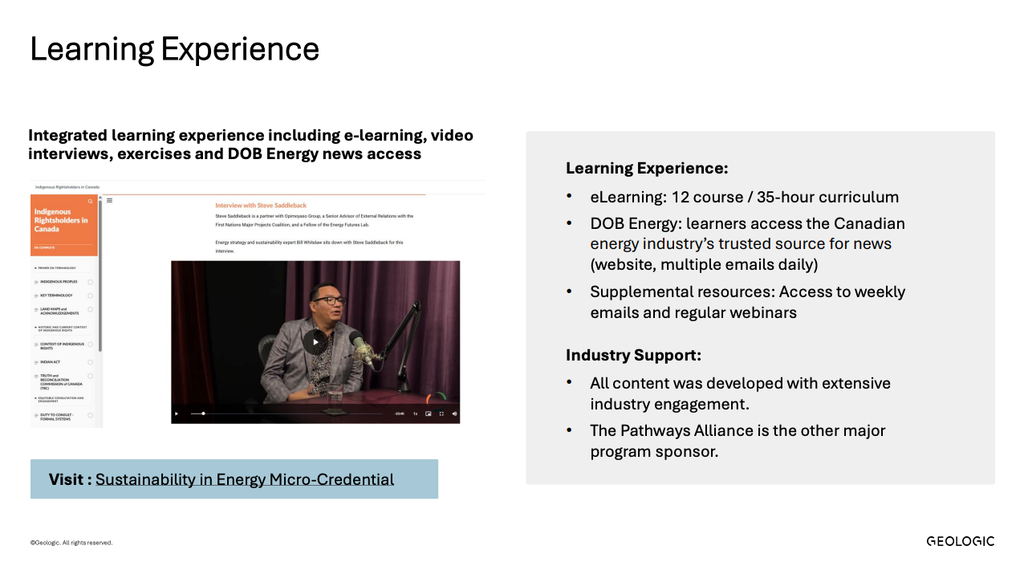
Screenshot from a presentation slide by Geologic to CEP funders saying that its program receives “extensive industry engagement” and is sponsored by the Pathways Alliance. Source: EIA (archived)
The end of the presentation discussed Geologic’s growth plans in 2026, where Geologic explicitly mentioned that “CEP’s generous support enables program expansion to southern Ontario,” listing ten academic institutions in the province.
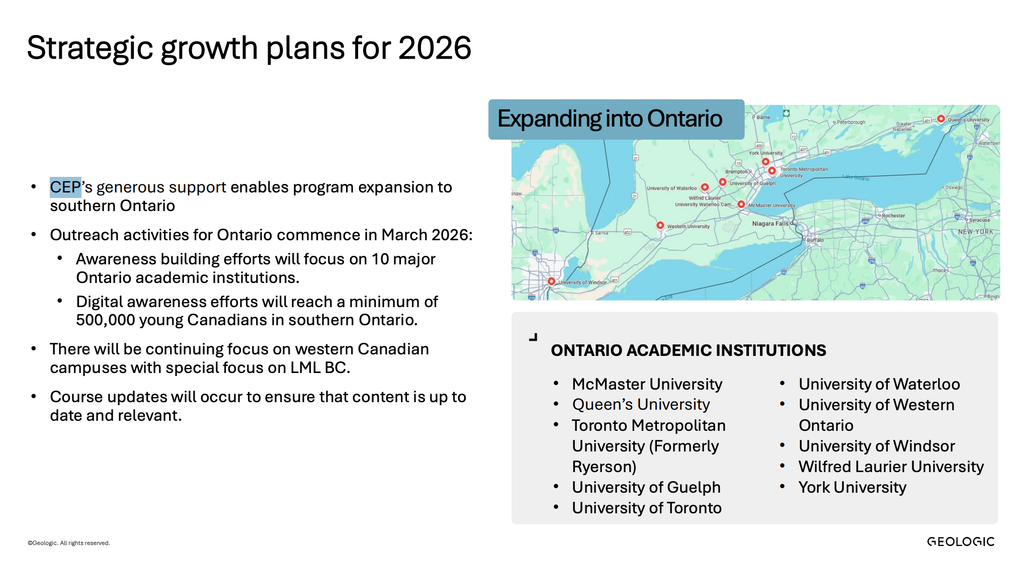
Screenshot from a presentation slide by Geologic to CEP funders showing the company’s expansion and targeting of university students in southern Ontario and thanks the network for its “generous support.” Source: EIA (archived)
Such ambitions appear to have been achieved, as according to another presentation found on EIA’s updates page dated June 30, 2026, the program had engaged with more than twenty institutions across Ontario and other provinces, including Saskatchewan, Quebec, Manitoba, Newfoundland and Labrador, and New Brunswick. Alberta accounted for the largest share of learners at 43%, followed by British Columbia and Ontario at 20% each, and Saskatchewan at 15%.
Evidence shown in this investigation suggests that EIA members are part of a coordinated effort to target and influence Canadian education across different levels, inserting pro-fossil fuel narratives and messages. Educational organizations and non-profits have the right to take part in energy discussions, yet conducting pro-oil coordinated efforts to influence students and educators while reporting metrics back to unknown funders is a breach of transparency. Greenpeace Canada demands that any organization targeting Canadian classrooms, educational institutions, students, and teachers be mandated to fully and publicly disclose its financial backers. The classroom should be a space for objective learning, not undisclosed advocacy.


