
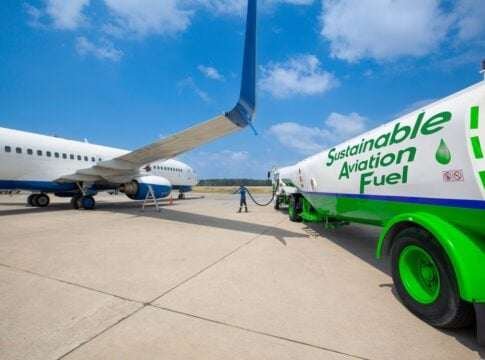
FlyORO, a clean aviation tech company from Singapore, is partnering with Menzies Aviation, a leading global aviation services provider. This collaboration aims to achieve their shared goals. The two companies signed a Memorandum of Understanding (MoU) to explore using FlyORO’s modular sustainable aviation fuel (SAF) blending technology in Menzies’ global fuel network.
The agreement comes as governments tighten clean fuel rules and airlines race toward net-zero targets. While global SAF production is growing quickly, it still supplies only a small share of the fuel that the aviation sector needs.
Damian Mc Loughlin, Chief Commercial Officer, FlyORO, remarked:
“Scaling SAF is no longer just a production challenge; it is increasingly a supply chain and infrastructure one. This collaboration combines FlyORO’s TRL 9 blending technology with Menzies’ expertise, to open a more practical path for SAF to reach the airports and airlines that need it. We are proud to be working alongside Menzies to help address one of aviation’s most critical infrastructure gaps.”
SAF Supply Is Growing, But Delivery Is the Real Challenge
SAF has become one of the aviation industry’s most important tools for cutting emissions.
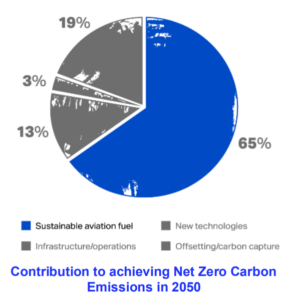
The International Air Transport Association (IATA) says that SAF could provide around 65% of the emission cuts needed for aviation to hit net-zero carbon emissions by 2050. Unlike electric or hydrogen aircraft, SAF can be used in today’s aircraft with little or no modification.
Production is increasing, but supply remains limited.
The association estimates global SAF production reached about 2 million tonnes, or 2.5 billion liters, in 2025. That was nearly double the previous year. Even so, it represented less than 1% of global jet fuel demand, showing how much production still needs to grow.
- IATA estimates aviation will need around 449 billion liters of SAF each year by 2050 to help reach net-zero emissions.
At the same time, airlines continue to face pressure to reduce emissions. The International Energy Agency (IEA) estimates that aviation makes up about 2.5% of global energy-related CO₂ emissions. Passenger demand could also keep rising over the coming decades, making cleaner fuels increasingly important.
FlyORO’s Alphalite: The Missing Link in Aviation’s Clean Fuel Future
Building more SAF plants is only part of the solution.
Fuel must also be blended, stored, certified, and delivered through airport fuel systems before it reaches aircraft. Many airports still lack infrastructure designed for large-scale SAF handling.
That is where FlyORO hopes to make a difference.
Its AlphaLite system allows SAF to be blended directly within existing fuel supply chains. The modular system doesn’t need big new blending facilities. It fits inside a standard 40-foot container. This allows it to work at refineries, fuel terminals, or airports.
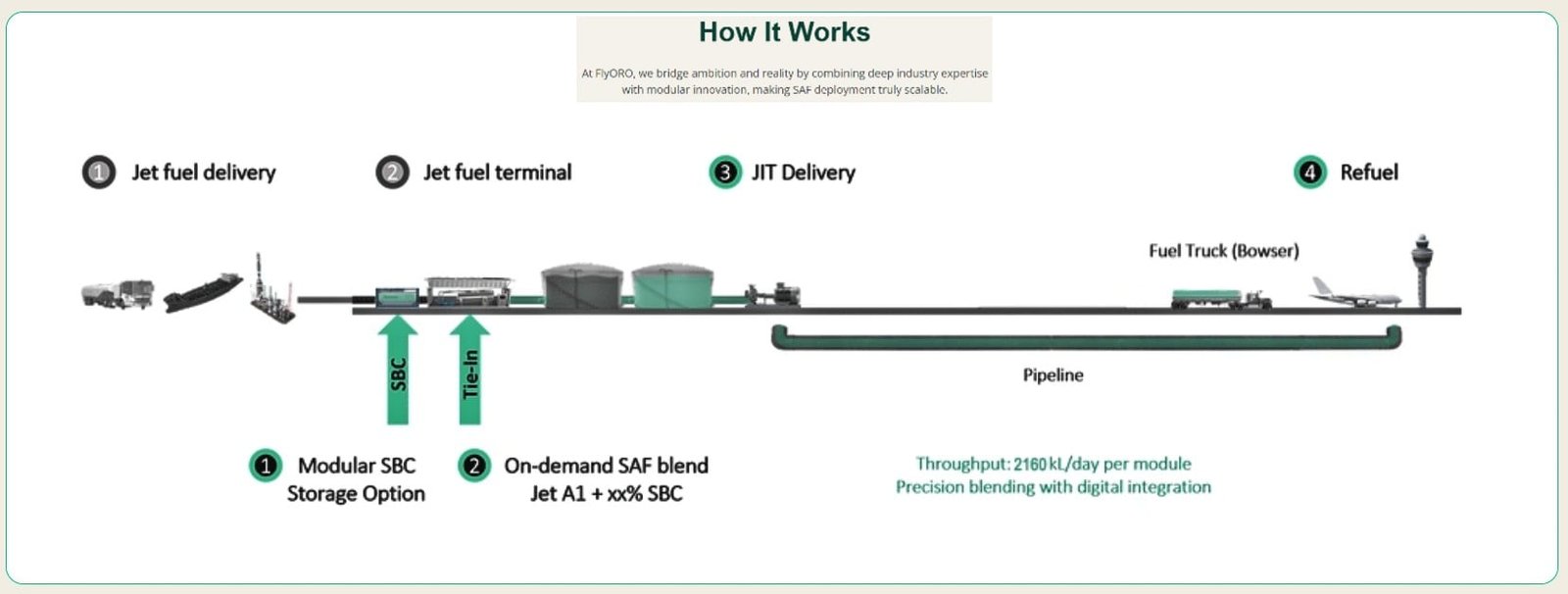
The technology is at Technology Readiness Level (TRL) 9. This means it has been tested and proven in real operating conditions. According to FlyORO, AlphaLite has already blended more than 500,000 liters of SAF during commercial operations.
This modular approach could help airports increase SAF availability while reducing upfront infrastructure costs and shortening deployment times.
FlyORO Proves Its System Works at a Real Airport
FlyORO has successfully tested its fuel-mixing system AlphaLite at a real airport. In 2025, the company set up the system at Australia’s Toowoomba Wellcamp Airport alongside Boeing and Wagner Sustainable Fuels.
- A World First: This project was the very first eco-friendly fuel blending station built right inside an airport.
- Real-World Success: It proved that these compact, portable mixing systems work safely and effectively during normal, everyday airport operations.
- Ready for Business: Because of this successful test, the AlphaLite system reached Technology Readiness Level 9 (TRL 9). This is an official rating showing the technology is completely finished, thoroughly tested, and ready for regular commercial use.
A Global Airport Network Meets New SAF Technology
FlyORO’s technology could reach a much larger market through Menzies Aviation.
Menzies is one of the world’s biggest aviation services companies. It operates at more than 347 airports across 65 countries. Each year, the company supports around 5.3 million flights. It also handles about 2.4 million tonnes of cargo. Additionally, the company employs roughly 65,000 people worldwide.
The company has also committed to achieving net-zero greenhouse gas emissions across Scope 1, 2, and relevant Scope 3 emissions by 2045. It is replacing diesel ground support equipment with electric options. It is also boosting the use of renewable electricity across its operations.
The new agreement allows the two companies to explore how FlyORO’s blending technology can help Menzies with SAF deployment at its airports worldwide.
The agreement does not guarantee immediate commercial deployment. But it connects a tech developer with a major fuel service provider at a time when airports seek practical ways to increase SAF use.
New Rules Are Driving Demand
Policy is becoming another major driver of SAF growth.
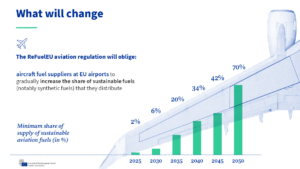
In Europe, the ReFuelEU Aviation regulation now requires fuel suppliers to blend at least 2% SAF in 2025. That requirement will increase to 6% by 2030, 20% by 2035, and 70% by 2050, with separate targets for synthetic e-fuels.
Similar policies are emerging in other regions as governments seek to reduce aviation emissions while maintaining air travel growth.
As these mandates expand, airports will need reliable systems that can blend and deliver larger volumes of sustainable fuel. That creates new opportunities for technologies designed to strengthen fuel infrastructure rather than fuel production alone.
Investment Is Fueling the Global SAF Race
Investment in sustainable aviation fuel is rising around the world. According to the International Energy Agency (IEA), more than 300 SAF projects have been announced globally.
Announced SAF Facilities
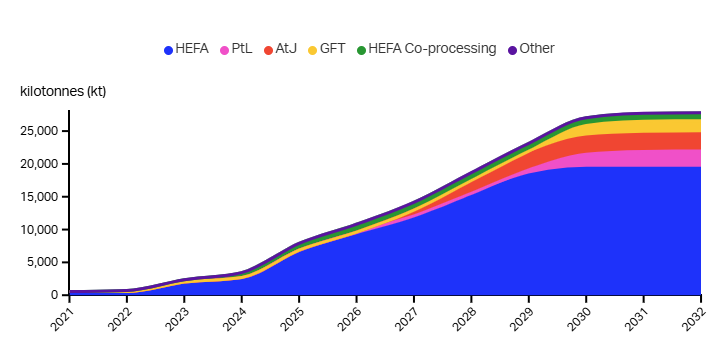
If all moves forward, production capacity could reach several million tonnes a year by the early 2030s. Governments in Europe, North America, Asia, and the Middle East are also offering grants, tax credits, and fuel mandates to speed up investment.
The market is expanding quickly. Industry analysts at SkyNRG estimate global SAF demand could exceed 17 million tonnes a year by 2030, driven mainly by new blending mandates. However, current production plans still fall short of that target. This gap highlights the need for both more fuel production and stronger airport infrastructure.
Many experts now believe that improving fuel logistics will become just as important as building new SAF plants.
Carbon Credits and SAF: A Dual Path to Lower Emissions
Carbon markets will continue to play an important role as airlines reduce emissions.
The aviation sector is part of the Carbon Offsetting and Reduction Scheme for International Aviation (CORSIA). This scheme was created by the International Civil Aviation Organization (ICAO).
The program asks airlines to offset extra international emissions by buying approved carbon credits. They also need to use cleaner fuels and more efficient aircraft.
SAF and carbon credits work together rather than compete. SAF reduces emissions at the source, while carbon credits help address emissions that cannot yet be eliminated. Many airlines could use both approaches as they work toward their net-zero commitments.
Depending on the feedstock and production pathway, certified SAF can reduce lifecycle greenhouse gas emissions by up to 80% compared with conventional jet fuel, according to IATA and ICAO.
As SAF becomes more common, there is a need for reliable systems to measure, blend, and track fuel volumes. This is important for compliance and voluntary climate programs.
Building the Next Stage of Aviation Decarbonization
The aviation industry has made clear that SAF will play a central role in reaching net-zero emissions. The next challenge is delivering that fuel where it is needed.
The partnership between FlyORO and Menzies Aviation reflects this shift. Instead of focusing only on producing more SAF, it aims to improve the infrastructure that connects fuel suppliers with airports and airlines.
If successful, partnerships like this could help close one of the industry’s biggest infrastructure gaps and support faster growth of the global sustainable aviation fuel market.
- FURTHER READING: Google Expands SAF Strategy with Amex GBT and Shell Aviation to Cut Aviation Emissions
The post SAF Takes Flight as FlyORO and Menzies Target Aviation’s Biggest Infrastructure Gap appeared first on Carbon Credits.


