
The U.S. biochar industry is growing fast. A new report from the U.S. Biochar Initiative (USBI) estimates the industry was worth about $157 million in 2025. That is nearly three times higher than in 2023.
The growth comes as more companies buy durable carbon removal credits to meet their climate goals. It also shows rising interest in biochar as both a carbon removal tool and a way to improve soil health.
Biochar Industry Enters a New Growth Phase
The latest State of the U.S. Biochar Industry Report shows strong growth across the sector.
The report says the industry’s value reached $157 million in 2025, up from about $52 million in 2023. Annual biochar production also increased to more than 97,000 metric tonnes. At the same time, installed production capacity rose to more than 400,000 metric tonnes per year.
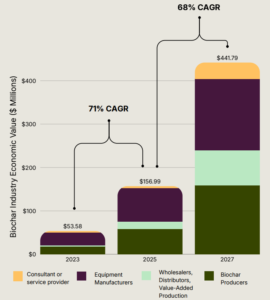
Today, the United States has more than 130 biochar production facilities. These plants support jobs in farming, forestry, manufacturing, engineering, and project development. Even with this growth, the report says the industry has only begun to tap its full potential.
Commercial biochar producers are also expanding quickly. The report estimates that producer revenue rose from $18.2 million in 2023 to $58.8 million in 2025. Producers expect that figure to reach about $159 million by 2027, showing confidence that demand will continue to grow.
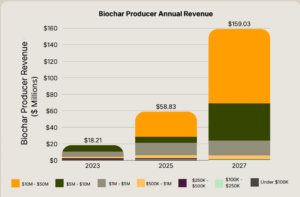
Much of the recent increase came from companies earning $10 million to $50 million a year, suggesting the industry is moving beyond small pilot projects toward larger commercial operations.
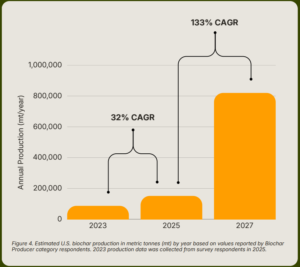
The report also shows that production could grow much faster over the next two years. U.S. biochar output is projected to increase from about 151,000 metric tonnes in 2025 to more than 819,000 metric tonnes by 2027 if announced projects move forward.
While the report notes these forecasts are ambitious, they show how quickly companies expect demand for biochar and carbon credits to grow.
Carbon Credit Demand Is Fueling the Market
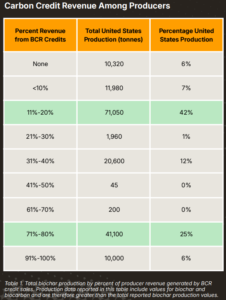
Carbon markets are becoming a major source of income for biochar producers. The report found that only 6% of U.S. biochar production came from companies that earned no revenue from biochar carbon removal credits.
The largest share of production (42%) came from producers earning 11% to 20% of their revenue from carbon credits. Another 25% came from producers earning 71% to 80%, while 12% came from companies generating 31% to 40% of revenue from carbon credits.
A further 6% came from producers earning more than 90% of their revenue from carbon credits. The findings show that carbon finance is becoming a key part of many producers’ business models, although most still rely on biochar sales and other income sources.
Demand continues to rise.
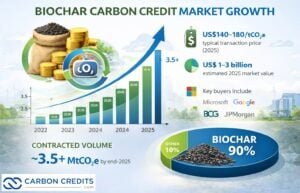
According to CDR.fyi, biochar supplied more than 90% of all durable carbon removal credits delivered worldwide in 2025. It also remained the largest source of delivered durable carbon removal by volume.
Large companies are helping drive this market. Microsoft, Google, Stripe, Shopify, JPMorgan Chase, and the Frontier buyers coalition have all signed major biochar carbon removal agreements. These long-term contracts help developers build larger facilities and increase production.
A Small Industry With Big Potential
Biochar is also one of the most mature carbon removal technologies on the market. Unlike newer methods such as direct air capture, commercial biochar plants are already operating at scale.
The technology is modular, uses widely available biomass waste, and generally costs less to deploy. These advantages have helped biochar become the leading source of delivered durable carbon removal credits.
The report identifies four main drivers behind the industry’s growth:
- rising demand for carbon credits,
- better use of agricultural and forestry waste,
- growing awareness of biochar’s soil benefits, and
- stronger interest in climate solutions that deliver both environmental and economic value.
Although the industry has grown quickly, it remains small relative to its long-term opportunity.
The USBI report says the United States produces hundreds of millions of tonnes of agricultural and forestry waste each year. Much of this material could be used to produce biochar instead of being burned or left to decay.
As demand for durable carbon removal grows, biochar is becoming an important part of the climate economy. The next step is to expand production while keeping high standards for carbon accounting, sustainable feedstocks, and environmental performance.
The market is expected to keep growing. Boston Consulting Group (BCG) estimates the global carbon removal market could reach $100 billion to $135 billion a year by 2050 if countries stay on track for net-zero emissions.
Biochar Offers More Than Carbon Removal: Helping Agriculture and Climate
Biochar creates value beyond carbon credits.
It helps store carbon for long periods while improving soil quality. Studies by the U.S. Department of Agriculture (USDA) show biochar can improve soil structure, increase water retention, and reduce nutrient losses. These benefits can help farmers improve crop yields while using resources more efficiently.
Biochar production can also reduce waste. Crop residues, forestry waste, and other biomass that might otherwise decompose or be burned can instead be turned into a useful product. This creates new income opportunities for farmers, forest owners, and rural businesses.
Because of these benefits, many experts see biochar as one of the few climate solutions that supports both emissions reductions and agricultural productivity. The global industry has seen tremendous growth in 2025, as shown below.
Scaling Up Remains the Biggest Challenge
Despite its huge potential, the industry still faces several hurdles.
Production capacity remains much smaller than future demand. Many projects also need more financing to build commercial-scale facilities.
Moreover, the industry must maintain high standards. Buyers want carbon credits backed by strong measurement, reporting, and verification. They also expect producers to use sustainable feedstocks and protect forests and biodiversity.
Meeting these standards will help build confidence as the market expands, and when quality will become even more important. Strong standards such as Verra’s VM0044 methodology help ensure biochar credits represent real and durable carbon removal.
A Strong Outlook for the Industry
The new USBI report shows that biochar is moving into the mainstream.
Industry value has nearly tripled in just two years. Production capacity continues to grow, and more companies are investing in new facilities. At the same time, demand for high-quality carbon credits remains strong as businesses work toward net-zero targets.
The International Energy Agency (IEA) says carbon removal will be needed alongside deep emissions cuts to reach global climate goals. Biochar is well placed to help meet that need because it delivers durable carbon storage while improving soil health and making use of waste biomass.
As investment grows and production expands, biochar is likely to play a much larger role in both the U.S. carbon market and the global carbon removal industry over the next decade.
The post U.S. Biochar Industry Triples to $157 Million as Carbon Removal Market Sparks Record Growth appeared first on Carbon Credits.


