
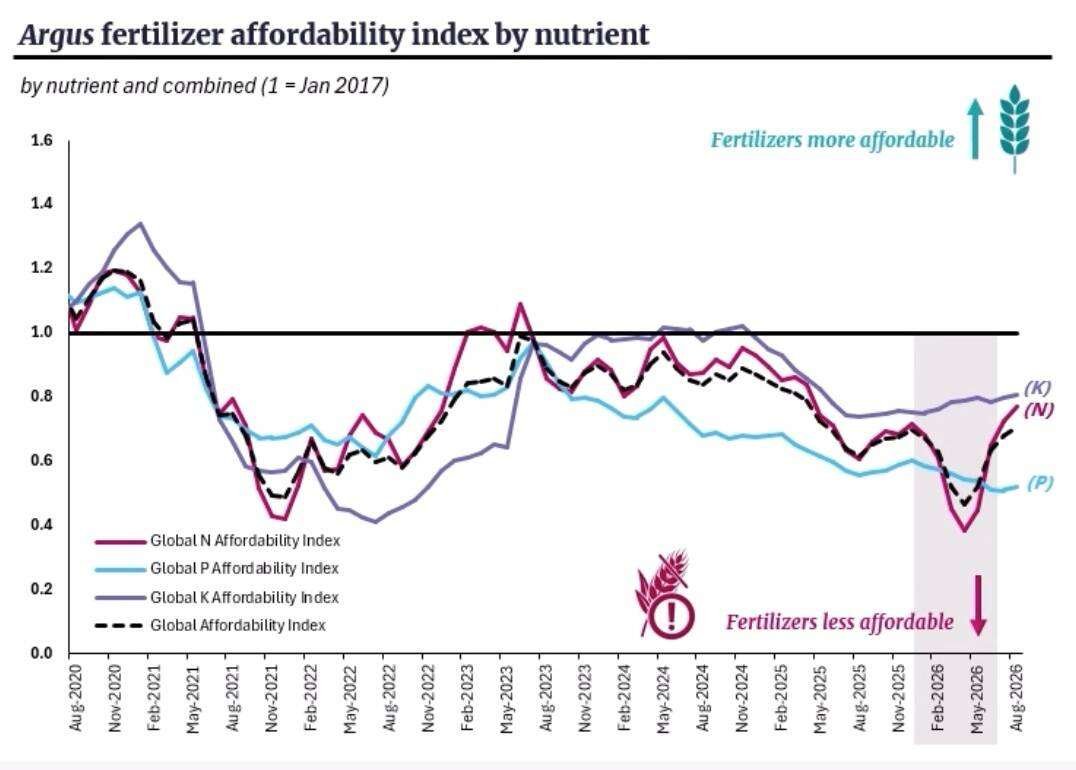
Farmers worldwide are seeing some fertilizer cost relief, with urea prices easing substantially since the United States-Iran war began.
“We have seen some improvement in overall fertilizer affordability as nitrogen affordability has improved,” said Aiden Wright, senior analyst with Argus Media, an independent market intelligence provider. “(But) phosphate is still trending firmly in that unaffordable level.”
Potash largely escaped the price run-up due to little regional production.
Despite softening urea prices, fertilizer remains less affordable than in 2023 and 2024, forcing a global cutback in fertilizer application, particularly phosphate and potash.
“We have seen people in the U.S. start to actively mine soil reserves, apply less and look to just tighten up budgets,” said Wright.
Globally, farmers are growing more cost-efficient, low-input crops like soybeans and sunflowers instead of wheat and corn.
China’s stable fertilizer supplies and good prices are the exception. Its export policy manages the domestic market, curtailing shipments of phosphate and sulphuric acid, said Lynn Wang, Argus senior consultant-China.
China exported six to seven million tonnes of urea in 2026, with 2027 a likely repeat, contributing to a urea price drop.
“Because of tight sulphur supplies, Chinese phosphate fertilizer production is currently focused solely on meeting domestic demand,” said Wang, with phosphate exports at almost nothing compared to 2025’s 5.3 million tonnes.
Argus expects phosphate exports to rebound slightly to about two million tonnes next year and recover further once sulphur supplies are more secure.
China is an importer of potash and sulphur.
Closures, bottlenecks persist
Marina Simonova, head of Argus’s fertilizer analytics, said logistics plague the fertilizer markets.
Following the Black Sea closure and end of transit through Finland’s Kotka port, the Baltic Sea is critical for Russian fertilizer and other commodity exports, with increased shipments of Belarusian potash and Kazakhstan sulphur.
“There is now increasing pressure on the Baltic throughput capabilities by the Russian ports specifically, which has started leading to various congestion issues,” said Simonova.
Problems shipping through the Strait of Hormuz and Bab el-Mandeb and a backlog of products on the Danube and Rhine river systems are affecting grain and fertilizer movement, with elevated freight rates, double those from before the Middle East war.
Despite logistical challenges, Russia remains the world’s leading fertilizer exporter, she said.
Exports are forecast to fall three per cent to 42.9 million tonnes in 2026, the first decline since 2022, with several European Union producers cutting plant run rates or announcing temporary outages due to high natural gas prices and EU Carbon Border Adjustment Mechanism costs.


