Where Are the World’s Electronics Hardware Made?
Key Takeaways
- China, Taiwan, South Korea, and Japan account for 80.5% of global digital hardware capacity.
- India ranks fifth globally at 3.8%, narrowly ahead of Vietnam at 3.6%.
- The United States accounts for 2.9% of global digital hardware capacity, while U.S.-headquartered firms remain major players in the semiconductor industry.
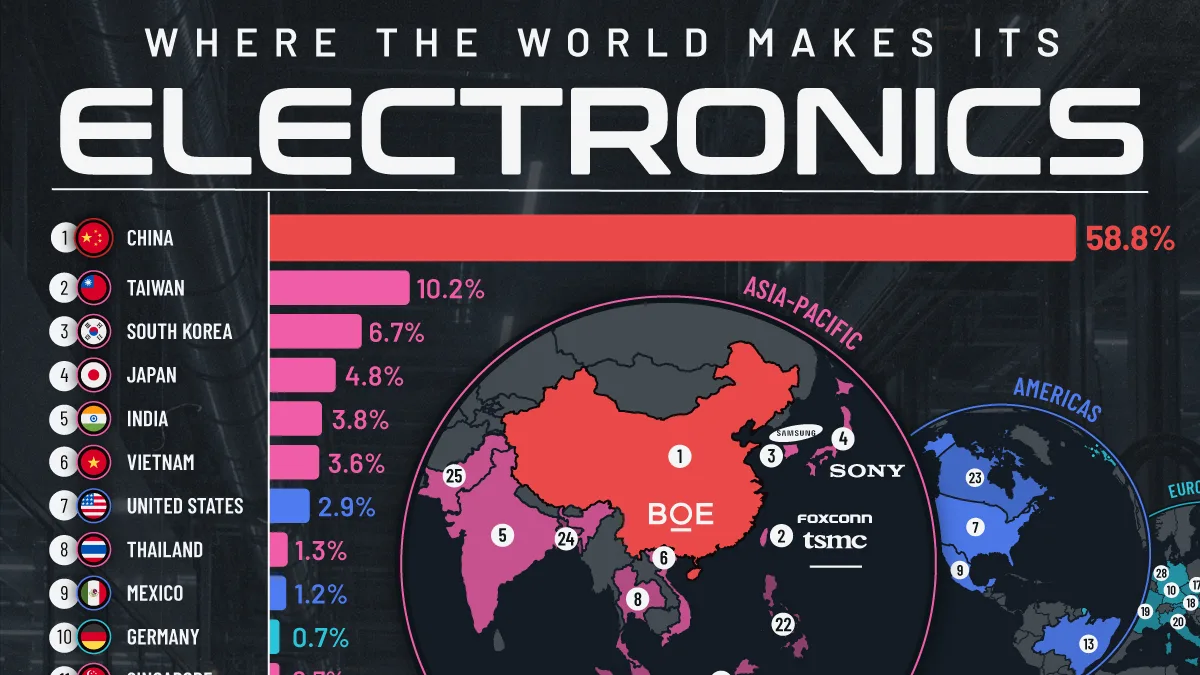
China dominates global electronics manufacturing, accounting for 58.8% of the world’s digital hardware capacity.
More broadly, East Asia sits at the center of the global technology supply chain, producing everything from semiconductor chips and displays to circuit boards, smartphones, and computers.
This graphic ranks countries by their share of global digital hardware capacity and highlights major electronics companies across key manufacturing hubs. The data for this visualization comes from Ember and covers 2024–2025.
China Dominates Global Electronics Manufacturing
China alone accounts for nearly three-fifths of the world’s digital hardware capacity. Its manufacturing ecosystem spans smartphones and computers, displays, printed circuit boards, and other electronic components.
| Rank | Country | Share of digital hardware capacity, 2024–25 |
|---|---|---|
| 1 |  China China |
58.8% |
| 2 |  Taiwan Taiwan |
10.2% |
| 3 |  South Korea South Korea |
6.7% |
| 4 |  Japan Japan |
4.8% |
| 5 |  India India |
3.8% |
| 6 |  Vietnam Vietnam |
3.6% |
| 7 |  United States United States |
2.9% |
| 8 |  Thailand Thailand |
1.3% |
| 9 |  Mexico Mexico |
1.2% |
| 10 |  Germany Germany |
0.7% |
| 10 |  Singapore Singapore |
0.7% |
| 12 |  Malaysia Malaysia |
0.6% |
| 13 |  Brazil Brazil |
0.4% |
| 14 |  Israel Israel |
0.3% |
| 14 |  Indonesia Indonesia |
0.3% |
| 15 |  Ireland Ireland |
0.2% |
| 15 |  Czechia Czechia |
0.2% |
| 15 |  Austria Austria |
0.2% |
| 15 |  France France |
0.2% |
| 15 |  Italy Italy |
0.2% |
| 15 |  Türkiye Türkiye |
0.2% |
| 22 |  Philippines Philippines |
0.1% |
| 22 |  Canada Canada |
0.1% |
| 22 |  Bangladesh Bangladesh |
0.1% |
| 22 |  Pakistan Pakistan |
0.1% |
| 22 |  Hungary Hungary |
0.1% |
| 22 |  United Kingdom United Kingdom |
0.1% |
| 22 |  Netherlands Netherlands |
0.1% |
| 22 |  Egypt Egypt |
0.1% |
| — |  Rest of World Rest of World |
1.7% |
China’s 58.8% share is almost six times Taiwan’s 10.2%, the second-largest share in the dataset. China’s capacity also exceeds the combined share of every other country in the ranking.
The country is also doubling down on its electronics leadership through a new five-year plan focused on semiconductors, artificial intelligence, and other strategic technologies. The plan prioritizes advances across the integrated-circuit supply chain, including chips, as Beijing pushes to reduce reliance on Western technology.
It also targets more than 30 trillion yuan (about $4.5 trillion) in operating revenue from related industries by 2030.
Four Countries Account for More Than 80% of Capacity
Taiwan, South Korea, and Japan contribute another 21.7% of global capacity, bringing the combined share of the four leading countries to 80.5%.
Each occupies an important position in the technology supply chain. Taiwan is a major hub for semiconductor manufacturing and electronics assembly, South Korea has significant semiconductor and display production, and Japan has a long-established electronics industry.
Together, these economies form a dense regional supply chain spanning semiconductor fabrication, components, displays, and finished electronics. Major companies headquartered across these markets include TSMC, Foxconn, Samsung, BOE, and Sony.
India and Southeast Asia Are Emerging Manufacturing Hubs
Outside the four East Asian leaders, India ranks fifth with 3.8% of global capacity, narrowly ahead of Vietnam at 3.6%. The United States follows with 2.9%.
Several Southeast Asian economies also appear in the ranking. Thailand accounts for 1.3%, Singapore for 0.7%, Malaysia for 0.6%, and Indonesia for 0.3%.
By comparison, Germany, the largest European country in the dataset, accounts for just 0.7%.
The U.S. Is Investing to Rebuild Chipmaking Capacity
While much of the world’s electronics manufacturing is concentrated in Asia, the U.S. remains a major force in semiconductor design and innovation. U.S.-headquartered companies accounted for 53.4% of global semiconductor sales in 2025, according to the Semiconductor Industry Association.
At the same time, semiconductor companies are investing heavily to expand physical production in the United States.
Since 2020, semiconductor companies have announced more than $770 billion in U.S. private-sector investment across 160 projects, spanning chip fabrication, advanced packaging, materials, manufacturing equipment, and research.
Learn More on the Voronoi App 
If you enjoyed today’s post, check out Big Tech AI Spending Over Time on Voronoi.